The Butcher of Brisbane


Before continuing, please be aware that all of this content is made possible by the goodwill and support of my backers on Patreon. If you enjoy the work on this site, please consider supporting the creation of more content like this by clicking the button.


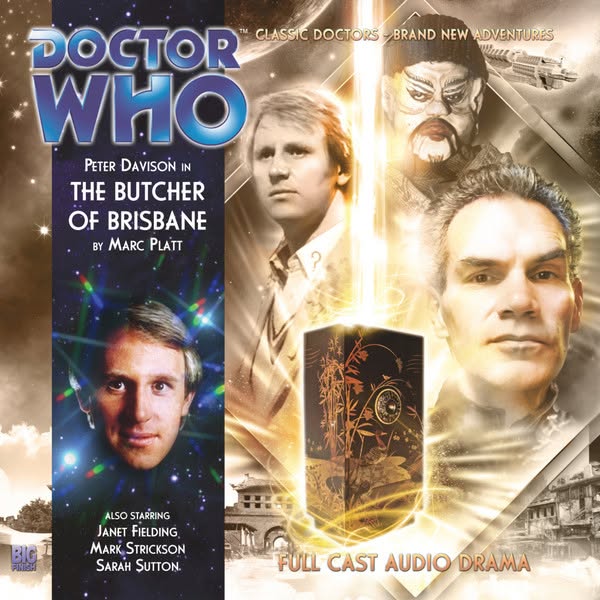
The Butcher of Brisbane finally breaks Peter Davison’s recent streak of “perfectly competent stories that immediately evaporate from my memory” by doing something radical.

It’s actually good. Not just “better than the last few.” Not “well, I wasn’t actively checking how much runtime was left.” Actually good. Properly good. The kind of story that reminds you why Big Finish keeps returning to old villains and old continuity in the first place. Because sometimes they get it right.

This adventure functions as a sequel to The Talons of Weng-Chiang, bringing back the legacy of Magnus Greel, the infamous war criminal from the fifty-first century. The Fifth Doctor, Nyssa, Tegan and Turlough arrive in a devastated future Australia where Greel’s shadow still hangs heavily over society. His atrocities have become history, mythology and propaganda all at once, and the consequences of his actions continue to shape the world long after his apparent demise.

And that’s where the story immediately succeeds. Unlike a lot of sequels, this isn’t interested in simply wheeling out an old villain and pointing at him while shouting “remember this?” Instead, it’s interested in legacy. How does history remember monsters? How does society mythologise tyrants? And perhaps most importantly, how much damage can one awful person continue to cause long after they’re gone? Good stuff. Really good stuff.

The setting helps enormously. The future Brisbane depicted here feels genuinely lived-in and believable. It’s scarred by old conflicts, divided by competing narratives and haunted by historical trauma. There’s a sense that this civilisation has survived catastrophe but never truly recovered from it. Which is more atmosphere than some entire Fifth Doctor box sets have managed lately.

The cast are similarly strong. Peter Davison sounds more engaged than he has in ages. Maybe it’s the material. Maybe it’s the stronger themes. Maybe somebody finally gave him a script with actual dramatic meat on its bones instead of another collection of space politicians explaining trade disputes. Whatever the reason, it works.

Nyssa gets meaningful material. Tegan gets opportunities to challenge people. Turlough gets to be useful without threatening to betray everyone for once, which honestly feels like character development.

The themes are where the story truly shines. Historical revisionism. Political extremism. The seductive appeal of strongman figures during periods of uncertainty. The way societies reshape history into convenient myths. There’s a surprising amount going on beneath what initially appears to be a straightforward dystopian adventure.

It’s also surprisingly relevant. The idea that people might romanticise a brutal tyrant because enough time has passed is unfortunately one of the most believable concepts in the entire Doctor Who universe.

My criticisms are relatively minor. Some sections feel a little exposition-heavy, particularly when explaining the history of the setting. A few supporting characters are more functional than memorable. And because the story is carrying a lot of thematic weight, the pacing occasionally slows while it explains itself.

But honestly? I’ll take that. After several audios that felt terrified of having anything to say, listening to one that actually engages with meaningful ideas feels refreshing. Most importantly, it earns its connection to Talons. It expands the mythology rather than merely referencing it. That’s harder than it sounds. And it’s exactly why this works.

Final Thoughts
A thoughtful and surprisingly intelligent sequel that explores the legacy of tyranny, the manipulation of history, and the scars left behind by political violence. Strong performances, strong themes and a compelling setting make this one of the Fifth Doctor’s best Monthly Range adventures in quite some time.

4 out of 5 future war criminals whose PR departments somehow survived longer than they did

The Jupiter Conjunction 


Before continuing, please be aware that all of this content is made possible by the goodwill and support of my backers on Patreon. If you enjoy the work on this site, please consider supporting the creation of more content like this by clicking the button.


The Jupiter Conjunction is one of those stories that I finished listening to and immediately had to spend several minutes remembering what had actually happened in it. This is not an encouraging start.

The adventure drops the Fifth Doctor, Nyssa, Tegan and Turlough into a sprawling space-opera conflict involving political intrigue, ancient conspiracies, interplanetary tensions, mysterious artefacts and enough proper nouns to fill a small encyclopaedia. Somewhere in the middle of all that, there’s a conspiracy involving the titular conjunction, various factions attempting to manipulate events for their own benefit, and the Doctor trying to stop everything from collapsing into chaos.

At least, I think that’s what happened. The problem with The Jupiter Conjunction isn’t that it’s incomprehensible. It’s that it’s weirdly, aggressively forgettable. Everything feels like it’s been assembled from spare parts left over from better science-fiction stories. Political disputes? Check. Ancient secrets? Check. Courtroom scenes? Check. Betrayals? Check. Last-minute revelations? Check. It’s all there. None of it lands.

The biggest issue is momentum. Or rather, the complete absence of it. Characters spend huge portions of the runtime discussing events rather than experiencing them. Revelations arrive with all the excitement of somebody reading out council planning applications. Entire scenes seem to exist solely to explain things that weren’t particularly interesting in the first place.

By the halfway point I found my attention wandering repeatedly. That’s never a good sign. And it feels particularly frustrating because Big Finish has proven time and again that it can do grand political science fiction exceptionally well. We’ve had stories packed with tension, atmosphere and memorable worldbuilding. This isn’t one of those stories. Instead, it feels like everybody is trapped inside a very expensive spreadsheet.

The one recurring bright spot is Turlough. Now, admittedly, his contribution largely consists of pretending to betray the Doctor and his companions. Again. At this point Turlough fake-betraying people has become less of a character arc and more of a hobby. If somebody offered him a loyalty card, he’d probably qualify for a free coffee. Still, at least it injects a little energy into proceedings.

There’s also a sequence where the Doctor and company find themselves on trial, which is probably the strongest material in the entire story. Suddenly characters are forced into direct conflict. Accusations are thrown around. Stakes emerge. Things actually happen. It’s amazing how refreshing basic drama feels after hours of exposition.

The ending similarly threatens to generate genuine emotion when the Doctor believes one of his companions has died. For a brief moment I sat up. For a brief moment the story had my attention. Then the inevitable “surprise, they’re actually fine” reveal arrives and the tension evaporates faster than a puddle on Skaro. Which neatly sums up the entire experience. Every potentially interesting idea gets smoothed down into something safe and predictable.

The cast do what they can. Sarah Sutton remains reliably excellent as Nyssa. Janet Fielding continues to weaponise exasperation as Tegan. Mark Strickson gets the few moments of actual character conflict. Meanwhile Peter Davison soldiers on with admirable professionalism despite increasingly feeling trapped in a run of stories that simply don’t know what to do with him.

That’s perhaps the saddest part. The Fifth Doctor isn’t the problem. The material is. Because lately his corner of the Monthly Range feels stuck in a loop of uninspired, middle-of-the-road science fiction that never takes risks, never surprises, and rarely leaves an impression once the credits roll.

Final Thoughts
A sprawling political science-fiction adventure that mistakes complexity for depth and exposition for drama. There are a handful of decent moments scattered throughout, but not enough to rescue a story that ultimately feels bland, repetitive and strangely lifeless.

1.5 out of 5 Turlough betrayal attempts, because apparently twenty-two wasn’t quite enough

The Emerald Tiger


Before continuing, please be aware that all of this content is made possible by the goodwill and support of my backers on Patreon. If you enjoy the work on this site, please consider supporting the creation of more content like this by clicking the button.


The Emerald Tiger begins with the Fifth Doctor dragging Nyssa, Tegan and Turlough halfway across time and space because he wants to watch a cricket match in 1920s Calcutta, which is perhaps the most Fifth Doctor sentence ever written. Unfortunately, the cricket match is the most interesting thing that happens for quite a while.

The story revolves around the mystery of the titular Emerald Tiger, a legendary figure tied to disappearances, hidden identities, colonial intrigue and jungle adventure. There are secretive aristocrats, mysterious attacks, local folklore, suspicious characters and enough references to old imperial adventure fiction that you can practically smell the dust on the library shelves.

And look, I can see exactly what the story is aiming for. This is trying to be one of those old-fashioned pulp adventures. Part mystery, part jungle serial, part colonial-era boys’ own yarn. The problem is that it never really becomes exciting enough to justify the exercise.

The mystery itself is strangely inert. Clues are uncovered, revelations happen, characters move around from one location to another, but very little of it feels urgent. The plot progresses because it has to, not because you’re desperately invested in finding out what happens next. More than once I realised I’d stopped paying attention and was thinking about literally anything else. That’s not a great sign.

What’s particularly frustrating is that this is an audio drama, a medium that lives and dies on atmosphere. Big Finish has produced stories that feel enormous. Stories where entire alien worlds seem to materialise inside your headphones. Stories packed with energy, texture and imagination. The Emerald Tiger feels weirdly cheap by comparison. Not necessarily in budget, but in ambition.

Fight scenes consist of the usual shouting, generic scuffling noises and somebody helpfully informing us that a fight scene is occurring. Action sequences arrive and leave without making much impression. The sound design rarely creates a sense of place beyond the bare minimum required. Even the jungle never feels particularly alive. It’s all functional. Painfully functional. Like everybody involved turned up, did their jobs professionally, then immediately went home.

And look, I understand what the story is trying to do. It’s deliberately emulating a particular style of adventure narrative. In many respects it succeeds. The atmosphere is convincing, the pacing is brisk enough, and the mystery itself is reasonably well constructed. There are some genuinely entertaining moments buried throughout.

The issue is that the style being emulated comes with a lot of baggage. A LOT of baggage. The story often feels less interested in interrogating those colonial adventure tropes than simply recreating them. Which means you spend much of the runtime bumping into familiar stereotypes and assumptions that were already questionable decades ago.

It’s a similar problem I have with Doctor Who stories like The Talons of Weng-Chiang. You can absolutely appreciate the craftsmanship involved while simultaneously recognising that some of the foundations are deeply uncomfortable.

The frustrating thing is that there are glimpses of a much stronger story hidden underneath. But rather than building toward something rich or thoughtful, the story remains trapped inside the shadow of the colonial adventure fiction it’s emulating. Less Loups-Garoux, more The Talons of Weng-Chiang. Not because it’s actively offensive, but because it’s dragging around all the baggage of its inspirations without bringing enough fresh ideas to the table.

The regular cast don’t help much either. Nyssa remains consistently reliable. Tegan sounds annoyed, which is admittedly her natural state. Turlough continues his lifelong campaign to be tolerated by the people around him. Meanwhile Peter Davison’s Doctor increasingly feels like somebody’s slightly grumpy grandfather who accidentally wandered into an adventure while looking for the cricket pavilion.

And honestly? That’s the problem. Nobody feels energised. Nobody feels excited. The whole production feels like it’s running on autopilot.

Final Thoughts
A competently made but deeply uninvolving adventure that mistakes movement for momentum and homage for atmosphere. There are traces of a stronger story hidden beneath the surface, but they’re buried beneath a dull mystery, uninspired production choices and a style of storytelling that never justifies revisiting.

1.5 out of 5 cricket matches that somehow managed to be less boring than the actual plot

Wirrn Isle


Before continuing, please be aware that all of this content is made possible by the goodwill and support of my backers on Patreon. If you enjoy the work on this site, please consider supporting the creation of more content like this by clicking the button.


Wirrn Isle drops the Sixth Doctor and Flip onto the frozen shores of future Loch Lomond and immediately starts waving giant space insects at them like a particularly aggressive tourism board. “Come visit scenic Scotland! Please ignore the parasitic alien horrors nesting in the snow.”

Honestly, it’s a decent little story. Not a great one. Not a terrible one. Just… decent. The audio equivalent of a competent pub meal. You eat it, enjoy it well enough, then six months later somebody mentions it and you’re forced to spend twenty seconds remembering it existed.

The setup is solid enough. The Doctor and Flip arrive in the year 16127 and discover an isolated family of colonists stranded on a frozen coastline, under siege from the Wirrn. Now, the Wirrn are one of those classic Doctor Who monsters that should be absolutely horrifying. Giant insectoid parasites that absorb memories and transform their victims into more Wirrn? That’s nightmare fuel. That’s the sort of thing that should have me hiding behind the sofa despite being an adult with a mortgage. Instead, they’re mostly just… there.

Which is frustrating because the ingredients are all present. Snowstorms. Isolation. A remote family with secrets. A hostile environment. Body horror bugs lurking in the darkness. This should be atmospheric as hell. It never quite gets there.

The family themselves are actually the strongest part of the story. As the Doctor and Flip dig into their circumstances, it becomes increasingly clear that not everybody is being entirely truthful. Hidden histories and buried motivations gradually emerge, leading to a couple of twists that genuinely caught me off guard. Not earth-shattering twists. Not “OH MY GOD” twists. More “oh, okay, that’s actually pretty clever” twists. And honestly, I’ll take those.

What elevates things further is the story’s interest in colonialism and ownership. Beneath the monster attacks, there’s a recurring thread about settlers occupying land, claiming ownership over places they don’t truly understand, and the consequences of imposing themselves upon hostile environments. The script never beats you over the head with it, but it’s there, lurking beneath the surface like a thematic iceberg. Which is fitting, given the amount of ice.

The Doctor handles these ideas well. Colin Baker continues to absolutely own this incarnation by this point in Big Finish’s run. His Sixth Doctor has become warm without becoming soft, authoritative without becoming pompous. He’s still larger than life, but now there’s a wisdom underpinning the bombast.

Meanwhile Flip continues to settle into the TARDIS nicely. I’m still not entirely convinced she’s fully escaped the shadow of Rose Tyler and Lucie Miller yet, but she’s gradually becoming more distinct. Her straightforward, practical perspective works well against the Doctor’s tendency to launch into lectures about history, ethics, and giant alien insects. Which is a useful skill set when giant alien insects are actively trying to eat you.

The problem is ambition. Or rather, the lack of it. Every time the story threatens to become something special, it pulls back. Every time it edges toward genuine horror, it retreats. Every time it hints at deeper exploration of its themes, it decides “actually let’s just have another Wirrn attack.”

Safe. That’s the word that kept rattling around my head afterwards. Safe. Competent. Professional. Entertaining enough. Safe. And sometimes that’s enough. Sometimes it isn’t.

Final Thoughts
A perfectly serviceable Sixth Doctor adventure with some interesting post-colonial themes, a few enjoyable twists, and strong performances from the leads. Unfortunately, it never pushes its horror, atmosphere, or ideas quite far enough to become memorable.

2.5 out of 5 giant space insects somehow failing to make frozen Scotland nearly as terrifying as it should have been