

Before continuing, please be aware that all of this content is made possible by the goodwill and support of my backers on Patreon. If you enjoy the work on this site, please consider supporting the creation of more content like this by clicking the button.
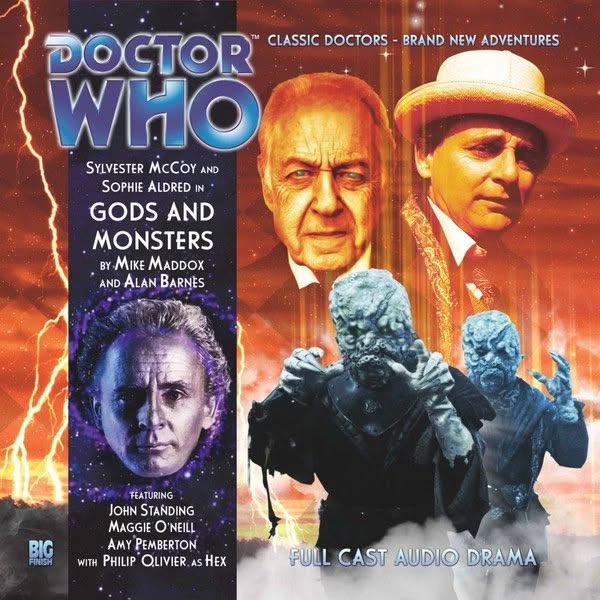
Gods and Monsters takes one look at ordinary Doctor Who plotting, throws it off a cliff, and instead decides to have the Seventh Doctor play multidimensional chess against ancient gods while standing on a literal metaphysical chessboard. Which, to be fair, is exactly the sort of nonsense I signed up for.
This story acts as the grand finale to the long-running Elder Gods arc, reuniting the Seventh Doctor with Ace, Hex, and his increasingly overqualified B-Team of Lysandra Aristedes and Sally Morgan from the Forge. The immediate threat is Fenric, returning to continue his eternal game against the Doctor, but things quickly become more complicated with the arrival of Weyland, or Volund, another Elder God whose own schemes have been quietly shaping events for far longer than anyone realised.
And that’s the clever twist. The Doctor believes he’s Fenric’s great opponent, matching wits with his oldest enemy across centuries of manipulation and counter-manipulation. Except he isn’t. He’s a pawn too. For a character as relentlessly calculating as the Seventh Doctor, that’s a wonderfully uncomfortable position to put him in.
The imagery throughout is superb. Big Finish has always excelled at creating vivid soundscapes, and this story absolutely leans into that strength. Characters navigate impossible landscapes that are simultaneously real places and giant chessboards. Every move has consequences. Every conversation feels like another piece sliding into position. It’s wonderfully theatrical without becoming incomprehensible, and the script trusts the audience to keep up rather than stopping every five minutes to explain the rules.
Thematically, it’s rich territory. Fate versus free will. The illusion of control. Whether anyone, even the Doctor, is ever truly the master of their own destiny. The Elder Gods don’t simply threaten reality; they undermine the comforting belief that intelligence and preparation are enough to stay ahead of the game.
Sometimes you’re just another piece. That’s unsettling. And very Seventh Doctor.
The performances are uniformly excellent. Sylvester McCoy slips effortlessly back into cosmic chessmaster mode, balancing warmth with that familiar undercurrent of manipulation that has always defined this incarnation. Ace continues to demonstrate why she’s one of the strongest companions in the franchise, while Sally and Aristedes prove once again that the Forge characters deserved far more stories than they ultimately received.
Then there’s Hex. Poor, bloody Hex. By this point the poor man has become the narrative equivalent of a football. Every major player in the story has taken a turn kicking him around. Fenric manipulates him. Weyland manipulates him. Nimrod manipulates him. The Doctor manipulates him, which admittedly is practically part of the job description when travelling with Seven.
And then the story decides to retroactively weave Weyland into huge chunks of Hex’s past, from surviving *The Angel of Scutari* to the origins of the Forge and even the tragedy surrounding his mother.
It’s ambitious. It’s clever. It’s also exhausting. Hex’s entire time in the TARDIS has become one prolonged exercise in emotional trauma. Where’s the wonder? Where’s the excitement? Where are the moments where he simply gets to marvel at the universe instead of being psychologically dismantled by it?
So when he embraces his final noble sacrifice, I wasn’t moved. I was angry. Not at Hex, at the Doctor. Because somewhere back in the Sixth Doctor era, he promised Evelyn Smythe he’d look after the lad. Looking back from here, that promise feels spectacularly broken.
Final Thoughts
A visually imaginative and intellectually engaging conclusion to the Elder Gods saga, packed with fascinating ideas, excellent performances and deliciously cosmic stakes. Unfortunately, it also pushes Hex’s suffering past the point of tragedy and into something that feels unnecessarily cruel, leaving a bittersweet aftertaste that undercuts an otherwise excellent finale.
3.5 out of 5 multidimensional chess games where literally everyone discovers they’re somebody else’s pawn