

Before continuing, please be aware that all of this content is made possible by the goodwill and support of my backers on Patreon. If you enjoy the work on this site, please consider supporting the creation of more content like this by clicking the button.
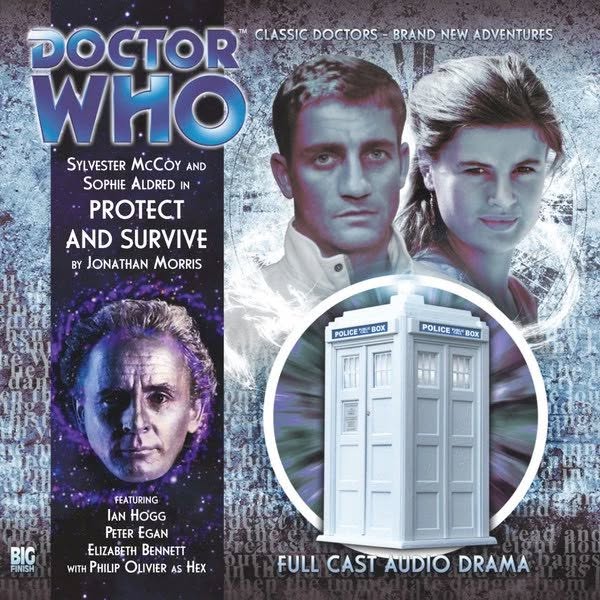
Protect and Survive commits the absolute audacity of advertising itself as a Seventh Doctor story, promptly shoving Sylvester McCoy offstage for most of the runtime, then somehow turning that into one of the best Big Finish audios I’ve ever heard. That’s confidence. Or witchcraft. Possibly both.
The setup is deliciously miserable. Ace and Hex find themselves stranded in an alternate 1980s where the Cold War finally tipped over the edge and somebody, somewhere, pressed the very bad button. The Doctor is nowhere to be found. The bombs have fallen. Society has evaporated. The pair end up sheltering from the radioactive fallout with an elderly couple named Albert and Peggy, armed with little more than ration books, tea, fading optimism, and the increasingly obvious realisation that they’re all going to die.
It’s impossible not to think of When the Wind Blows during these scenes. The same crushing mundanity. The same quiet horror. The same desperate attempts to cling to normality while the world quietly ends outside. And my God, it’s effective.
There’s no triumphant action music. No glorious last stands. Just the slow, methodical collapse of hope as radiation poisoning creeps in one symptom at a time. Albert and Peggy aren’t action heroes. They’re just ordinary people trying to make sense of something no ordinary person could ever prepare for. It’s bleak. Properly bleak.
The performances absolutely sell it. Ace and Hex bounce off one another brilliantly, each trying to keep the other going while slowly accepting that there might not actually be a way out. Meanwhile Albert and Peggy are so utterly believable as an elderly English couple that you immediately adopt them in your heart.
Which, naturally, means the story is sharpening the knife. Because halfway through everything breaks. Time resets. The bombs fall again. The same conversations happen. The same deaths approach. Ace and Hex realise they’re trapped in a loop, reliving Albert and Peggy’s final days over and over. At which point the story somehow gets even better.
The revelation that this isn’t history at all, but a prison constructed by the Doctor himself, is magnificent. Albert and Peggy aren’t innocent pensioners. They’re ancient servants of the Elder Gods, creatures aligned with horrors in the same cosmic neighbourhood as Fenric, guilty of atrocities so monstrous that the Doctor devised the cruellest punishment imaginable. Not execution. Not eternal torture. Humanity.
He’s condemned them to become human. To love. To fear. To grow old together. To watch the world end. To grieve. To die. Then to do it all again until they’ve finally learned what all those countless victims once felt. That is SUCH a Seventh Doctor solution. It’s compassionate. It’s horrifying. It’s morally questionable. It’s completely brilliant.
Thematically, the story juggles nuclear annihilation, justice, empathy, redemption and punishment without dropping any of them. It asks whether understanding suffering can truly redeem evil, and whether even the Doctor should possess the authority to make that judgement.
My only criticism is that poor Sylvester McCoy barely appears. Normally that would be a fatal flaw. Here? The absence becomes part of the point. His influence hangs over every scene like an invisible chess player who’s already won several moves ago. That’s pure Seven. That’s exactly why the ending lands so hard.
Final Thoughts
An astonishingly bleak, emotionally devastating and morally fascinating story that combines Cold War horror with one of the most perfectly judged Seventh Doctor twists Big Finish has ever produced. It’s tense, heartbreaking, thought-provoking and utterly unforgettable.
5 out of 5 government-issued nuclear survival pamphlets that were about as useful as a chocolate radiation suit