

Before continuing, please be aware that all of this content is made possible by the goodwill and support of my backers on Patreon. If you enjoy the work on this site, please consider supporting the creation of more content like this by clicking the button.
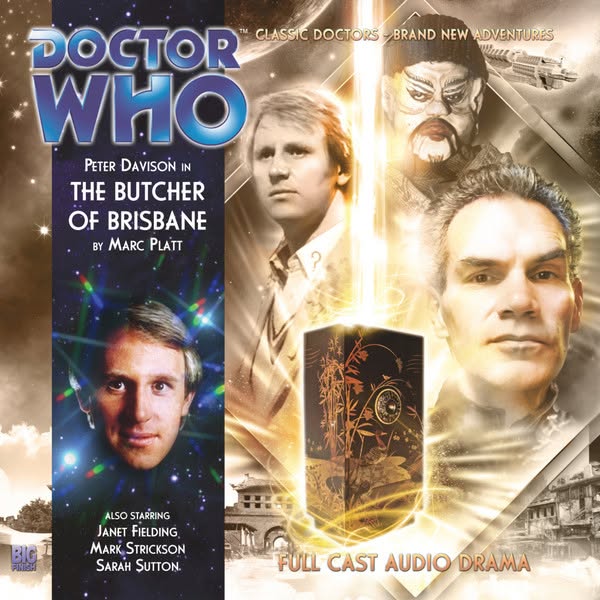
The Butcher of Brisbane finally breaks Peter Davison’s recent streak of “perfectly competent stories that immediately evaporate from my memory” by doing something radical.
It’s actually good. Not just “better than the last few.” Not “well, I wasn’t actively checking how much runtime was left.” Actually good. Properly good. The kind of story that reminds you why Big Finish keeps returning to old villains and old continuity in the first place. Because sometimes they get it right.
This adventure functions as a sequel to The Talons of Weng-Chiang, bringing back the legacy of Magnus Greel, the infamous war criminal from the fifty-first century. The Fifth Doctor, Nyssa, Tegan and Turlough arrive in a devastated future Australia where Greel’s shadow still hangs heavily over society. His atrocities have become history, mythology and propaganda all at once, and the consequences of his actions continue to shape the world long after his apparent demise.
And that’s where the story immediately succeeds. Unlike a lot of sequels, this isn’t interested in simply wheeling out an old villain and pointing at him while shouting “remember this?” Instead, it’s interested in legacy. How does history remember monsters? How does society mythologise tyrants? And perhaps most importantly, how much damage can one awful person continue to cause long after they’re gone? Good stuff. Really good stuff.
The setting helps enormously. The future Brisbane depicted here feels genuinely lived-in and believable. It’s scarred by old conflicts, divided by competing narratives and haunted by historical trauma. There’s a sense that this civilisation has survived catastrophe but never truly recovered from it. Which is more atmosphere than some entire Fifth Doctor box sets have managed lately.
The cast are similarly strong. Peter Davison sounds more engaged than he has in ages. Maybe it’s the material. Maybe it’s the stronger themes. Maybe somebody finally gave him a script with actual dramatic meat on its bones instead of another collection of space politicians explaining trade disputes. Whatever the reason, it works.
Nyssa gets meaningful material. Tegan gets opportunities to challenge people. Turlough gets to be useful without threatening to betray everyone for once, which honestly feels like character development.
The themes are where the story truly shines. Historical revisionism. Political extremism. The seductive appeal of strongman figures during periods of uncertainty. The way societies reshape history into convenient myths. There’s a surprising amount going on beneath what initially appears to be a straightforward dystopian adventure.
It’s also surprisingly relevant. The idea that people might romanticise a brutal tyrant because enough time has passed is unfortunately one of the most believable concepts in the entire Doctor Who universe.
My criticisms are relatively minor. Some sections feel a little exposition-heavy, particularly when explaining the history of the setting. A few supporting characters are more functional than memorable. And because the story is carrying a lot of thematic weight, the pacing occasionally slows while it explains itself.
But honestly? I’ll take that. After several audios that felt terrified of having anything to say, listening to one that actually engages with meaningful ideas feels refreshing. Most importantly, it earns its connection to Talons. It expands the mythology rather than merely referencing it. That’s harder than it sounds. And it’s exactly why this works.
Final Thoughts
A thoughtful and surprisingly intelligent sequel that explores the legacy of tyranny, the manipulation of history, and the scars left behind by political violence. Strong performances, strong themes and a compelling setting make this one of the Fifth Doctor’s best Monthly Range adventures in quite some time.
4 out of 5 future war criminals whose PR departments somehow survived longer than they did