The Burning Prince


Before continuing, please be aware that all of this content is made possible by the goodwill and support of my backers on Patreon. If you enjoy the work on this site, please consider supporting the creation of more content like this by clicking the button.


The Burning Prince desperately wants to be an epic. You can hear it straining for it. Every scene is reaching for sweeping space opera. Every plot twist wants to feel Shakespearean. Every speech seems convinced it’s moments away from becoming Doctor Who’s answer to Game of Thrones.

Instead, it ends up feeling like somebody dropped all the ingredients for a magnificent banquet onto the kitchen floor and then served them anyway.

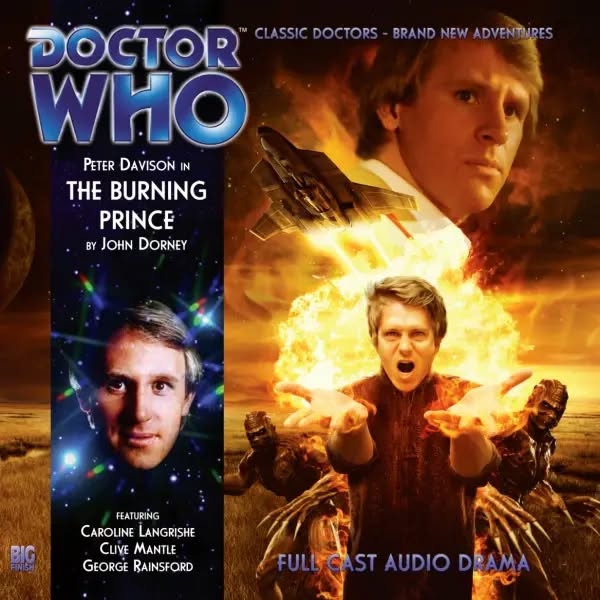
The Fifth Doctor arrives in the middle of a galactic civil war between two rival royal houses, the Gadarel and the Sorsha. The conflict has dragged on for generations, and the only hope of peace lies in the arranged marriage between Prince Kylo and Princess Aliona. It’s essentially the War of the Roses with spaceships, which is already a premise I’m perfectly willing to buy into.

Then things immediately go sideways. There are assassinations. Betrayals. Political conspiracies. Rampaging alien monsters. Secret agendas. Royal family drama. And because apparently the script looked at all that and thought, “Not enough,” Prince Kylo can also set people on fire with his mind.

It’s gloriously overstuffed. Unfortunately, “overstuffed” doesn’t necessarily mean “coherent.” The biggest problem is that the story never quite figures out what it’s actually wants to be. Is it a political thriller? A tragic romance? A monster story? A royal family melodrama? A war epic? The answer appears to be “yes,” which sounds ambitious until you realise it never gives any of those ideas enough room to properly breathe.

Every plotline feels like it’s sprinting to keep up with the next one. Characters are constantly betraying one another, revealing hidden motives, switching allegiances or discovering yet another inconvenient secret, but because the story is juggling so many moving parts, very little of it carries the emotional weight it’s clearly aiming for. You don’t get time to process one revelation before the next arrives waving its arms frantically for attention.

The themes are actually pretty solid. Cycles of vengeance. Political marriages sacrificing personal happiness for national stability. The burden placed upon children born into dynasties they never chose. Even Kylo’s pyrokinesis works as a neat metaphor for inherited power that cannot easily be controlled.

There’s good material buried in here. It just feels like it’s buried under another three scripts. Even the production feels unusually restrained. Big Finish normally excels at making alien civilisations sound enormous, but this empire never quite comes alive. The worldbuilding exists largely in dialogue rather than atmosphere, so despite all the talk of great houses and centuries of conflict, everything feels oddly small.

Then there’s the Doctor. Poor Peter Davison. He spends much of the story wandering through everybody else’s narrative looking faintly confused about why he’s there. He investigates. He offers sensible advice. He occasionally prevents somebody from making an even worse decision. But this never really becomes *his* story.

The Fifth Doctor often shines when he’s forced to hold impossible moral positions together while everybody else falls apart around him. Here, he mostly feels like an unusually polite observer. That’s perhaps the greatest disappointment. Because all the ingredients for a genuinely excellent political science-fiction drama are sitting right there on the table. Nobody quite manages to assemble them into the feast they promised.

Final Thoughts
An undeniably ambitious adventure packed with intriguing ideas, compelling themes and enough political intrigue to fuel an entire season. Sadly, it spreads itself too thin, leaving the Doctor strangely sidelined and the emotional payoffs far weaker than the excellent premise deserves.

2 out of 5 telekinetic royal wedding receptions that somehow managed to catch fire before the marriage even started

Gods and Monsters


Before continuing, please be aware that all of this content is made possible by the goodwill and support of my backers on Patreon. If you enjoy the work on this site, please consider supporting the creation of more content like this by clicking the button.


Gods and Monsters takes one look at ordinary Doctor Who plotting, throws it off a cliff, and instead decides to have the Seventh Doctor play multidimensional chess against ancient gods while standing on a literal metaphysical chessboard. Which, to be fair, is exactly the sort of nonsense I signed up for.

This story acts as the grand finale to the long-running Elder Gods arc, reuniting the Seventh Doctor with Ace, Hex, and his increasingly overqualified B-Team of Lysandra Aristedes and Sally Morgan from the Forge. The immediate threat is Fenric, returning to continue his eternal game against the Doctor, but things quickly become more complicated with the arrival of Weyland, or Volund, another Elder God whose own schemes have been quietly shaping events for far longer than anyone realised.

And that’s the clever twist. The Doctor believes he’s Fenric’s great opponent, matching wits with his oldest enemy across centuries of manipulation and counter-manipulation. Except he isn’t. He’s a pawn too. For a character as relentlessly calculating as the Seventh Doctor, that’s a wonderfully uncomfortable position to put him in.

The imagery throughout is superb. Big Finish has always excelled at creating vivid soundscapes, and this story absolutely leans into that strength. Characters navigate impossible landscapes that are simultaneously real places and giant chessboards. Every move has consequences. Every conversation feels like another piece sliding into position. It’s wonderfully theatrical without becoming incomprehensible, and the script trusts the audience to keep up rather than stopping every five minutes to explain the rules.

Thematically, it’s rich territory. Fate versus free will. The illusion of control. Whether anyone, even the Doctor, is ever truly the master of their own destiny. The Elder Gods don’t simply threaten reality; they undermine the comforting belief that intelligence and preparation are enough to stay ahead of the game.

Sometimes you’re just another piece. That’s unsettling. And very Seventh Doctor.

The performances are uniformly excellent. Sylvester McCoy slips effortlessly back into cosmic chessmaster mode, balancing warmth with that familiar undercurrent of manipulation that has always defined this incarnation. Ace continues to demonstrate why she’s one of the strongest companions in the franchise, while Sally and Aristedes prove once again that the Forge characters deserved far more stories than they ultimately received.

Then there’s Hex. Poor, bloody Hex. By this point the poor man has become the narrative equivalent of a football. Every major player in the story has taken a turn kicking him around. Fenric manipulates him. Weyland manipulates him. Nimrod manipulates him. The Doctor manipulates him, which admittedly is practically part of the job description when travelling with Seven.

And then the story decides to retroactively weave Weyland into huge chunks of Hex’s past, from surviving *The Angel of Scutari* to the origins of the Forge and even the tragedy surrounding his mother.

It’s ambitious. It’s clever. It’s also exhausting. Hex’s entire time in the TARDIS has become one prolonged exercise in emotional trauma. Where’s the wonder? Where’s the excitement? Where are the moments where he simply gets to marvel at the universe instead of being psychologically dismantled by it?

So when he embraces his final noble sacrifice, I wasn’t moved. I was angry. Not at Hex, at the Doctor. Because somewhere back in the Sixth Doctor era, he promised Evelyn Smythe he’d look after the lad. Looking back from here, that promise feels spectacularly broken.

Final Thoughts
A visually imaginative and intellectually engaging conclusion to the Elder Gods saga, packed with fascinating ideas, excellent performances and deliciously cosmic stakes. Unfortunately, it also pushes Hex’s suffering past the point of tragedy and into something that feels unnecessarily cruel, leaving a bittersweet aftertaste that undercuts an otherwise excellent finale.

3.5 out of 5 multidimensional chess games where literally everyone discovers they’re somebody else’s pawn

Black and White


Before continuing, please be aware that all of this content is made possible by the goodwill and support of my backers on Patreon. If you enjoy the work on this site, please consider supporting the creation of more content like this by clicking the button.


Black and White takes the Seventh Doctor, removes him from most of the story, throws Ace and Hex into ancient Denmark, adds Beowulf, a sarcastic alien pretending to be a legendary monster, and somehow turns all of that into a surprisingly thoughtful meditation on what makes a hero.

Because apparently Big Finish looked at Norse mythology and thought, “You know what this needs? More time travel nonsense.” And honestly? They weren’t wrong.

This is another story where Sylvester McCoy’s Doctor is technically the headline act but spends much of the runtime lurking around the edges like a mysterious old man who knows exactly what’s happening and refuses to explain anything because apparently that’s just his hobby now.

Instead, the focus is on Ace and Hex, who are joined by Lysandra Aristedes and Sally Morgan from the Forge organisation as they continue their search for the missing Doctor. Their investigation leads them to ancient Denmark, where they encounter a kingdom terrorised by a monstrous creature and a young warrior destined to become a legend.

That warrior? Beowulf. The monster? Grendel. Except, naturally, things are never quite that simple. Because this is Doctor Who. The monster isn’t actually a monster. He’s Garundel, an alien being whose existence has become tangled up with human mythology, and he’s played with wonderfully smug energy by Stuart Milligan. He’s not simply a villain waiting to be defeated, but a complicated character caught between perception and reality.

Which is where the story gets interesting. Because Black and White isn’t really about fighting monsters. It’s about how monsters are created.

History remembers heroes and villains differently from how those people actually were. Legends simplify. Stories reshape. The truth gets buried beneath centuries of retelling until a person becomes an idea rather than an individual. And that applies beautifully to Beowulf. The story asks what makes someone heroic. Is it strength? Is it sacrifice? Is it the willingness to stand against impossible odds even when nobody remembers the truth afterwards?

Big questions for a story involving a man fighting a sarcastic alien. But Doctor Who has always been good at making ridiculous things surprisingly meaningful.

The performances are excellent across the board. Ace remains one of Big Finish’s strongest companions because she carries so much history with her. She isn’t just the reckless teenager from the television series anymore. She’s someone shaped by trauma, experience and the Doctor’s influence, and those layers continue to make her fascinating. Hex works well alongside her too. Their relationship feels natural, with both characters bringing different perspectives to the search for the Doctor.

And then there is the Doctor himself. The scenes involving him and the infant TARDIS are genuinely some of the most affecting moments in the story. Watching him nurture this new sentient machine, explaining its purpose and the role it will eventually play, is surprisingly emotional. There’s a beautiful parallel between the TARDIS’s future and Beowulf’s legacy: both are shaped by what they become rather than what they start as.

It’s a lovely bit of storytelling. Is it perfect? No. Coming immediately after Protect and Survive means it suffers from an unfair comparison because that story is operating at another level entirely. Black and White is less ambitious, less devastating and less likely to leave you staring silently into space afterwards.

But that’s not really a criticism. Not every story needs to be a masterpiece. Sometimes you just need a really good Doctor Who adventure. And this is one.

Final Thoughts
A strong, memorable adventure that blends mythology, science fiction and character drama into a thoughtful exploration of heroism and legacy. It may not reach the heights of the story before it, but with excellent performances, smart themes and a wonderfully strange alien Grendel, it remains a very enjoyable trip through time.

4 out of 5 legendary warriors who probably should have asked more questions before punching the alien pretending to be a monster

Protect and Survive


Before continuing, please be aware that all of this content is made possible by the goodwill and support of my backers on Patreon. If you enjoy the work on this site, please consider supporting the creation of more content like this by clicking the button.


Protect and Survive commits the absolute audacity of advertising itself as a Seventh Doctor story, promptly shoving Sylvester McCoy offstage for most of the runtime, then somehow turning that into one of the best Big Finish audios I’ve ever heard. That’s confidence. Or witchcraft. Possibly both.

The setup is deliciously miserable. Ace and Hex find themselves stranded in an alternate 1980s where the Cold War finally tipped over the edge and somebody, somewhere, pressed the very bad button. The Doctor is nowhere to be found. The bombs have fallen. Society has evaporated. The pair end up sheltering from the radioactive fallout with an elderly couple named Albert and Peggy, armed with little more than ration books, tea, fading optimism, and the increasingly obvious realisation that they’re all going to die.

It’s impossible not to think of When the Wind Blows during these scenes. The same crushing mundanity. The same quiet horror. The same desperate attempts to cling to normality while the world quietly ends outside. And my God, it’s effective.

There’s no triumphant action music. No glorious last stands. Just the slow, methodical collapse of hope as radiation poisoning creeps in one symptom at a time. Albert and Peggy aren’t action heroes. They’re just ordinary people trying to make sense of something no ordinary person could ever prepare for. It’s bleak. Properly bleak.

The performances absolutely sell it. Ace and Hex bounce off one another brilliantly, each trying to keep the other going while slowly accepting that there might not actually be a way out. Meanwhile Albert and Peggy are so utterly believable as an elderly English couple that you immediately adopt them in your heart.

Which, naturally, means the story is sharpening the knife. Because halfway through everything breaks. Time resets. The bombs fall again. The same conversations happen. The same deaths approach. Ace and Hex realise they’re trapped in a loop, reliving Albert and Peggy’s final days over and over. At which point the story somehow gets even better.

The revelation that this isn’t history at all, but a prison constructed by the Doctor himself, is magnificent. Albert and Peggy aren’t innocent pensioners. They’re ancient servants of the Elder Gods, creatures aligned with horrors in the same cosmic neighbourhood as Fenric, guilty of atrocities so monstrous that the Doctor devised the cruellest punishment imaginable. Not execution. Not eternal torture. Humanity.

He’s condemned them to become human. To love. To fear. To grow old together. To watch the world end. To grieve. To die. Then to do it all again until they’ve finally learned what all those countless victims once felt. That is SUCH a Seventh Doctor solution. It’s compassionate. It’s horrifying. It’s morally questionable. It’s completely brilliant.

Thematically, the story juggles nuclear annihilation, justice, empathy, redemption and punishment without dropping any of them. It asks whether understanding suffering can truly redeem evil, and whether even the Doctor should possess the authority to make that judgement.

My only criticism is that poor Sylvester McCoy barely appears. Normally that would be a fatal flaw. Here? The absence becomes part of the point. His influence hangs over every scene like an invisible chess player who’s already won several moves ago. That’s pure Seven. That’s exactly why the ending lands so hard.

Final Thoughts
An astonishingly bleak, emotionally devastating and morally fascinating story that combines Cold War horror with one of the most perfectly judged Seventh Doctor twists Big Finish has ever produced. It’s tense, heartbreaking, thought-provoking and utterly unforgettable.

5 out of 5 government-issued nuclear survival pamphlets that were about as useful as a chocolate radiation suit