The Fourth Wall


Before continuing, please be aware that all of this content is made possible by the goodwill and support of my backers on Patreon. If you enjoy the work on this site, please consider supporting the creation of more content like this by clicking the button.


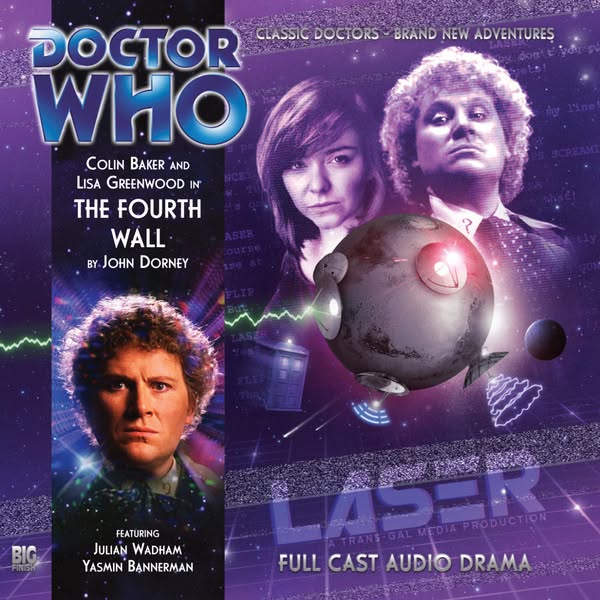
The Fourth Wall takes one look at reality, points at it accusingly, then climbs through a hole in the script and starts punching continuity in the face. Which is exactly the sort of gloriously stupid premise that can either become a masterpiece or an absolute train wreck. Thankfully, it mostly lands on the right side of that divide.

This time around, Colin Baker’s Sixth Doctor and Flip Jackson stumble into a corporation that’s using alien technology to create television programmes. Not television programmes about fictional events, mind you. Actual alternate realities where those events genuinely happen.

Imagine if every soap opera, crime drama, and prestige streaming series was secretly generating a parallel universe full of people doomed to suffer because somebody in a writers’ room thought it would boost ratings. Congratulations. You’ve invented existential horror television. And honestly? For the first half, this concept is carrying the story on its shoulders like a weary labourer dragging a grand piano uphill. Because it’s a REALLY good idea.

There’s a lot of fun philosophical territory here. What responsibility do creators have toward their creations? If a fictional person becomes self-aware, are they still fictional? If an entire reality exists purely because somebody wrote a script, what rights do its inhabitants possess?

It’s all got a distinctly Blade Runner flavour to it. Artificial people questioning their existence. Manufactured realities. The uncomfortable ethics of creating life for entertainment. And, considering we’re now living in a world where people happily generate endless AI-created images and stories without thinking twice about the implications, the whole thing feels surprisingly modern despite being released years before that conversation became unavoidable.

Then the story remembers it’s a Doctor Who adventure and decides to get very silly. The villain of one of these manufactured shows becomes aware he’s fictional. Good setup. He breaks through into reality. Still good. He decides to destroy the universe… because. Just because. Because that’s the way characters like him are written in fiction, and this story’s writer knew that and decided to poke some fun at it.

This is a comedy first and foremost. A big, cheeky, self-aware comedy that spends much of its runtime poking fun at television conventions, storytelling mechanics, and the relationship between creators and audiences.

It genuinely reminds me of Red Dwarf: Back to Earth at times. Not necessarily in terms of plot, but in spirit. That same willingness to acknowledge the audience, play with meta concepts, and occasionally disappear up its own narrative backside for a joke. Fortunately, unlike some meta-fiction, it never becomes insufferably pleased with itself.

A lot of that comes down to the cast. Colin Baker is having an absolute blast. His Sixth Doctor thrives in stories that let him be witty, theatrical, and mildly exasperated by everybody around him. Meanwhile Flip continues to settle into the companion role nicely. She’s still finding her identity as a character, but her straightforward practicality works well against the Doctor’s larger-than-life personality.

Thematically, the story revolves around authorship, identity, and the nature of reality itself, but it never lingers too long on the heavier questions. Sometimes that’s a weakness. Sometimes it’s exactly the right choice. Here, it mostly works. I just wish the final villain had been given the same level of thought as the premise that created him.

Final Thoughts
A clever, funny, and delightfully meta adventure packed with strong ideas about fiction, reality, and creation. The central concept is far more interesting than the underdeveloped villain, but the humour, performances, and sheer inventiveness keep things entertaining throughout.

4 out of 5 self-aware television villains angrily escaping their own cancellation notices

The Curse of Davros


Before continuing, please be aware that all of this content is made possible by the goodwill and support of my backers on Patreon. If you enjoy the work on this site, please consider supporting the creation of more content like this by clicking the button.


The Curse of Davros crash-lands into your ears screaming about identity, hatred, and the Battle of Waterloo while a bunch of Daleks apparently looked at European history and decided “you know what this needs? MORE fascism,” and honestly? Respect the commitment to the bit.

This is the official introduction of Flip Jackson as a proper companion for Colin Baker’s Sixth Doctor, after her earlier appearance in The Crimes of Thomas Brewster, and immediately the dynamic is… interesting. Because the Doctor is acting WRONG.

Not subtle wrong either. Not “slightly off.” We’re talking full television-era Six. Abrasive, egotistical, rude enough to strip paint. And at first I genuinely thought the story was pulling some timeline trickery where we’d landed back in the early days of his incarnation before the character mellowed into the magnificent technicolour disaster uncle we know and love in Big Finish.

But no. SURPRISE. Mind swap with Davros. Which is honestly a much better idea.

And to the story’s credit, this is where it comes alive. The psychological overlap between the Doctor and Davros has always been fertile ground for Doctor Who. Two brilliant minds, both convinced they know what’s best for the universe, separated by morality and about twelve billion war crimes.

So putting each inside the other’s perspective? Good stuff. Even if the story occasionally handles it with all the subtlety of a Dalek reversing through a greenhouse.

A lot of the middle section is devoted to “wow, being Davros sure is awful,” with the Doctor trapped inside Davros’s broken body while Davros gets to gallivant around in the Doctor’s healthier form. Now, I can already hear discourse approaching in the distance like thunder, because yes, some of this edges uncomfortably close to “disabled body as horror” territory.

But honestly? My bigger issue isn’t even that. It’s that the script keeps TELLING us how horrifying and hateful the experience is rather than letting the character work organically reveal it. It’s exposition-heavy in places where it should be emotional.

Still. Colin Baker and Terry Molloy absolutely carry the material on pure performance power. Baker playing traces of Davros creeping into the Doctor is deliciously unsettling, while Molloy getting to embody the Doctor’s mannerisms underneath Davros’s venom is equally fun. It’s theatrical as hell. Two veteran actors chewing scenery through a psychic body-swap prism. Love that for them.

Then there’s the BONKERS historical angle. The Daleks want Napoleon to win Waterloo. I’m sorry, that sentence alone almost earns an extra half-star. It’s so gloriously ridiculous in exactly the way Doctor Who should be. The image of Daleks carefully micromanaging nineteenth-century warfare like angry space accountants is deeply funny to me.

Flip herself is… promising. She absolutely has shades of Rose Tyler and Lucie Miller in the “working-class modern companion who mouths off at aliens” mould, but with a rougher, more uncertain edge. There’s a slight “class clown masking insecurity” vibe to her that makes her feel less polished and more human.

That said, right now she still feels like an early draft of a character rather than a fully distinct presence. Some of the “dumb girl” writing undercuts her, though you can feel the potential for growth underneath it.

And honestly? Pairing her with Six is smart. His larger-than-life intensity needs someone grounded and emotionally reactive to bounce off.

Final Thoughts
A messy but entertaining body-swap thriller elevated massively by Baker and Molloy’s performances, with some wonderfully absurd historical Dalek nonsense and a companion introduction full of potential, even if the script occasionally explains itself to death.

3.5 out of 5 Daleks aggressively trying to rewrite European history for absolutely no sensible reason

Army of Death


Before continuing, please be aware that all of this content is made possible by the goodwill and support of my backers on Patreon. If you enjoy the work on this site, please consider supporting the creation of more content like this by clicking the button.


Army of Death sounds like the kind of title that should arrive kicking the door off its hinges with a flaming skeleton cavalry and a choir screaming in Latin while the sky explodes into bone fragments.

Instead it sort of wanders into the room, coughs politely, and spends four episodes explaining intergalactic local politics at me while an undead army mills around in the background like extras waiting for catering.

This SHOULD have been my jam. We’ve got Paul McGann and Mary Shelley landing on an alien world dealing with the aftermath of political assassination, scheming factions, staged murders, an undead uprising, and eventually a giant skeletal overlord because apparently someone looked at a heavy metal album cover and went “yes, narrative structure.”

That is objectively ridiculous. That is objectively WONDERFUL material. And yet somehow this story achieves the impossible feat of making an army of undead skeleton monsters feel like an administrative meeting.

The core plot revolves around the assassination of the planet’s leader and the political chaos that follows, with various power players manipulating events while the dead inconveniently refuse to stay dead. The undead themselves are tied into the planet’s social and political systems in ways that could have been fascinating, especially with all the implications about death, power, and control.

Could have been. Instead the whole thing just kind of… trudges.

It’s not even offensively bad. Honestly, I think that’s the problem. It’s this foggy middle ground of competence where scenes happen, information is exchanged, and my brain quietly drifts out of the nearest window searching for stimulation elsewhere.

At one point I genuinely realised I’d stopped processing the story despite it still actively playing in my ears. That’s not even boredom anymore. That’s astral projection. Which is tragic because there ARE good elements here.

Julie Cox is excellent as Mary Shelley. There’s intelligence and warmth in the performance, and she continues to bring a grounded emotionality that keeps the Eighth Doctor era feeling human even when the plots get particularly silly. Paul McGann, meanwhile, remains absurdly charismatic through sheer force of will. The man could read takeaway menus and somehow make them sound melancholically romantic.

But then the story decides to push the “Mary is romantically infatuated with the Doctor” angle and I just… Guys. Come on. Even in 2011 this was already a well-trodden road. We’ve BEEN here. We’ve bought souvenirs here. We’ve had entire seasons of television doing this exact dynamic already. And the frustrating part is that Mary and the Doctor already have enough chemistry without forcing it into “ooh tragic yearning” territory.

Sometimes a rich intellectual bond is enough! Sometimes two emotionally complicated weirdos travelling through time together can just EXIST without one of them gazing wistfully into the middle distance every twelve minutes!

Thematically, there’s stuff buried in here about political decay, societies built on death, and the manipulation of fear during periods of instability. There’s even some interesting tension between memory and legacy, especially with the undead imagery looming over everything.

But the story never sharpens those ideas into anything memorable. They just sort of drift around in the fog alongside the skeletons.

And the skeletons SHOULD be memorable. There is a GIANT BONE LORD in this. A giant. Bone. Lord. How are we boring?? That feels medically impressive.

Final Thoughts
A story packed with potentially fantastic ingredients that somehow blends them into the sci-fi equivalent of room-temperature soup. Strong performances help, especially from Mary Shelley, but not enough to stop the whole thing feeling weirdly lifeless despite the abundance of literal undead.

2.5 out of 5 politically motivated skeleton uprisings that desperately needed more actual uprising

The Witch from the Well


Before continuing, please be aware that all of this content is made possible by the goodwill and support of my backers on Patreon. If you enjoy the work on this site, please consider supporting the creation of more content like this by clicking the button.


The Witch from the Well throws Paul McGann and Mary Shelley into seventeenth-century witch paranoia, adds shapeshifting aliens, an interdimensional fear-creature, and a professional witch-hunter with the emotional warmth of mildew, then shakes the whole thing violently until plot points start flying out like cursed confetti.

And honestly? I had a pretty good time.

This is one of those stories that feels like it was assembled in a laboratory labelled “Peak Doctor Who Ingredients.” Historical setting? Check. Mob hysteria? Check. Alien nonsense being mistaken for folklore? Check. A weird extradimensional entity skulking around like it escaped from someone’s sleep paralysis demon collection? BIG check.

The setup is deliciously chaotic. The Doctor and Mary arrive in a village where tensions are already simmering, only to discover that several locals suspected of witchcraft are actually aliens masquerading as humans. Which, naturally, is not helping the whole “burn the witches” atmosphere.

Complicating matters further is an actual alien entity tied to another dimension, something all creepy whispers and ancient hunger, which means the story keeps bouncing between “historical paranoia thriller” and “eldritch corridor horror.”

Sometimes elegantly.

Sometimes like a shopping trolley with one broken wheel.

But the energy carries it.

A huge part of why this works is the pairing of Paul McGann and Mary Shelley. McGann continues to be absurdly listenable, gliding between warmth, melancholy, and barely-contained cosmic menace like it’s effortless. Meanwhile Mary remains one of the best historical companions Big Finish ever stumbled into. She’s thoughtful, empathetic, curious, and crucially, the story actually lets her engage with the themes instead of just reacting to plot explosions.

Which is important, because the themes here are pretty juicy. Fear. Othering. The way ignorance mutates into violence. The tendency humans have to slap a supernatural label onto things they don’t understand and then immediately set them on fire. Cheerful stuff!

The witch trials backdrop works because the story understands that “witch” was often just shorthand for outsider, inconvenience, or vulnerable target. The aliens aren’t evil invaders so much as frightened strangers trying to survive, and the real horror often comes from the humans around them. Well. Humans and whatever the hell is lurking in the well dimension.

That thing’s fun too. A bit nebulous, admittedly, but fun. It gives the story this nice undercurrent of unreality, like the village itself is teetering on the edge of some older, stranger nightmare. Critically though, the whole thing is kind of a mess. An entertaining mess! But a mess.

There are a LOT of moving parts. Witch hunters. Alien refugees. Dimension monsters. Suspicious villagers. Historical commentary. Identity drama. At times it feels like the script is juggling chainsaws while riding a unicycle through a fog machine. Some ideas get plenty of room to breathe, others flash past so quickly you barely process them before the next revelation arrives screaming through the wall.

And despite all the strong ingredients, it never quite becomes memorable. Good? Absolutely. Enjoyable? Definitely. But it lacks that extra layer of emotional or philosophical depth that elevates a story from “solid Doctor Who” to “something that haunts your brain at 2 AM.”

Still, I’d rather have an ambitious, overstuffed story swinging wildly for the fences than something safe and bloodless. Even if occasionally it feels like the fences are swinging back.

Final Thoughts
A messy but entertaining blend of historical paranoia, alien intrigue, and gothic weirdness elevated by excellent performances and strong thematic ideas, even if it never fully crystallises into something truly unforgettable.

4 out of 5 suspicious villagers one accusation away from setting the entire plot on fire