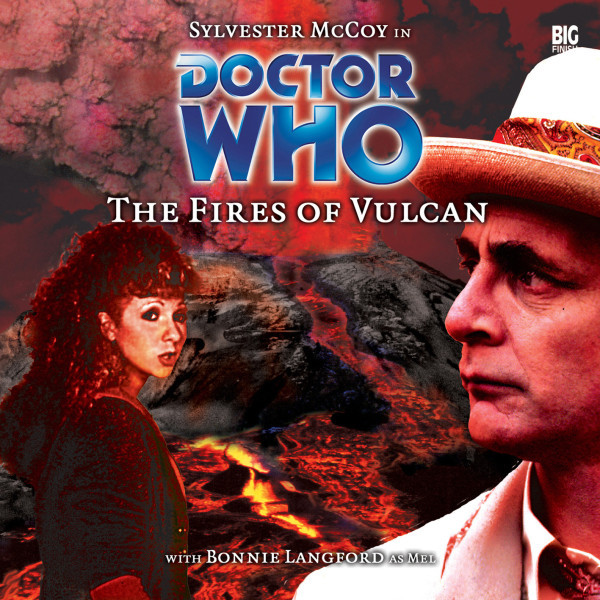
The Fires of Vulcan


Before continuing, please be aware that all of this content is made possible by the goodwill and support of my backers on Patreon. If you enjoy the work on this site, please consider supporting the creation of more content like this by clicking the button.


Oh look, a Doctor Who story with no psychic aliens, no ancient prophecies about Time Baby’s return, no ghosts made of data, and no one screaming the word “TIME” like it’s punctuation — just a good old-fashioned historical with actual stakes and no CGI MacGuffin to smother the tension. I almost forgot this was allowed.

The Fires of Vulcan slaps you into Pompeii like someone threw Mel down the wrong chute at the Time-Space Waterpark. It’s hot, it’s messy, and everyone’s going to die — and you feel it. No technobabble, no last-minute vortex resets. Just ash and dread and the soft, terrible crunch of history closing in. The Doctor knows what’s coming. Mel doesn’t. And you, dear listener, get to sit in the middle of that slowly tightening emotional vice and scream internally.

Let’s talk about Mel. No, actually, let’s celebrate her, because Bonnie Langford finally gets something meaty and brilliant to do. Gone is the pastel scream-emoji we were forced to endure on telly. This Mel is smart, empathetic, and completely willing to push back against the Doctor’s fatalism. She sees people suffering and decides to do something about it. Revolutionary! She’s the moral compass without being the designated lecture device. She’s the audience surrogate without being a naive tagalong. I am, for once, pro-Mel. Truly we live in strange times.

And the Doctor — this is one of those stories where McCoy finally clicks into that wounded, weary, chess-master energy he does so well. You can feel the weight on him, pressing down like the ash cloud itself. He’s seen the history books. He knows Pompeii is a death sentence. And it’s eating him alive to stay and watch. But oh gods, does he try.

The supporting cast are all fantastic, too. No faceless cannon fodder here. Everyone’s got motives, regrets, petty ambitions. The slave girl trying to buy her way out of fate, the gladiator with a little-too-much swagger, the desperate innkeeper — it’s like watching a stage play where everyone’s destined to burn and no one knows they’re holding the match. The politics of survival are everywhere, and it’s glorious. And then the lava hits.

That eruption scene? Absolutely gobsmacking. This is where audio earns its keep — you don’t need visuals when the sound design punches you in the gut with every crumbling wall, every screaming citizen, every thunderous death-knell of a civilisation crumbling under fire. It’s not spectacle for spectacle’s sake. It’s tragedy made real.

Honestly, the only reason I’m not giving it a full five is because I reserve that for the ones that emotionally ruin me. This one merely left me shattered and breathing ash.

Final Verdict:
Mel finally gets a real story, McCoy gets to bleed dignity and guilt, and Big Finish remembers that tension is better than technobabble. Pompeii burns, and we feel every second of it.

5 out of 5 doomed Roman holiday postcards

The Apocalypse Element


Before continuing, please be aware that all of this content is made possible by the goodwill and support of my backers on Patreon. If you enjoy the work on this site, please consider supporting the creation of more content like this by clicking the button.


Okay. Strap in. Because The Apocalypse Element is what happens when someone who’s definitely read a lot of old Doctor Who Magazine lore columns gets the keys to the car, floors it into Gallifreyan continuity, and then promptly drives it off a cliff. And instead of wreckage, we get… whatever this is. An explosion of Time Lord politics, Dalek screeching, Evelyn shouting into space, Romana being dragged through the narrative like a reluctant bridesmaid at a regeneration ceremony, and a plot so dense with fanservice it practically wheezes under its own canon.

It wants to be a “major event.” I mean, it’s got everything: a vanished Gallifreyan delegation, a missing Romana, time-scoopy Daleks being Very Evil™, and an ancient cosmic threat that sounds like a Warhammer 40K artifact crossed with a GCSE geography project. Also: the titular “Apocalypse Element,” which is apparently what happens when you cross solar flares with microwave-grade nonsense. Do not attempt to understand the science. There is none. It’s like a student film that tried to adapt The Deadly Assassin and gave up halfway through to LARP as Davros.

The Daleks are… here. They yell. They invade. They monologue like fascist kettles with a thesaurus. I think they want to control time again? Or destroy it? Or redecorate the universe in grayscale? Honestly, their motivations have all the consistency of soup flung at a wall. Their big move this time is hijacking a conference and threatening the universe with timeline genocide. It’s like C-SPAN meets Skaro’s Got Talent.

Colin Baker, God bless him, is trying so hard to steer the flaming wreckage of this plot with his usual velvet bombast, but even he sounds like he’s blinking at the script going, “Wait… we’re in the Eye of Harmony again? Who let the fanfic in?” Evelyn—bless her teapot soul—is just baffled by everything, which is fair, because same. And poor Romana. Lalla Ward deserved better than to be tortured for half the runtime and then stuck reading Gallifreyan technobabble like she’s auditioning for a Time Lord PowerPoint presentation.

There’s no time for atmosphere. No tension. No pacing. Just lore dumps, shouty scenes, and more Big Capitalised Sci-Fi Words™ than a boxset of The Trial of a Time Lord. I kept waiting for something emotionally resonant to happen. Or funny. Or fun. But instead, it’s just “here’s a crisis,” “here’s another,” “suddenly Daleks,” “Romana’s wearing ceremonial Time Lord IKEA headgear,” and then we’re done.

Final Verdict:
If you’ve ever wanted to be bludgeoned with outdated continuity, pompous exposition, and plot threads so tangled they make The Timeless Children look like Blink, this is your stop. Everyone else? Run. You deserve better Time Lord trauma.

1.5 out of 5 untraceable Rassilon relics

Winter for the Adept


Before continuing, please be aware that all of this content is made possible by the goodwill and support of my backers on Patreon. If you enjoy the work on this site, please consider supporting the creation of more content like this by clicking the button.


You know that creeping dread when someone says, “We’re doing a ghost story at a Victorian boarding school,” and your soul immediately curls up in a ball because you’ve already seen that episode of Doctor Who? And that one. And… yeah. Welcome to Winter for the Adept, the tenth in Big Finish’s early-run collection of “What if we did the same plot again, but colder?”

We’re in the Swiss Alps this time, because snow is apparently spooky. Nyssa is dropped straight into a mountain Gothic horror setup, all girls’ dormitories and religious repression and rattling tea trays. Meanwhile, the Doctor rocks up like someone wandered in from a better script. There’s a ghost (sort of), there’s psychic nonsense (of course), and by the end there are aliens (because we can’t just have one genre, that’d be too focused).

The twist is that there isn’t a ghost—it’s just latent telekinetic energy left behind by a dead epileptic. Yes, really. That’s the payoff. You sit through 80 minutes of frostbitten tedium, and it turns out the haunting was a paranormal case of bad vibes. There’s also a deranged fundamentalist teacher, because what’s a posh boarding school without a bit of theocracy? But don’t worry—she mostly just yells “God disapproves!” at lesbians and psychic children, then vanishes from narrative relevance.

And then, just when you’re dozing off to the gentle sound of plot inertia, BAM: aliens. The Spillagers! Who are they? Who cares! They crash the party right at the end like uninvited stoners at a séance, get instantly bodied by the Doctor, and leave again. It’s the kind of pointless intrusion that feels like the scriptwriter panicked and googled “Doctor Who mandatory alien quota.”

The dialogue is peak early Big Finish clunk: people shriek things like “Look out, it’s the piano!” with all the urgency of someone announcing a bus timetable. And speaking of the haunted piano—it’s real, it’s dumb, and it literally chases people. Like a ghostly Wile E. Coyote gag, except with zero irony.

The only vaguely noteworthy thing here is the debut of India Fisher as Peril Bellamy (yes, that’s her actual character name). She’ll go on to play Charley Pollard in better audios, but here she’s stuck playing the most annoying telepath since Bester from Babylon 5. The rest of the cast try their best to emote through snowdrifts of exposition, but there’s only so much you can do when half the script is “Look! It’s cold! Something moved!”

This isn’t even camp enough to be fun-bad. It’s just bland, cold, and so aggressively middle-tier that it feels like it was written by an AI trained exclusively on 1980s Target novelisations.

Final Verdict:
Because apparently we can’t do ghosts, boarding schools, telepathy, and aliens without killing the vibe completely.

1 out of 5 haunted pianos

The Spectre of Lanyon Moor


Before continuing, please be aware that all of this content is made possible by the goodwill and support of my backers on Patreon. If you enjoy the work on this site, please consider supporting the creation of more content like this by clicking the button.


It begins, like many great British traditions, with someone getting murdered in the countryside.

The Spectre of Lanyon Moor is what happens when you take the gothic weirdness of folk horror, throw in some aliens, a cranky old aristocrat, and a Doctor in a Technicolor dreamcoat who’s finally found his stride—and then somehow it all works. Miraculously. Grubbily. Comfortably. Like an old stone cottage that probably has three ghosts and a slow-boiling kettle at all times.

Let’s start with the obvious: this one doesn’t reinvent the wheel. It doesn’t even try. But what it does do is roll the perfectly serviceable wheel straight down the foggy hillside of rural Cornwall into a pit full of telepathic glowing alien wreckage and ancient subterranean spite. Which, frankly, is my kind of day out.

Colin Baker, whose Sixth Doctor has often suffered from “angrily yells exposition until someone dies” syndrome, is finally given a story where he can actually breathe—and charm. He’s warm, clever, occasionally testy, but never cruel. And when you pair him with Evelyn Smythe (as always, a joy: witty, grounded, and forever ready to throw academic shade), the dynamic crackles like a log fire after a miserable rainy hike. Their friendship is the cozy heart of this story, and it’s on full display here.

Oh, and did I mention the Brigadier’s here? Yes, that Brigadier. Nicholas Courtney turns up like a warm jumper you forgot you owned and instantly feel better wearing. His interactions with both Evelyn and Sixie are wonderful—full of understated affection, dry humour, and that trademark British resignation in the face of certain death. You could pair him with a haunted eggcup and he’d still make it work.

Now, the actual plot: something spooky is happening around Lanyon Moor, where people are dying, things are glowing, and Sir Archibald Flint—a moustache in search of a brain—is conducting mysterious rituals and being casually racist in the way only posh Doctor Who villains from the countryside can. Yes, he’s absurd. But at least he’s fun absurd, not “menacing Klan cosplayer” absurd. And the twist—that the folk tales are actually about a long-buried alien war criminal with psychic abilities—is handled with surprising restraint.

It’s this blend of local legend and off-world menace that makes the episode work. It doesn’t go full horror (this ain’t Image of the Fendahl), but it also never leans into the “aliens are gods” cliché too hard. It respects the rural setting while keeping the pacing tight and the tone sharp. Also, the supporting cast—normally a Big Finish crapshoot—are uniformly solid, even when their characters are ridiculous.

Final Verdict:
The Spectre of Lanyon Moor doesn’t try to blow your mind. It just delivers a grounded, moody, character-led story with great chemistry, rural mystique, and zero continuity-porn smugness. And in this economy? That’s practically witchcraft.

4 out of 5 subterranean warlocks with trust funds.