Invaders from Mars


Before continuing, please be aware that all of this content is made possible by the goodwill and support of my backers on Patreon. If you enjoy the work on this site, please consider supporting the creation of more content like this by clicking the button.


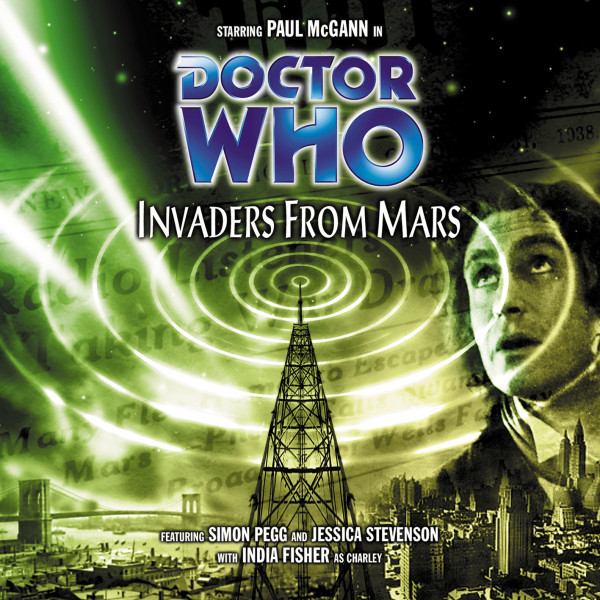
Imagine a detective noir, a gangster flick, a spy thriller, a tongue-in-cheek alien invasion saga—all dumped into a blender stuck on pureed chaos. That, my friends, is Invaders from Mars. It’s got style and energy in spades, but it’s so bloated it forgets who it’s even meant to entertain.

Let’s start with the good: Mark Gatiss clearly knows his 1930s New York pulp. The dialogue crackles like radio static, and Paul McGann’s Eightie Doctor slips into gumshoe mode with irresistible gusto. India Fisher’s Charley meanwhile… gets lost in the shuffle, which is a shame—she’s sidelined early and underused, never given room to shine. Honestly, her character deserves better.

The cast is stacked—Simon Pegg as gangster Don Chaney, Jessica Stevenson’s sultry Glory Bee, Orson Welles (yes, the Orson) voiced by David Benson—and they all turn in performances that nearly save the tsunami of subplots. There’s Captain Cosmo Devine, Moscow agents, secret labs, Nazis, mob bosses, spies, martians, atomic secrets—and soldiers dying from dropped script threads like caramel popcorn in a blender. The audio even punctuates every reveal with trumpets like it’s chewing through a comic strip, and while that can be fun, here it just becomes audio wallpaper after the third act.

And the plot? Think of a heist movie on crack: the Doctor and Charley dive in after a dead PI and a crashed UFO, entangling themselves with gangsters who stumbled onto alien tech. Then there’s the Russian scientist, the flamboyant Nazi columnist—whose “secret sympathies” feel half-baked—and Orson, who goes from aloof radio star to conspiratorial cameo. Meanwhile, the aliens (the Lederplacker species) are flying in to grab their gizmo back. Everything careens, gallops, and eventually crashes through Soviet plotlines, gangster diplomacy, Nazi intrigue, Orson radio theater… you name it.

At its core? A clever premise: what if the real invasion happened during Welles’s broadcast? But as the narrative careens, that anchoring joke gets buried. By the final act, characters are biting it left, right, and center—mere casualties in the writer’s rush to defuse unresolved storylines. Far from tension, it feels like story fatigue. Nothing is given room to breathe or hit emotionally.

This would’ve been a slick triple-act radio caper as long as they’d trimmed the fat and held onto a couple of storylines. Instead, it’s got more threads than a knitting convention—and none of them finish cleanly. The production design still sparkles with 1930s radio drama nostalgia: jazzage FX, cast laughter, crackling static. But style can only paper over so much.

Final Verdict:
Gutsy, audacious, occasionally hilarious—but overstuffed and undercut by its own ambition. A classic “too much, too late” scenario.

2 out of 5 narrative transmission failures

The One Doctor


Before continuing, please be aware that all of this content is made possible by the goodwill and support of my backers on Patreon. If you enjoy the work on this site, please consider supporting the creation of more content like this by clicking the button.


Let’s call it what it is: The One Doctor is a gloriously unhinged sugar high of a story, dipped in glitter, wrapped in a whoopee cushion, and launched screaming into the vortex in a space-toilet. And that’s not even a metaphor.

This is Doctor Who if you jammed a Douglas Adams novella into a novelty Christmas cracker and exploded it over Colin Baker’s head. It’s pantomime, it’s parody, it’s pastiche—and, against all odds, it’s also just really good.

Colin’s here in full pomp and swirl, with Bonnie Langford’s Mel in tow—who, by the way, is on absolute form. No screaming sidekick here, thank you very much—this is Mel as space-Moneypenny with a cheat code for chaos. She’s smart, unfazed, and delivers quips with laser-precision. Evelyn who?

The plot is delightfully insubstantial, in the way soufflé is technically food: the Doctor and Mel arrive on Generios, only to discover that someone else has beaten them to the “heroic galactic rescuer” gig—namely, Banto Zame (Christopher Biggins at his most Biggins-y), a conman impersonating the Doctor for clout, credits, and possibly discount hover-meals. His companion? A bottle-blonde space grifter named Sally-Anne who is simultaneously 110% done with him and also three steps ahead.

Cue a reality-TV quest to retrieve three legendary artefacts: IKEA-meets-Mordor flatpack furniture, a smug AI who has never lost a quiz, and a hermit made of jelly with social anxiety and an Amazon Prime addiction. It’s all so perfectly bonkers it could have been scripted by a caffeinated Magrathean.

And somehow? It works. The pacing’s tighter than a Dalek’s ethics subroutine. The jokes land like sonic booms—some clever, some cheap, some groan-worthy in that beautiful British tradition of wordplay and surrealism. And when they don’t land? That’s the joke. Even the soundtrack is in on the gag.

But here’s the real shocker: beneath all the ridiculousness, there’s actual heart. Colin’s Doctor still burns with righteous indignation under the clown makeup. Mel still gives a damn about people. And even Banto, charlatan that he is, gets a tiny sliver of redemption beneath the bravado and sequins.

It’s rare that comedy Doctor Who doesn’t completely fall down its own trousers. But this one struts. If you’re the sort who prefers your sci-fi with blood, thunder, and tortured Time War metaphors, back away slowly. But if you want to hear the Sixth Doctor try to out-quiz a smug sentient computer while his doppelgänger argues over a folding shelf? Oh yes. This is your moment.

Final Verdict:
This isn’t “serious Who.” This is “smoke-bomb exit from a collapsing con” Who—and it’s fabulous.

4.5 out of 5 interstellar grift-fueled farces

Primeval


Before continuing, please be aware that all of this content is made possible by the goodwill and support of my backers on Patreon. If you enjoy the work on this site, please consider supporting the creation of more content like this by clicking the button.


So. Primeval. A story that starts with a sick Nyssa, a frantic Doctor, and a return to Traken—except not the Traken we remember. No lush civility, no quiet dignity, no Anthony Ainley skulking around in a velvet cape. This is prequel Traken. Ancient Traken. Petty, paranoid, smug-as-hell Traken. And it’s about as welcoming as a philosophical slap in the face.

The setup sounds good on paper: the Doctor brings Nyssa to her home planet to heal her from some vague, undefined space-curse. And because the TARDIS is constitutionally incapable of landing anywhere boring, they arrive during an ideological Cold War between two cults: the prissy light-worshipping Trakenites, and Team Kwundaar—devotees of an exiled god-entity with a voice like wet gravel and the moral compass of a toddler armed with a taser.

There could be something there, right? A contrast of philosophies. Tranquil selflessness vs cosmic narcissism. How societies mythologize their own origins, banish the inconvenient bits, and pretend they invented morality. But instead of running with any of that, the story just kind of… peters into a shrug.

The Consuls of Traken are a bunch of luminous elitist lampshades who clutch their pearls at the Doctor and refuse to help Nyssa because… she has a medical condition and therefore might be dirty? Honestly, it’s like watching a hospital get run by a yoga cult. The entire governing system of Traken is just a conveyor belt of robes, judgments, and very slow decisions.

So the Doctor does what any Time Lord in a narrative cul-de-sac would do: he unleashes an exiled demigod who hates everyone and once helped build the Source, the literal glowing lifeforce of Traken, only to be cast out for…reasons? Vibes? He was rude at brunch? Whatever the logic, Kwundaar has returned to claim vengeance, monologue excessively, and swish around with the kind of smugness usually reserved for tech bros who just discovered stoicism.

There’s potential here, buried deep in the script like a moral fossil—ideas about forgotten creators, spiritual betrayal, the pitfalls of utopia—but they’re skated over in favor of a lot of dialogue where people say things like “But the Source!” and “Your sin is revealed!” with absolutely no irony. And then it ends with the Doctor installing a new Keeper to set up the events of The Keeper of Traken, as if that will make anyone care more retroactively.

Nyssa spends most of the story being ill, unconscious, or used as a philosophical bargaining chip. She deserves better. Hell, the audience deserves better.

The sound design is passable. The music is fine. There’s an overuse of floaty echo FX that make everyone sound like they’re delivering TED Talks in a crystal cavern. And if you’ve got no deep affection for Traken lore (and I say this with love: who does??), this is going to feel like a politely dull fever dream from which you’ll awaken with zero memory and mild disappointment.

Final Thoughts:
There are sparks of ideas here, but they burn out before ignition.

2 out of 5 philosophically-malnourished space crystals

Colditz


Before continuing, please be aware that all of this content is made possible by the goodwill and support of my backers on Patreon. If you enjoy the work on this site, please consider supporting the creation of more content like this by clicking the button.


Sometimes Doctor Who slaps you in the face with a rubber chicken. Other times, it carves your heart out with a scalpel while murmuring “oops.” Colditz is the latter. And it’s glorious.

The premise? Straightforward. Seventh Doctor and Ace land inside Colditz Castle, that big spooky Nazi POW camp that history nerds love. It’s 1944, the war is winding down, and within 90 seconds both our heroes are captured by shouty Germans. It should be cliché, right? Nazis, time travel, Colditz… we’ve done this dance. But Colditz doesn’t care about tropes. Colditz lures you into familiar territory, then pulls a grenade pin with a wink.

What unfolds is pure tension ballet. Everyone’s playing three-dimensional emotional chess with a pistol under the table. There’s Feldwebel Kurtz (David Tennant in full pre-Doctor meltdown mode), who’s like a walking therapy session with a gun. He’s twitchy, insecure, desperate to assert dominance—but instead just screams “I peaked in high school.” On the other side is British prisoner Timothy Wilkins, who proves cowardice isn’t a nationality—it’s a lifestyle. Both of them fold under pressure, mirror images of mediocrity on opposite sides of the barbed wire.

And then there’s Ace. Glorious, punk, never-take-your-crap Ace. She immediately joins the POW escape circuit like it’s a summer internship, all while trying not to scream “I KILL NAZIS FOR BREAKFAST.” She’s fierce, but not cartoonishly so—she lies low, she listens, and she burns with that under-the-skin fury that’s more dangerous than a stick of dynamite in a cigar box. And in a moment of actual emotional weight (rare in genre stuff), she decides to drop the nickname. Dorothy. She says it, soft and raw, like it matters. And it does.

Meanwhile, the Doctor’s doing his usual “oh look I’m harmless” routine while surgically dismantling timelines. That’s when Klein shows up. German. Cold. Knows way too much about the TARDIS. Why? Because she’s from an alternate universe where the Nazis won the war—thanks to, I kid you not, Ace’s Walkman. It’s a butterfly-effect gut-punch. One cassette player, one Nazi timeline. That’s peak Doctor Who, baby.

Klein is a standout. A calm, calculating ideologue with just enough humanity to make her terrifying. She’s not moustache-twirling—she’s pragmatic, efficient, and absolutely convinced she’s right. You want more of her instantly. And you’ll get it—later. Much later. But that seed is planted hard.

The only stumble here is the wrap-up—it leans into “talky explain-o-rama” mode rather than letting the drama breathe. Some of the side-characters vanish into the ether without proper curtain calls. But honestly? Who cares. McCoy and Aldred are in peak form. They don’t just play their roles—they bleed into them. Laughing in the face of fascists, then turning on a dime into genuine fury? Iconic.

Final Verdict:
This isn’t just a good Big Finish. It’s the blueprint. Strip it down and what you’ve got is raw tension, complex characters, and emotional honesty—disguised as a time-travel POW caper. Bravo.

5 out of 5 exploding Walkmans.