

Before continuing, please be aware that all of this content is made possible by the goodwill and support of my backers on Patreon. If you enjoy the work on this site, please consider supporting the creation of more content like this by clicking the button.
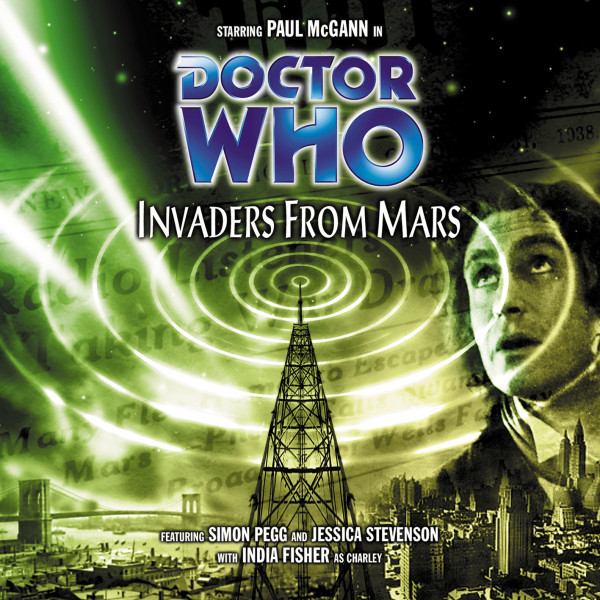
Imagine a detective noir, a gangster flick, a spy thriller, a tongue-in-cheek alien invasion saga—all dumped into a blender stuck on pureed chaos. That, my friends, is Invaders from Mars. It’s got style and energy in spades, but it’s so bloated it forgets who it’s even meant to entertain.
Let’s start with the good: Mark Gatiss clearly knows his 1930s New York pulp. The dialogue crackles like radio static, and Paul McGann’s Eightie Doctor slips into gumshoe mode with irresistible gusto. India Fisher’s Charley meanwhile… gets lost in the shuffle, which is a shame—she’s sidelined early and underused, never given room to shine. Honestly, her character deserves better.
The cast is stacked—Simon Pegg as gangster Don Chaney, Jessica Stevenson’s sultry Glory Bee, Orson Welles (yes, the Orson) voiced by David Benson—and they all turn in performances that nearly save the tsunami of subplots. There’s Captain Cosmo Devine, Moscow agents, secret labs, Nazis, mob bosses, spies, martians, atomic secrets—and soldiers dying from dropped script threads like caramel popcorn in a blender. The audio even punctuates every reveal with trumpets like it’s chewing through a comic strip, and while that can be fun, here it just becomes audio wallpaper after the third act.
And the plot? Think of a heist movie on crack: the Doctor and Charley dive in after a dead PI and a crashed UFO, entangling themselves with gangsters who stumbled onto alien tech. Then there’s the Russian scientist, the flamboyant Nazi columnist—whose “secret sympathies” feel half-baked—and Orson, who goes from aloof radio star to conspiratorial cameo. Meanwhile, the aliens (the Lederplacker species) are flying in to grab their gizmo back. Everything careens, gallops, and eventually crashes through Soviet plotlines, gangster diplomacy, Nazi intrigue, Orson radio theater… you name it.
At its core? A clever premise: what if the real invasion happened during Welles’s broadcast? But as the narrative careens, that anchoring joke gets buried. By the final act, characters are biting it left, right, and center—mere casualties in the writer’s rush to defuse unresolved storylines. Far from tension, it feels like story fatigue. Nothing is given room to breathe or hit emotionally.
This would’ve been a slick triple-act radio caper as long as they’d trimmed the fat and held onto a couple of storylines. Instead, it’s got more threads than a knitting convention—and none of them finish cleanly. The production design still sparkles with 1930s radio drama nostalgia: jazzage FX, cast laughter, crackling static. But style can only paper over so much.
Final Verdict:
Gutsy, audacious, occasionally hilarious—but overstuffed and undercut by its own ambition. A classic “too much, too late” scenario.
2 out of 5 narrative transmission failures