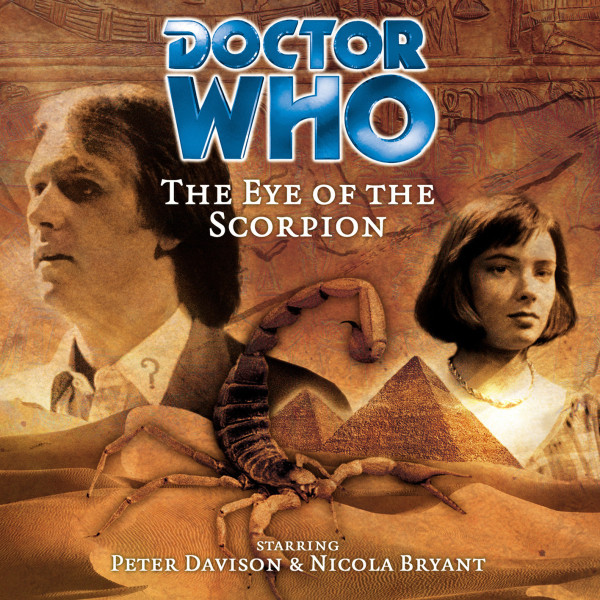
The Eye of the Scorpion


Before continuing, please be aware that all of this content is made possible by the goodwill and support of my backers on Patreon. If you enjoy the work on this site, please consider supporting the creation of more content like this by clicking the button.



Right, gather round, kids. Big Finish just dropped the Doctor Who equivalent of a BBC history doc presented by a time-travelling bisexual disaster and his American bestie, and it’s genuinely… pretty damn great.

So the TARDIS crash-lands in ancient Egypt—because of course it does—and wouldn’t you know it, the Doctor and Peri immediately stumble across a woman being hunted in the desert. That woman? Pharaoh Erimem. Yes, a Pharaoh. Yes, a woman. Yes, that is not how we remember history, but who are we to judge when Time is already spaghetti?

Erimem is instantly fascinating—regal, clever, a little arrogant, and completely unprepared for just how weird the Doctor’s life is. Honestly, it’s so refreshing to get a non-21st-century companion who isn’t a fawning sidekick or a romantic interest. She just stands there like, “You saved my life? Cool. Here’s my royal court, don’t trip over the human sacrifices.”

And Peri? Oh, my sweet Peri. She gets to shine here. Okay, yes, she has that one line about penicillin that makes you go “oh no, they’ve written her like a child,” but give it a minute. Her friendship with Erimem is actually the best part of the whole damn story. It’s tender, warm, curious—exactly the sort of TARDIS dynamic we don’t get enough of. It’s less “flirty banter” and more “let’s dismantle a patriarchal dynasty while discussing feminism and poison”. And honestly? That slaps.

Speaking of poison, there’s a whole bit where the Doctor gets taken out of the story for a while, which normally I’d be furious about—but here it works. It gives Peri and Erimem room to take the lead and get stuff done without the universe’s favourite space grandpa monologuing all over them.

The villain, though? Yanis. Oof. He’s got all the subtlety of a panto warlord crossed with a drunk gladiator. He bellows. He broods. He probably chews scenery off mic. But hey, sometimes a story needs a big, dumb bad guy to contrast with the political intrigue—and this is definitely a story where backstabbing is an Olympic sport.

And then there’s the twist: aliens. Obviously. It’s Doctor Who. There’s always aliens. But this one keeps them in the background just enough that they enhance the plot rather than smother it in goo and glowing crystals.

So what do we get in the end? A beautifully balanced historical sci-fi hybrid, some honestly great character writing, a surprisingly feminist undercurrent, and a companion exit that actually adds to the lore. Oh—and Erimem joins the TARDIS team. Thank Anubis.

Could it have pushed the envelope harder? Sure. Is it a perfect story? No. But it doesn’t need to be. It knows what it’s doing—and it does it with style.

Final Verdict:
The desert’s never looked so damn inviting.

4.5 out of 5 scorpion-stung headdresses

Project: Twilight


Before continuing, please be aware that all of this content is made possible by the goodwill and support of my backers on Patreon. If you enjoy the work on this site, please consider supporting the creation of more content like this by clicking the button.


Somewhere in a greasy East End alley, between the fish and chip wrappers and the stench of something half-dead, the Doctor and Evelyn stumble into Project: Twilight—and immediately wish they hadn’t.

This one’s grimy in a good way. Less “vampires in cloaks with a pipe organ” and more “vampires in tracksuits threatening you behind a dodgy casino.” It’s moody, modern, and absolutely wallowing in the kind of horror that makes your skin crawl—not because of the monsters (though they’re plenty horrific), but because of the people who made them.

This is the debut of The Forge, a sinister little black-ops group that basically looked at UNIT and said, “What if we were evil and allergic to consent?” The villains here aren’t moustache-twirling loons—they’re lab coats with no off-switch. People who treat human lives like petri dishes. And right in the middle of it is Cassie.

Let’s talk about her, because she’s what makes this story hit harder than it otherwise might. Cassie is just a girl trying to survive, caught in a nightmare she didn’t choose, and transformed into something monstrous against her will. What follows is not some sexy vampire power fantasy. It’s trauma. Plain and gut-wrenching. The way she breaks—slowly, then all at once—is handled with such raw realism that it cuts through the sci-fi sheen. She’s betrayed, used, and reshaped by people who see her as a tool, not a person. And yet she still clings to humanity, even as it’s bleeding out of her.

Evelyn’s bond with her is beautifully written—Evelyn, ever the moral compass, doesn’t treat Cassie like a monster but like someone who’s suffering. Her compassion is the antidote to everything else in this story: the coldness, the violence, the dehumanisation. A cup of cocoa never felt more like a middle finger to evil.

The story itself is tight, with a creeping tension that ratchets up steadily. The twist that the gangland cronies are literal vampires works surprisingly well, mostly because it doesn’t try to be subtle. They’re mean, territorial, and terrifyingly banal in their cruelty. You could imagine bumping into them at a dive bar and not realising they’d just drained a guy out back. That’s the horror. It’s close.

Enter Nimrod, our resident cyborg monster-hunter with the most unfortunate codename this side of an edgy X-Men issue. He’s technically terrifying but also slightly silly, like if the Terminator read Lovecraft and developed a superiority complex. Still, he works in context, and his scenes with the Doctor add an extra layer of dread.

The ending doesn’t totally land—things wrap a bit too neatly for a story steeped in this much blood—but the ride is worth it. There’s a weight here, a sadness that lingers long after the audio stops. This isn’t a story that sings, exactly, but it howls. Quietly. And in pain.

Final Thoughts:
Keep your neck covered and your empathy switched on.

4 out of 5 genetically-modified cockney bloodsuckers.

Bloodtide


This image has an empty alt attribute; its file name is support-us-on-patreon-button.png

Before continuing, please be aware that all of this content is made possible by the goodwill and support of my backers on Patreon. If you enjoy the work on this site, please consider supporting the creation of more content like this by clicking the button.


Right then: Bloodtide. You know it’s going to be an odd one when the TARDIS lands in the Galápagos Islands and the first person Evelyn meets is Charles Actual Darwin having an existential breakdown. And the first thing the Doctor does? Immediately senses Silurian shenanigans, because it’s not a Colin Baker story unless ancient reptiles are about to start lecturing you on natural history and genocide.

This is a story that plays it calm. No pantomime villains, no orchestral swells every time someone says “the future of humanity.” Just good old-fashioned quiet dread.

Evelyn is the MVP here. Again. Her dynamic with Darwin is the soft heart of the thing—part philosophy class, part therapy session, part “I’m too old for this but I’m doing it anyway” maternal support. She walks Darwin through the horrifying realization that evolution might not be God’s little clockwork hobby but instead a chaotic, brutal, and morally neutral system that ends in him. And then keeps going. It’s deeply human and played with so much sincerity that you almost forget there’s a secret reptile base underneath all this.

Meanwhile, the Doctor’s off negotiating with lizard monarchs and trying to talk down a Silurian leader who casually claims she cultivated the human race like a houseplant. She’s cold, arrogant, and disturbingly plausible. Her species has been asleep for millions of years and now wants the keys back, and honestly? Who can blame them. Humanity has not exactly been the best tenant.

This is Silurian territory through and through—moral ambiguity, ancient grievances, uneasy diplomacy. It echoes Doctor Who and the Silurians, but swaps out the Cold War tension for evolutionary theory and theological panic. The twist? Darwin is now part of the philosophical battleground. It’s not about guns, it’s about belief, responsibility, and who owns the future.

The sound design is effective without being overbearing (thank god after the migraine-inducing FX from Dust Breeding). The pacing’s measured—sometimes a little too measured—but it gives the characters space to have actual conversations rather than plot-dump at each other like caffeinated Wikipedia pages.

The flaws? Sure. The plot’s familiar. Some side characters don’t leave much of a mark. The whole “Silurians as genetic overlords” angle is interesting, but it doesn’t quite get the thematic deep-dive it’s begging for. And the ending, while emotionally satisfying, wraps things up a bit too neatly.

But Bloodtide knows what it is. It’s not here to reinvent the fossil record. It’s here to reflect, to let Evelyn shine, and to watch Charles Darwin quietly lose his mind in real time while Colin Baker delivers ethical monologues in a rainbow coat.

Final Thoughts:
Would recommend, especially if you like your Doctor Who thoughtful and slightly sad.

4 out of 5 evolutionary crises.

Dust Breeding


Before continuing, please be aware that all of this content is made possible by the goodwill and support of my backers on Patreon. If you enjoy the work on this site, please consider supporting the creation of more content like this by clicking the button.


Okay, look. I am so here for haunted paintings, the Master in masquerade drag, Ace being a punk, and deserts that scream. I mean, that sentence alone? I’d marry it. But Dust Breeding somehow takes all of that delicious gothic nonsense and turns it into the sonic equivalent of licking a Hoover.

The setup is promising in that “ooh spooky art gallery in space” kind of way. The Doctor and Ace arrive on a dust-covered planet plagued by psychic screams and sandstorms so loud you’d swear Big Finish just sat on the volume knob and never looked back. They’re chasing after Edvard Munch’s The Scream, which in this version is apparently a cursed painting full of ancient evil. Love that for it. Unfortunately, said evil is a telepathic dust-entity called the Warp Core—which sounds like a rejected Star Trek joke and acts like a migraine with voice lines. It doesn’t do much, it just floats around whispering “be afraid” and making actors overact like they’re auditioning for Hamlet in a wind tunnel.

Then there’s the masked figure, who’s obviously the Master in a bad Phantom of the Opera cosplay. They drag out the “mystery” of his identity like it’s some dramatic rug-pull when it’s about as subtle as a Dalek in a tutu. And what’s his master plan? To coax the dusty scream-monster into becoming… a slightly bigger scream-monster? So he can control it? Or maybe just vibe with it? Who knows. He and the Doctor basically yell psychic threats at each other while the actual resolution is handed off to a random side character like, “Oh, you had a bomb? Cool. Guess the plot’s over.”

The real kicker here is the sound design. It is unhinged. I don’t know if they mixed this story during a power outage or in the middle of a leaf blower convention, but the background noise is CONSTANT. The storm never stops. There’s this high-pitched screaming that loops like a cursed ringtone. It’s supposed to be atmospheric, but it just turns the whole thing into a game of “what did Ace just say? Turn it up, I still can’t hear her.” It’s audio claustrophobia, but not the cool kind.

Even the performances feel like they’re screaming over the storm. Everyone’s cranked to eleven with big feelings and bigger vocal cords. The Warp Core manipulates people into becoming Shakespearean lunatics, which is… a choice. Ace barely gets to be Ace, and the Doctor spends most of the runtime moodily brooding in the background like he’s in a Nine Inch Nails music video.

Final Thoughts:
This is one of those rare stories where the concept should be a banger but the execution trips over its own dusty shoelaces. You could listen to it. But you could also stick your head in a vacuum cleaner and get a similar experience.
1 out of 5 tragic Munch faces. Let this one scream in peace.