Before continuing, please be aware that all of this content is made possible by the goodwill and support of my backers on Patreon. If you enjoy the work on this site, please consider supporting the creation of more content like this by clicking the button.
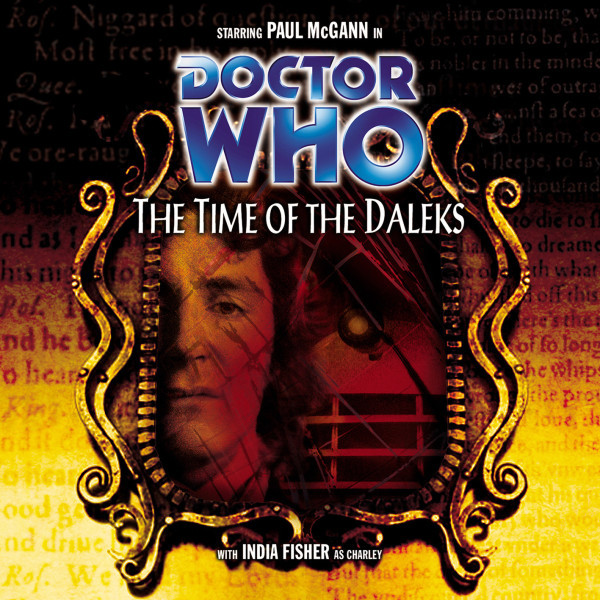
Okay. So. Picture this: Shakespeare, gone. Wiped. Not just dead—he never existed. Nobody remembers his name, not even Tennant. Libraries are empty. Theatre departments weep into their ruffled collars. The Doctor, naturally alarmed at the prospect of a world without iambic pentameter, hauls Charley off to a post-apocalyptic Britain where everything’s gone a bit Children of Men by way of BBC Radio 4. The roads are quiet, the Empire’s clinging to the wallpaper, and General Mariah Learman—cultural LARPer, time machine hoarder, and part-time fascist—is about to get a lesson in dramatic irony. Her tutors? The Daleks, who are so obviously evil from frame one it’s like watching the Scooby Gang pretend that the guy in the Dracula mask isn’t the villain.
And the thing is—it should work. Daleks quoting Shakespeare? That should be catnip. The Bard through a ring modulator? Yes please. Time travel via magic mirrors, paradoxes blooming like paradox-flowers in paradox-fields, and McGann doing his floppy-haired best to hold it all together? There’s enough on this buffet table to promise a feast. But what we get instead is more like a lukewarm finger sandwich with the crusts already curling. The story just… doesn’t land. It wants to be clever. It wants to say something about cultural memory, the myth of empire, the way we cling to art like it’s a lifeline while the world burns—but it never quite hits the rhythm. Shakespeare’s absence should feel like a cosmic wound. Instead it’s just… a plot device. A very polite, well-behaved plot device.
Learman is interesting in concept, if a little arch. Her obsession with rescuing the past and preserving a Shakespearean England that probably never existed anyway is loaded with metaphor. Cultural control through time travel. The weaponisation of nostalgia. The dangers of tying identity to a static vision of history. It’s all in there—but the play never lets her really sing. And once the Daleks go full Dalek (which takes ages, despite all the foreshadowing yelling “HELLO! HI! WE’RE THE BAD GUYS!”), the story loses interest in nuance entirely and just drifts toward a conclusion like a balloon with a slow leak.
The Doctor is fine. Charley’s fine. The supporting cast… fine. It’s all fine. But this is one of those stories that feels like it needed another draft—or maybe just someone to shake it and say “this is cool, but can we care more?” The pacing’s off, the stakes feel nebulous, and the whole thing stumbles where it should have soared. Even the Daleks don’t feel all that threatening—they’re just sort of around, like interns in a Shakespeare-themed escape room who’ve forgotten what the puzzle was supposed to be.
Final Verdict
Look, it’s not bad. It’s just limp. There’s enough here that you can see the story it could’ve been—sharp, eerie, weighty. But the finished product feels like a shadow of itself. Polished, sure, but hollow. This is the kind of tale that makes you want to grab the script and scribble in the margins, “more teeth please.”
2.5 out of 5 propaganda mirrors.