

Before continuing, please be aware that all of this content is made possible by the goodwill and support of my backers on Patreon. If you enjoy the work on this site, please consider supporting the creation of more content like this by clicking the button.
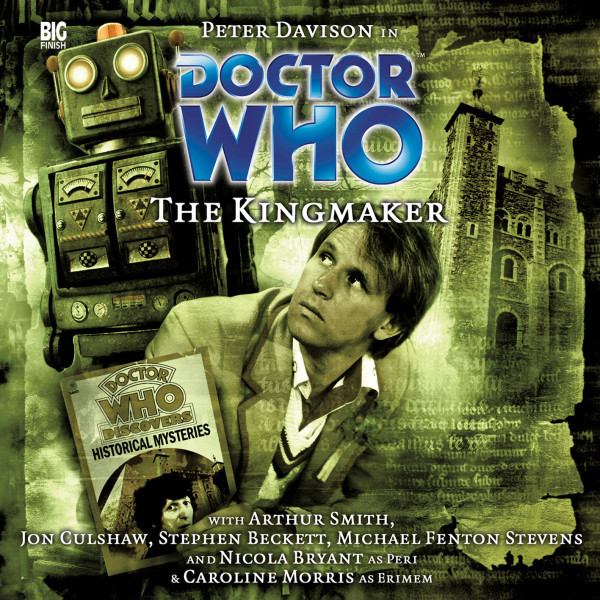
The Kingmaker is fiesta-history warfare with a side of meta nonsense—and I’m mostly here for it. This is the Fifth Doctor, Peri, and Erimem getting shoved into England’s worst rumor mill: Richard III, the Princes in the Tower, Shakespeare, robots publishing books, and more paradoxes than a student essay at 2 a.m. It doesn’t quite outshine The One Doctor, but it’s more coherent, more cheeky, and laughs in the face of “serious historical drama.”
From the off, you know you’re in for a ride when the Doctor is chased by a publishing robot demanding he finish his “Doctor Who Discovers Historical Mysteries” books. That, right there, sets the tone: this will be a story about history, myth, and control of narrative. Meanwhile, Peri and Erimem tumble into that tangled jungle of time, chase ghosts of princes, and watch Shakespeare get tangled in his own plays. The plot twists enough to make you blink and go, “Wait, did Shakespeare just swap places with Richard III? Did the Doctor just change how history remembers the Tower?” And yes—he does.
Stephen Beckett’s Richard III is a delight. He’s simultaneously snarling, wounded, weary, and exasperated. He’s been meeting so many time-travellers preaching “you murdered your nephews” that he’s become cynically practiced at it. He bristles at the way history treats him, and Fountain uses that to ask: how much is history rewritten by myth, by popular culture, by who gets to tell the story? Mr. Seyton, a suspicious advisor, plays the role of hidden manipulator well, and there’s a consistent running gag about codpieces and mechanical anachronisms that lands more often than you’d expect. The guests—including Jon Culshaw as Earl Rivers and the impromptu Fourth Doctor voice recording—add fun layers of intertextual homage and parody.
Comedy in The Kingmaker isn’t broad punchlines; it’s whispers, sideways jabs, bizarre logic loops. Shakespeare is mailed drunk letters, characters leap through time to deliver letters to themselves, the Doctor struggles with literary deadlines like a stressed author, and yes, there’s talk of the Master and Satan because of course. There’s delight in absurdity. It doesn’t always land, but when it does, it hits with a grin.
Yet it’s niche. You need to know your English monarchy, your Shakespeare, your Tudor conspiracies, and have some patience for time-splitting logic. If you don’t, parts will just spin past, and the robot publishing shtick might feel bizarre rather than clever. Some jumps in time feel a little too convenient, motivations get hazy, and the balance between comedy and drama tilts sometimes awkwardly. The story occasionally lingers too long on explanation when it should just stab you with emotional moments.
Themes: control of history and myth, identity vs legacy, narrative authority, how the past is dragged into the present by storytellers and power. The Kingmaker asks: who gets to define history? Who is the villain when everyone is being written into a script? Also, time travel responsibility—if you can step in and tweak memory, you risk erasing truth.
Final Thoughts:
I came in thinking “comedy historical? Uh oh.” But I left grinning, tangled in paradox, wishing the script had been tightened in parts. It’s not flawless, but I love that it tries—that it juggles roistering fun with serious questions about myth and memory.
Rating: 4.5 out of 5 codpiece-clanking historical paradoxes.