

Before continuing, please be aware that all of this content is made possible by the goodwill and support of my backers on Patreon. If you enjoy the work on this site, please consider supporting the creation of more content like this by clicking the button.
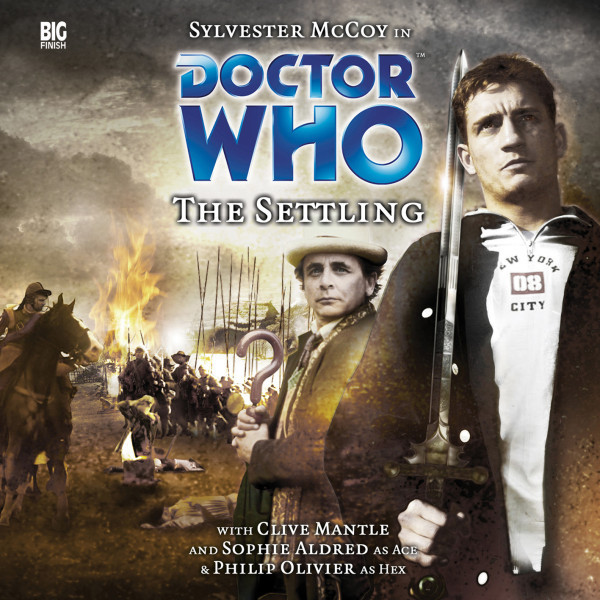
I’ve got Irish and Scottish grandparentage, so stories that drag Oliver Cromwell out of history’s sewer hit me like a punch. The Settling dares to drop the Seventh Doctor, Ace, and Hex into 1649 Ireland—Drogheda, to be precise—during Cromwell’s genocide. This is not glossed over; it’s brutal, messy, morally gross, and in some ways exactly the kind of Doctor Who I want when we confront history at its ugliest.
But here’s the problem. Doctor Who, as a franchise, has always been the polite face of English colonialism dressed in a velvet coat and talking about “the sanctity of time.” The Doctor’s whole ethos—“history must proceed as it should”—is just temporal imperialism with good lighting. He doesn’t rewrite atrocities; he observes them, wrings his hands, and mutters about fixed points. He tells people not to fight back because “violence solves nothing,” which, when you’re standing in the middle of a massacre, is the moral equivalent of handing someone a napkin during an airstrike. In The Settling, this makes him look painfully naïve. Sylvester McCoy plays him beautifully—gentle, sorrowful, trying—but the story itself quietly exposes the hypocrisy of his philosophy.
The plot: The Doctor, Ace, and Hex arrive just before the siege of Drogheda. They’re separated early—Doctor ends up caring for Mary (a pregnant civilian), Ace joins Irish defenders, Hex meets Cromwell face to face, trying to reason with him. Cromwell’s troops promise no harm to civilians and children, but we all know what that promise is worth. Soldiers laugh off the idea. Unarmed Kieran is executed even after laying down weapons. The blood flows. Civilians are killed. Ace is horrified. The Doctor tries medicine and midwifery in battle. Hex is tortured, broken. Mary almost dies from a gunshot, gets saved in a chaotic, miraculous moment. Cromwell, for all his complexity, remains irredeemable, cruel. The event ends with Cromwell ordering Hex to be released, but only barely; but the hovering horror of what was done—bodies in streets, smoke, cries—stays with you. The framing device has Ace and Hex later looking back on it, wounded in body and soul, as all of us who know this history feel the scars.
What works: the story earns its violence. It doesn’t shy away. Big Finish uses sound design and atmosphere to make the massacre of motley civilians feel close. There are screams, mud underfoot, rain, gunfire, dying bodies strewn over fields. The music—Irish-tinged, mournful, violin-cutting—makes you ache. Phillip Olivier’s Hex is magnificent here: his morality is tested, his horror is raw, his fear legitimate. Ace is thrown into a position where she has to confront the failsafe Doctor speech (“you can’t change history”) and wonder if silence is complicity. The Doctor is more than just fixer; he’s every bit the witness, guilt, caretaker. The story gives civilians faces—Mary, Kieran, the unarmed, the pregnant. That matters. Cromwell is shown as a man of iron will, religious belief, political calculation—but never as a good man redeemed. That matters too.
What doesn’t land: the ending peters out. After all that build, the final moments give relief, but less catharsis. The lament is strong, but the script doesn’t push the emotional reckoning as far as it might’ve. Also, while Cromwell is frightening and morally monstrous, the story doesn’t always show what his soldiers also believed or how English ruling class ideology enabled them. It sometimes isolates the cruelty as Cromwell’s alone rather than a system. Given your history background, I wished the script had leaned harder into why people believed him, the justifications, the theology, the rhetoric of colonization. Also, the story underplays how utterly large the atrocity was. Drogheda is horrifying, but the narrative foregrounds a handful of characters rather than the full scale of suffering. That’s fair for drama’s sake, but it means the story doesn’t knock you off your feet as completely as it might.
Still, The Settling is a bold and necessary story. It acknowledges that some wounds are too deep for clever speeches or sonic screwdrivers. It remembers that history was written by the people holding muskets, and for once, it lets us hear the people being crushed beneath them. It’s a rare moment when Doctor Who stares into its own moral reflection and doesn’t blink.
Final Thoughts:
The Settling is grim comfort. It’s not easy, and parts of it feel like the story is straining under its own weight, but it does something rare: it gives horror breathing space, faces to history, refuses to let Cromwell be mythologized or sanitized. It makes you feel, morally and emotionally, what many gloss over. For me, it’s one of the best historical Doctor Who stories—not because it’s perfect, but because it cares.
Rating: 4 out of 5 rose-stained sabres and the cry of unborn hope.