

Before continuing, please be aware that all of this content is made possible by the goodwill and support of my backers on Patreon. If you enjoy the work on this site, please consider supporting the creation of more content like this by clicking the button.
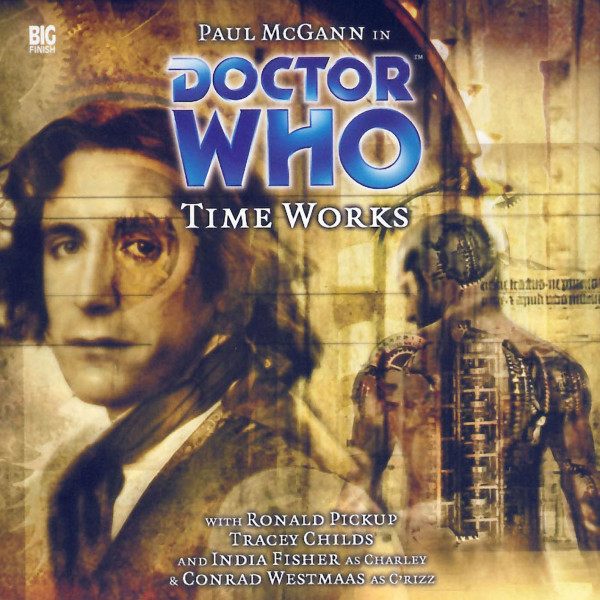
Time Works drops the Eighth Doctor, Charley, and C’rizz onto a planet where time itself is a factory. Time is measured, timed, managed, kept, rationed. Clocks everywhere. Industry and clockwork as culture. And when the TARDIS arrives, none of that order wants to make room for strangers. The trio wind up partially displaced — Charley and C’rizz find themselves in an interstitial realm “between seconds,” where clockwork men manipulate the world, while the Doctor moves through the regular timeline trying to catch up. The seconds are already counting down to a future that has already happened.
The ambition here is high. The notion that time can be a machine, that people are cogs to be wound, that redundancy kills you — these are harsh and resonant ideas. The mythology of “Time Keepers,” Great Clock, clocks as gods, citizens who “wind down,” people mocked as “time-waster” — these touches give the world flavor. There’s also a dramatic tension in the displacement of Charley and C’rizz: when they can “touch” the Doctor, it’s only at timeline intersections, placing them at odds and making their rescue feel fragile and urgent.
But — and yes, there’s a but — much of the script leans into its quirks to exhaustion. Dialogue is littered with overwrought clock puns. People complain “you’ve not got the cogs,” or “my arms are winding down,” or that something didn’t happen “in a tick of a tock.” It starts charming, then becomes tiresome. That constant language layering wears you thin. I kept thinking: “We get it. Time is mechanical. Now do something with it.”
Secondary characters are underwritten. The antagonists, the timekeepers, the collateral victims — many exist just as voices in the machine, not real people. The story is so focused on the machinery and the metaphor that human stakes often feel sidelined. The “revolution” subplot—that people oppressed by overstrict time regulation might rebel—is there, but never fully fleshed out, pushed to the margins. The conclusion feels inevitable, somewhat anticlimactic: the machine breaks, the rules shift, the “system” topples. But emotionally, by that point, I was worn out.
It also feels like leftover Divergent Universe DNA. Time Works has the tonal hollow feel of stories originally intended for that arc, repurposed for the regular range. The world may be conceptually strong, but the story is missing connective tissue: the “why now,” the costs of intervention, the internal change in characters. Without those, you’re watching gears grind, not hearts break.
The music and atmosphere try their best: ticking ambient scores, creaking clockwork, winds blowing, echoes of deserted halls. There are moments where you forget the flaws and feel immersed in the time-machinery. But these produce flickers, not a sustained blaze.
Final Thoughts:
Time Works has a giant, brutal, unsettling idea at its heart. It toys with identity, oppression, mechanised time, the grind of routine as spiritual death. But it never quite turns that toy into a weapon. Frustrating, because you sense what could have been there. Instead, it slides into slog. You respect the attempt. You wish it had sharper edges.
Rating: 1.5 out of 5 half-wound clockwork men.