The Silver Turk


Before continuing, please be aware that all of this content is made possible by the goodwill and support of my backers on Patreon. If you enjoy the work on this site, please consider supporting the creation of more content like this by clicking the button.


The Silver Turk clanks onto the stage in nineteenth-century Vienna wearing a velvet opera cape over cold metal horror and immediately goes “hello yes would you like existential dread with your gothic melodrama?” and honestly? That’s my kind of evening.

We’ve got Paul McGann’s Eighth Doctor at peak Byronic disaster genius levels, paired with Mary Shelley as a companion, which already feels unfairly overpowered. Like the universe looked at gothic science-fiction and said “what if we simply weaponised atmosphere?”

And atmosphere is EVERYWHERE in this thing. Foggy streets. Candlelight. Decaying grandeur. The constant sense that science has wandered somewhere it absolutely should not have gone and is now pretending everything’s fine while body parts twitch ominously in the corner.

Also: Cybermen. Or… sort of Cybermen. Because the genius move here is that the Cybermen aren’t actually the core threat. They’re almost the symptom. The real villain is the deliciously unhinged mad scientist energy at the centre of the story, all ambition and obsession and “I can transcend death if I simply ignore several ethical boundaries and most of human morality.” Classic. No notes.

The plot follows the Doctor and Mary arriving in Vienna and stumbling into a series of strange disappearances and experiments surrounding the titular Silver Turk, an automaton inspired by the historical chess-playing machine. Except this version has a little more corpse-adjacent nightmare fuel attached to it.

And what I love is how naturally the Cybermen fit into the themes. This isn’t just “oh look, Cybermen in corsets.” The story digs into the overlap between early scientific ambition and Cyber-conversion ideology. The fear of mortality. The desire to perfect humanity by stripping away weakness. The arrogance of believing suffering can simply be engineered out of existence.

Very Frankenstein. Which is PERFECT when one of your leads is literally Mary Shelley. And honestly? She’s fantastic here. Not just “historical celebrity companion” fantastic, but genuinely layered. Intelligent, compassionate, quietly haunted. The script gives her room to challenge the Doctor intellectually and morally, and Paul McGann plays off her beautifully. Their chemistry feels natural in that specifically Eighth Doctor way where half the scenes sound like flirtation between two people discussing cosmic horror over wine.

Meanwhile McGann himself is, unsurprisingly, excellent. Warm one second, ancient and quietly terrifying the next. He gives the story this emotional richness that smooths over the occasional structural wobble.

Because okay, critiques. The story is VERY good. Impressively so. But you can feel it brushing up against greatness without fully crossing the threshold. And that’s frustrating because all the ingredients are THERE.

The themes are rich enough to sustain something truly transcendent. Identity, mortality, the ethics of technological progress, humanity’s obsession with conquering death. This could have been one of those stories that stops being “great Doctor Who” and becomes “great science fiction, full stop.”

Think those rare moments in Star Trek where an episode escapes franchise gravity entirely and becomes timeless speculative fiction on its own merits. The Silver Turk gets SO close to that level I could scream.

But it doesn’t quite push far enough. It resolves a little too neatly. Some concepts that could’ve been explored more deeply instead stay comfortably within the bounds of “excellent franchise storytelling.”

Which still leaves us with an atmospheric, thoughtful, emotionally engaging Cyberman story that absolutely obliterates most of the competition. It just stops one step short of immortality.

Final Thoughts
A rich, gothic, beautifully produced Cyberman story elevated by strong performances, smart thematic work, and fantastic chemistry between the Doctor and Mary Shelley. Not quite the genre-defining masterpiece it could have been, but still exceptional Doctor Who.

4.5 out of 5 ethically catastrophic clockwork science projects fuelled entirely by grief and terrible ideas 
House of Blue Fire


Before continuing, please be aware that all of this content is made possible by the goodwill and support of my backers on Patreon. If you enjoy the work on this site, please consider supporting the creation of more content like this by clicking the button.


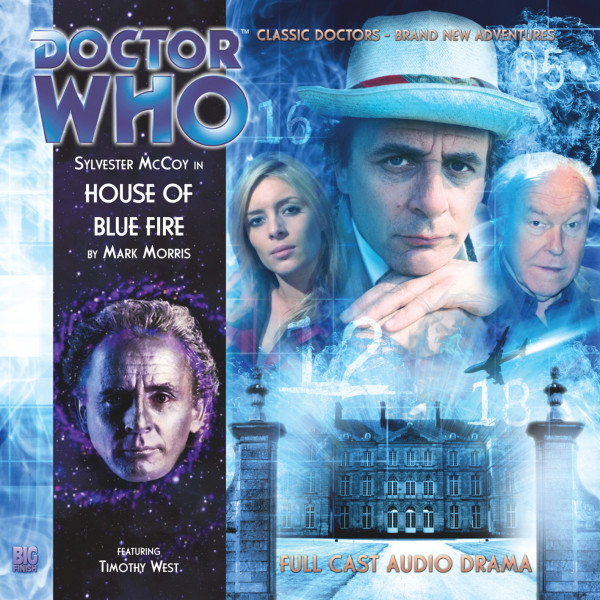
House of Blue Fire creaks open its gothic doors, candles flickering, shadows stretching like they’ve got something to prove, and I’m immediately like YES give me haunted manor energy, give me creeping dread, give me characters unraveling under psychological pressure…

…and then it just sort of… stalls. Like a ghost dramatically entering a room and then forgetting why it’s there.

We start strong. A mysterious manor. A cast of guests, each carrying their own bespoke nightmare like emotional baggage with teeth. The atmosphere is doing the heavy lifting here and honestly? It’s GOOD. Properly eerie. You can feel the tension, the sense that the house is watching, listening, tailoring itself to its occupants’ worst fears.

It’s giving haunted house. It’s giving therapy session from hell. I am INTO it. But here’s the catch. Where is Sylvester McCoy? No, seriously. I checked behind the curtains. I checked under the ominous staircase. I checked inside the metaphorical trauma. Man does not show up until the END of the first episode. Which is… a choice.

So for a good chunk of the story, we’re just vibing with these characters, watching them react to spooky happenings, and while that’s fine in theory, it drags. There’s only so many times you can go “ooh unsettling” before your brain goes “okay but where is this GOING?”

And then we hit the twist. The house isn’t real. It’s a simulation. A constructed environment. The guests are actually soldiers being experimented on to create psychic weapons, because apparently the military looked at “trauma” and went “what if we weaponised that?” which is… uncomfortably on brand.

Also lurking in the mix? An ancient Gallifreyan entity embodying primal fear itself, because why have ONE concept when you can have THREE stacked on top of each other in a trench coat.

Now, on paper? This is GREAT. Layers of reality, fear as both weapon and weakness, the ethics of turning people into tools, and the Doctor trying to pull them out of it before they’re completely broken.

In execution? …oh dear. Because the pacing is a MESS. The first two parts stretch themselves thin, padding out atmosphere without enough progression, and then the third part just panics and dumps EXPOSITION all over you like it’s trying to apologise for the first half. It’s whiplash. Emotional, structural, possibly spiritual whiplash.

“Here is the mystery.” “Here is more mystery.” “Here is even MORE mystery.” “HELLO EVERYTHING IS EXPLAINED NOW PLEASE KEEP UP.” I am TRYING.

And the characters, while initially intriguing, don’t quite get the depth they need to really land the emotional punch. They’re defined by their fears, which is thematically appropriate, but it means they don’t always feel like fully rounded people beyond their assigned trauma package.

When Sylvester McCoy finally gets going, he does what he always does best, weaving through the chaos with that slightly sinister, knowing edge. But even he can’t fully stabilise the structure when it’s wobbling this hard.

And the resolution? “Defeat fear by not giving into fear.” Yes. Thank you. Groundbreaking. Truly we have solved psychology. Okay that’s unfair. It works on a thematic level. It just feels… undercooked. Like it needed more time to develop the ideas properly, or less time padding the setup.

Final Thoughts
A story bursting with strong ideas and eerie atmosphere, but dragged down by uneven pacing and a structure that front-loads mystery then speedruns explanation. There’s something great in here. It just never quite fully ignites.

2 out of 5 haunted mansions that are actually trauma simulators but still somehow feel underfurnished

The Doomsday Quatrain


Before continuing, please be aware that all of this content is made possible by the goodwill and support of my backers on Patreon. If you enjoy the work on this site, please consider supporting the creation of more content like this by clicking the button.


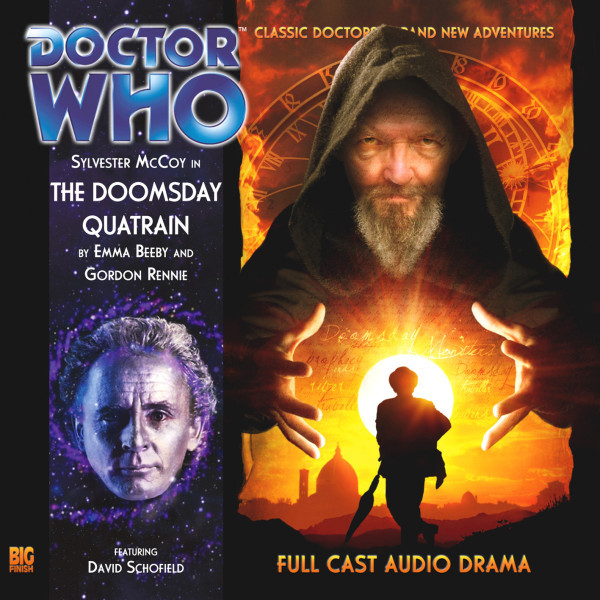
The Doomsday Quatrain is the 151st of these audio plays I’ve listened to, and it strolls into Renaissance Italy with a lute in one hand and an apocalypse in the other, winks at you, and goes “don’t worry, it’s only the end of the world… probably,” which is exactly the kind of chaotic energy Sylvester McCoy thrives on.

So, picture this. The Doctor rocks up, meets Nostradamus, and is immediately told “ah yes, I have foreseen the end of everything.” Standard Tuesday. Except this time, the universe goes “actually, yes, we’re doing that now,” and suddenly we’ve got crocodile-esque aliens invading like they’ve taken a wrong turn at a historical reenactment.

At first glance, it’s playing things very straight. Prophecy. Doom. Renaissance setting. Big scaly invaders ruining everyone’s day. You’re settling in like, okay, I know this rhythm, I know this beat.

And then the story just casually leans over and whispers, “by the way, none of this is real.”

Because the twist, and it’s not even hiding it for long, is that this isn’t Earth. It’s a simulation. A fully fabricated Renaissance playground populated by synthetic people, including Nostradamus himself, rented out by a third-party alien race so some other aliens can practice invasion tactics like it’s the galaxy’s most ethically questionable training simulator. Which is WILD.

And also where the story lives or dies. Because instead of holding that reveal back like a big mic-drop moment, it just… tells you. Early. Very early. We’re barely settled before the curtain is pulled back and the narrative goes “here’s how the trick works.”

Now, on one hand, bold choice. It shifts the focus away from “what’s happening?” to “how do the characters respond to what’s happening?” On the other hand… yeah, you do feel that lost potential. There is a version of this where the reveal hits later and absolutely floors you.

Still, what it lacks in surprise, it makes up for in character. Sylvester McCoy is in full manipulative chessmaster mode, but with that slightly whimsical edge that keeps him from tipping into full cosmic menace. He knows more than he’s saying, as always, and watching him navigate a world that isn’t real but still matters is where the story finds its teeth.

And then there’s Nostradamus. Genuinely the MVP here. Because he knows. Not in a vague, mystical “I sense doom” way, but in a creeping, existential “I am predicting the end of a world that only exists because someone rented it” way. His prophecies stop being dramatic flair and start being… awareness. Self-awareness. And that’s where things get properly interesting.

Because what does it mean to foresee your own non-existence when your entire reality is already artificial? Fun! Light! Totally not going to spiral about that later!

The supporting cast do solid work selling the stakes, even when those stakes are technically happening inside what is essentially a very elaborate alien sandbox. The performances carry the emotional weight needed to make you care, even when the plot is going “none of this is technically real,” which is always a tricky balancing act.

Critically though, it does feel a bit front-loaded. The early reveal robs some tension, and the pacing occasionally dips into “explaining the concept again just in case you missed it” territory. You get it. Simulation. Layers. Ethics. Move on.

But when it leans into the emotional core, especially through Nostradamus, it really works.

Final Thoughts
A clever, concept-driven story that sacrifices a killer twist for early transparency, but still lands thanks to strong character work and a quietly unsettling central idea about reality and awareness.

3.5 out of 5 deeply concerned Renaissance prophets slowly realising they’re in a cosmic training simulator

Recorded Time


Before continuing, please be aware that all of this content is made possible by the goodwill and support of my backers on Patreon. If you enjoy the work on this site, please consider supporting the creation of more content like this by clicking the button.


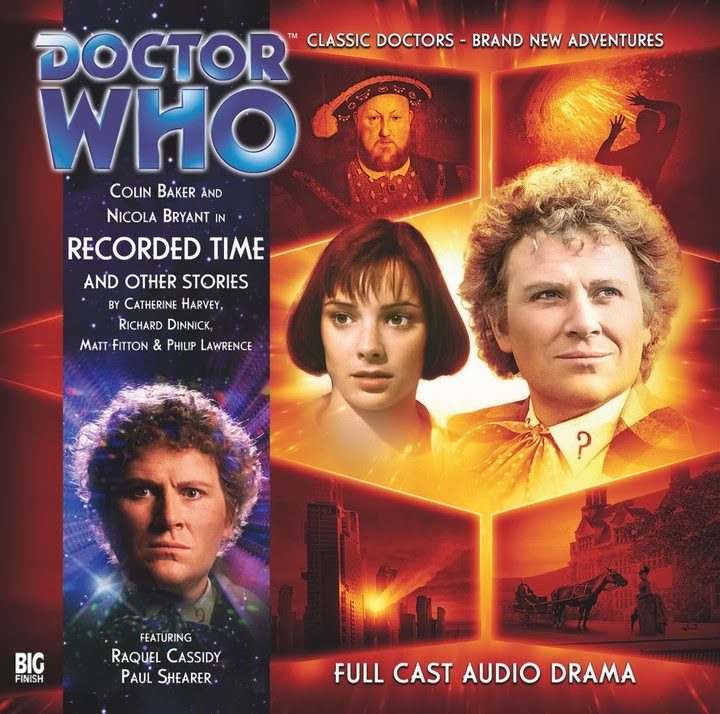
Recorded Time and Other Stories is the 150th of these I’ve listened to. Jesus. This collection is what happens when Colin Baker and Peri Brown get handed four completely different narrative toys and told “go on then, break them in interesting ways,” and honestly? It’s a mixed bag, but the kind where at least two of the items are secretly incredible and one is… well. We’ll get there.

The first story, Recorded Time, kicks off in the court of Henry VIII, which already feels like a playground for Six and Peri. Big personalities, political chaos, and the Doctor absolutely refusing to behave himself in front of royalty. Delicious.
The central hook is fantastic. A royal scribe is being forced to literally write the king’s future into existence. Not metaphorically. Actually. And the story leans into that with this lovely blend of historical intrigue and timey-wimey meddling. It’s clever, it’s funny, and it feels like it could sustain something bigger. Like you could spin this into a full four-parter and just let it breathe.
Performances are sharp, dialogue snaps, and the whole thing balances humour with genuine stakes in that very Sixth Doctor way where everything is slightly heightened but still grounded enough to care.
Final Thoughts
A witty, energetic historical with a brilliant central concept that absolutely could have supported something bigger, but still shines in short form.
4.5 out of 5 increasingly stressed Tudor scribes rewriting the king’s bad decisions in real time

Next up is Paradoxicide and… Oh no. We go from “clever historical sci-fi” to “time paradox soup but someone forgot to season it.”
The Doctor and Peri land on Sendos, where there’s a paradox involving an all-female military force, a bunker, and a distress call from Future Peri. Which should be intriguing. SHOULD be.
Instead it’s… clunky. The time mechanics feel like they’re being explained with a shrug and a whiteboard that’s already been erased twice. The gender stuff? Painfully on-the-nose in a way that feels dated rather than insightful. And the whole thing just sort of trudges along like it’s tired of itself.
There are ideas here. You can see them. They just never quite assemble into something engaging.
Final Thoughts
A muddled and frustrating entry that never quite gets its paradoxes or its themes to line up in a satisfying way.
2 out of 5 time paradoxes that needed at least one more editing pass and a strong cup of tea

After that, we have A Most Excellent Match. Okay, this one is just having fun and I respect that.
The Doctor and Peri get dumped into a virtual reality mash-up of classic literature, hopping between things like Wuthering Heights and Jane Eyre, while being hunted by a villain who keeps re-skinning himself as various brooding literary men. It’s chaotic. It’s theatrical. It’s a bit indulgent.
And the cast clearly has a GREAT time with it, switching tones and styles like they’re in an acting showcase. If you’re deeply into the source material, there’s a lot to enjoy in the pastiche. If you’re not, it’s still entertaining, just maybe not as rich. It doesn’t go especially deep, but it doesn’t need to. It knows exactly what it is, and it commits.
Final Thoughts
A playful, theatrical romp that leans hard into literary parody. Not deep, but undeniably fun.
3.5 out of 5 aggressively dramatic literary heartthrobs lurking in digital moors

Finally we have Question Marks. Oh. Oh THIS is the good stuff.
We open on pure confusion. The Doctor, Peri, and a handful of others wake up with no memory, trapped in a collapsing underground station, trying to piece together who they are and what’s going on. It’s tense, it’s stripped back, and it trusts the audience to keep up.
And then the twist lands. They’re copies. The originals already escaped. These versions, the ones we’ve been following, are effectively echoes left behind to die. EXCUSE ME???
It’s bleak. Existential. Quietly devastating. There’s a real SOMA energy here, that same question of identity and continuity and whether being a “copy” makes your experiences any less real. The answer, emotionally, is a resounding NO and that’s what makes it hurt. This is Doctor Who doing proper sci-fi. Thoughtful, unsettling, and willing to end on a note that doesn’t neatly resolve.
Final Thoughts
A standout piece of science fiction that delivers a genuinely haunting premise and sticks the landing with brutal elegance.
5 out of 5 doomed duplicate consciousnesses having a truly terrible day