

Before continuing, please be aware that all of this content is made possible by the goodwill and support of my backers on Patreon. If you enjoy the work on this site, please consider supporting the creation of more content like this by clicking the button.
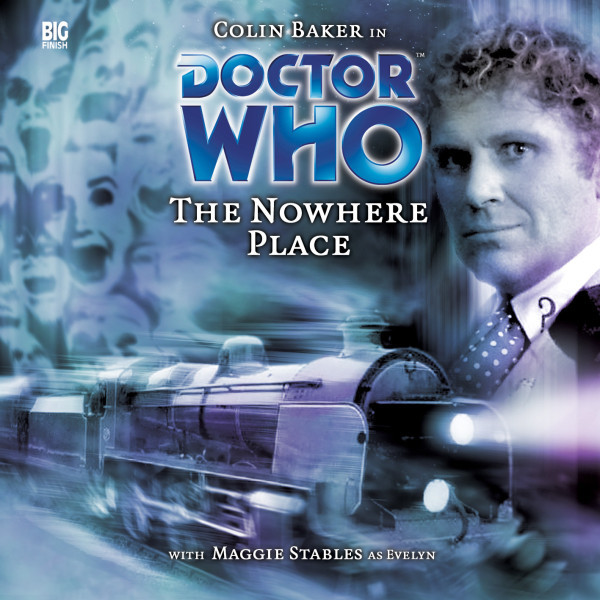
The Nowhere Place lands the Sixth Doctor and Evelyn smack between two strange timelines—2197 aboard the carrier Valiant in orbit beyond Pluto, and 1952 on a steam train, hurtling through the night with secrets tucked between its cars. It’s horror, cosmic mystery, and old-school Doctor Who all for one—to be honest, I really liked this one. Evelyn shows up again (with no explanation, and I’ll take it), and that pairing with Colin Baker in a horror frame is a rare delight. The horror here isn’t about monsters so much as the unknown, the uncanny, the shiver you feel when doors don’t lead where they should.
From the start the air is wrong. The crew of the Valiant hear a bell. They sense something. They don’t believe it, but they hear the echo, the resonance. Then there’s the door—ancient, spectral, impossible. Open it, and you step into “nowhere,” a place that is literally absence, that unbeing. On the 1952 train, passengers vanish, documents slip, shadows stretch. The juxtaposition of spaceship and steam engine, futurism and history, gives the story wings. It feels like the Doctor stepping over his own timelines and being unmoored from certainty.
One of the strongest elements is how the Doctor is pushed beyond confidence. The Sixth Doctor often leans into arrogance, into the “I know more than you” posture. But here, that veneer cracks. He’s afraid. He guesses. He seeks, uncertain, as Evelyn stares at corridors and phantom shapes, as faces flicker, as she sees screaming eyes behind walls. That sense of not knowing is the core of the horror. The imagery helps: halls folding into themselves, faces in doorways, distant bells, the train whistle in impossibility, Evelyn’s voice becoming alien, the scale stretching beyond years. The story borrows from 2001: A Space Odyssey in its vastness, its suggestion of something so old no mind can fully contain it.
Performances are mostly sharp. Baker is more vulnerable than he often is; Evelyn is human anchor, fearful but brave. The cast around them—Hayman, the crew, the voices in corridors—add texture. The sound design is a marvel: that bell, the door’s hum, the rail wheels, breathing halls, ghost echoes. The way space, time, and reality fray is audibly atmospheric.
Sound design deserves its own ovation. The echoing clang of that phantom train bell against the silence of space — goosebumps. The way the two time periods overlap, sound bleeding from one reality into the other, gives it that wrongness you can’t quite name. And the pacing… up until the finale, it’s near perfect: deliberate, eerie, and full of that rare “what the hell is happening” tension Doctor Who sometimes forgets it can do.
Yes, the ending skids a little. There’s an infodump that tries too hard to explain what should have stayed unknowable. You can feel the script sprinting to wrap up its cosmic ballet with a neat bow — but honestly? I don’t care. The ideas are gorgeous. The atmosphere lingers. I’d rather a story stumble from ambition than coast in mediocrity. The final act might rush, but it doesn’t collapse; it just burns too bright too fast.
Final Thoughts:
So yeah — I loved this one. It’s smart, eerie, oddly moving, and it gives the Sixth Doctor something precious: fear. Not weakness, but awe. The kind of fear that makes him human.
Rating: 4.5 out of 5 ghost-tolling bells in the door to nothingness.