

Before continuing, please be aware that all of this content is made possible by the goodwill and support of my backers on Patreon. If you enjoy the work on this site, please consider supporting the creation of more content like this by clicking the button.
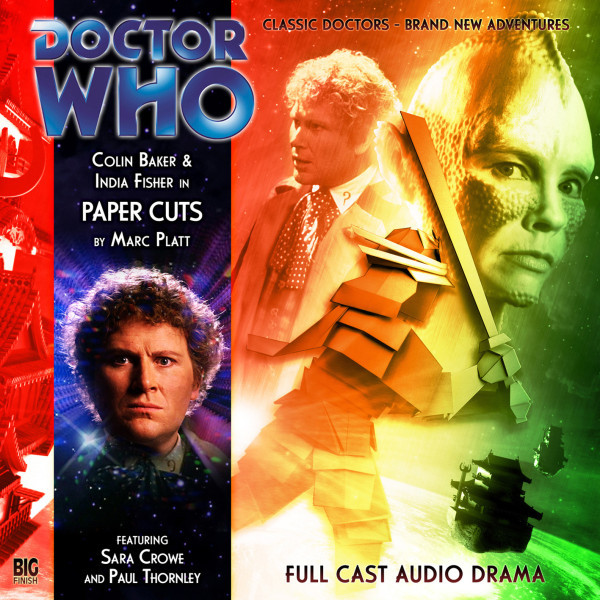
Paper Cuts opens by doing the single most irritating thing it could possibly do, which is to clear up the cliffhanger from Patient Zero in about thirty seconds of muttered exposition and then immediately wander off like nothing happened. I genuinely laughed, not because it was funny, but because of the sheer audacity of it. This absolutely should have been the final beat of the previous story, and if it had been, Patient Zero would have sailed cleanly into five-out-of-five territory. Instead, we get a narrative shrug, a “yeah yeah, that’s sorted,” and then on with today’s programme. None of it matters to what follows. None of it is relevant. It’s just there, squatting at the start like a damp editorial note.
Once past that speedbump, the Doctor receives an invitation from an old friend: the Deathless Emperor of Draconia. Which, first of all, Deathless Emperor is a job title that practically guarantees something has gone terribly wrong. Sure enough, when the Sixth Doctor and “Charley” arrive, the emperor is very much dead, and a rigid, ceremonial succession ritual is underway. The Doctor is one of several outsiders summoned to witness proceedings, each representing a different strand of Draconian society, all bound by suffocating tradition and hierarchy.
Things escalate quickly. Political factions circle. The prince and the high priestess glare at one another like knives in silk sleeves. Before long, the Doctor and Charley are imprisoned in a tomb that appears to have been designed by someone who asked, “But what if origami killed you?” Life-size paper chess pieces loom. Paintings redraw themselves to reflect people’s inner truths. Paper becomes metaphor, prison, and weapon all at once. It’s very theatrical, very Doctor Who historical in flavour, even though it’s sci-fi, and the real danger isn’t monsters so much as power structures calcified into ritual.
The central revelation is genuinely strong: the emperors of Draconia were never allowed to truly die. Each was captured at the brink of death by the priesthood, preserved and consulted as a chorus of trapped wisdom, allowing the priests to consolidate power under the guise of tradition. It’s a sharp idea about authority, stagnation, and the lie of continuity. Progress is impossible when the past is literally chained beneath your feet, whispering instructions.
Unfortunately, this is also where the story steps directly into a cultural bear trap. The Draconians are reptilian aliens, but their aesthetics, customs, and political structure are unmistakably lifted wholesale from ancient Japanese culture. No metaphor. No meaningful alienation. Just a straight copy-paste of an “exotic” Earth culture onto a non-human species, written and performed by people entirely outside that culture. It’s uncomfortable, distracting, and undercuts the story’s thematic intelligence by leaning on tired genre shorthand.
That said, Colin Baker is in glorious form. Commanding, witty, sharp. And India Fisher’s performance as Mila pretending to be Charley is quietly excellent. She nails Charley’s cadence and warmth, but there’s something slightly wrong underneath, a fraction off, like a reflection that doesn’t quite sync with your movements. It’s layered, unsettling, and genuinely fascinating to listen to.
Final Thoughts
Paper Cuts is clever, atmospheric, and thematically rich, but also deeply frustrating in places. It has brilliant performances, strong ideas about power and tradition, and one absolutely unnecessary narrative decision right at the start. It could have been great. Instead, it’s merely good, with a side of wince.
3 out of 5 lethal origami chess sets that absolutely should not be touchable