

Before continuing, please be aware that all of this content is made possible by the goodwill and support of my backers on Patreon. If you enjoy the work on this site, please consider supporting the creation of more content like this by clicking the button.
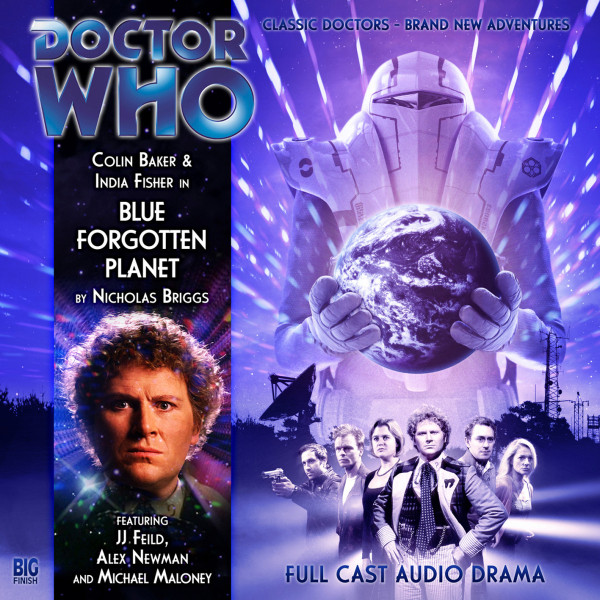
Blue Forgotten Planet is Charley Pollard’s final bow in the Big Finish Monthly Range and it does not go quietly into the night. It kicks the door in, coughs ominously, and asks what happens when history, memory, and identity all rot at the same time. This is the end of a three-story arc, the payoff to years of emotional investment, and it is big, messy, furious Doctor Who that understands exactly what kind of goodbye it’s trying to be.
The Sixth Doctor and “Charley” finally return to Earth, only to find it in the grip of a worldwide pandemic that has stripped humanity of higher reasoning. People haven’t just got sick; they’ve lost the capacity to think beyond tribal instincts. Wars have flared. Nations have collapsed into suspicion and fear. It’s near-future apocalypse done with chilling restraint, and yes, listening to this after recent years hits hard. The world feels bruised and frightened rather than theatrically destroyed, which makes it worse in the best possible way.
Complicating matters are the Viyrans, back from Patient Zero, whose remit is the eradication of viruses. Their solution is brutally efficient: wipe out the disease and everyone infected with it. Earth is a failed experiment. Time to clean house. And then the final ingredient drops into place: the real Charley Pollard arrives with them. The Charley we’ve been travelling with is Mila, the displaced echo, the imposter with borrowed memories. Suddenly everything collides. Doctor. Two Charleys. An Earth on the brink. An alien force with a god complex and a flamethrower approach to ethics.
Spoilers, because this story earns them: the Doctor is forced to choose between saving humanity as it is and allowing it to be erased in the name of cosmic hygiene. Mila’s deception collapses under the weight of guilt and longing. Charley confronts the life that continued without her. And when the dust settles, it’s Charley who makes the choice that matters. She doesn’t return to the Doctor. She doesn’t reclaim the life she lost. She accepts her place in time, lets the universe move forward without her, and closes the loop that began when she wasn’t supposed to survive at all. It’s devastating. It’s right.
The production is unusually cinematic for Big Finish. The soundscape does the heavy lifting, giving us a world that feels populated, damaged, and lived in. Crucially, the script resists the franchise habit of endless exposition. We hear the consequences. We feel the collapse. It shows restraint, which makes the emotional beats land harder.
The Viyrans are imperialism with a clean conscience. They frame themselves as neutral, logical, benevolent, but their solution to every problem is annihilation. No consent. No nuance. Just “we know better.” It’s colonialism in lab coats, and the story is very clear about how monstrous that is, even when it’s dressed up as necessity.
Charley Pollard’s arc has always been about survival, guilt, and displacement. She lived when she shouldn’t have. She loved the Doctor but could never truly stay. Over time, she grew from plucky Edwardian adventurer into someone carrying the weight of history on her shoulders. Here, she finally stops running from that weight.
And yes, this is a good ending. It’s painful, but it honours who Charley became. She doesn’t vanish. She chooses. She closes her story with agency, dignity, and heartbreak, which is more than Doctor Who often gives its companions.
Final Thoughts
This is Big Finish at the top of its game: bold, emotional, political, and unafraid to end things properly.
5 out of 5 blue planets everyone forgot to look after