

Before continuing, please be aware that all of this content is made possible by the goodwill and support of my backers on Patreon. If you enjoy the work on this site, please consider supporting the creation of more content like this by clicking the button.
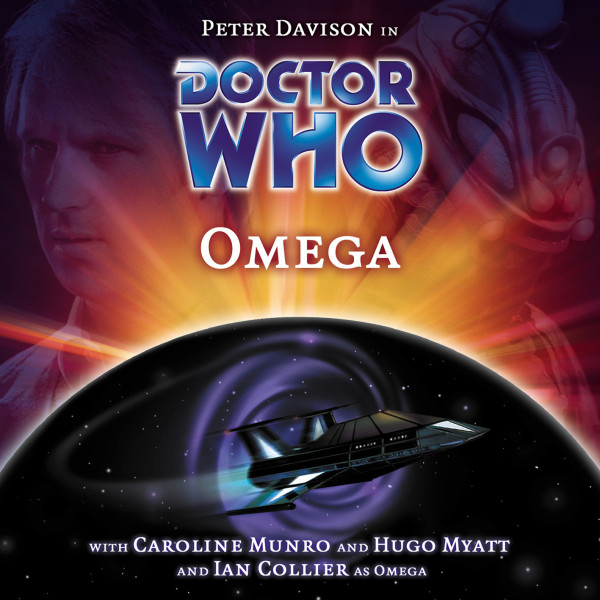
History isn’t written by the victors. It’s reenacted by cheerful tour guides with laser pointers and souvenir mugs. That’s the vibe when the Fifth Doctor turns up at the Sector of Forgotten Souls and finds Omega’s great stellar detonation—y’know, the event that made Time Lord society possible—being packaged and sold by “Jolly Chronolidays,” a company whose name sounds like a drug-resistant parasite. There’s no actual time travel, just a badly disguised museum ride on the Eurydice, Omega’s fabled sunship. Until the actors start screaming and slicing off their limbs in tribute to a cosmic death cult. As one does.
The first half of the story is delightfully acidic. Peter Davison leans into his unimpressed librarian energy, horrified by Gallifrey’s sacred origin being turned into theatre for gormless tourists. Everything feels off-kilter: actors glitching, timelines wobbling, ominous static where there should be technobabble. And then comes Omega. Not swaggering in with thunderbolts, but leaking psionic whispers into your brain like a ghost with a grudge and a PhD in narcissism. The vibe pivots from “Black Mirror: Gallifrey Edition” to “Greek Tragedy With Lasers.”
And then it goes weirder.
Omega, you see, is rebranding. Not content to be a howling exile in the anti-matter realm, he’s hijacked the simulation and is now staging a remake of his own legend using thought-creatures called Scintillans—who are literally born of belief. He’s conjuring actors, events, even a fake Fifth Doctor using the real Doctor’s mind as scaffolding. (Hi, identity theft, my old friend.) He’s not trying to escape. He’s trying to make the universe remember him right. You know, as a misunderstood genius god-emperor-husband figure. Omega has… needs.
The heart of the story is the increasingly intense flirt-off between Davison and Ian Collier’s Omega, a battle of minds and memories dressed as a philosophical wrestling match. The Doctor is exhausted. Omega is deranged but sympathetic, like a Time Lord Hamlet who read one too many Reddit threads about being The Main Character. There are moments of quiet devastation. There are screams. There’s a mock wedding. There is Sentia.
Sentia, played with glittery madness by Caroline Munro, is what happens when you feed a tour guide too many Gallifreyan conspiracy podcasts and a big jug of antimatter Kool-Aid. She goes from perky hostess to Omega’s death-wife in record time, insisting on piloting the Eurydice straight into hell so her man can live his best demiurge life. We love a woman with goals.
But it’s the final twist that kicks you in the brainstem. The Doctor—real Doctor—shows up in the fourth episode. The “Doctor” we’ve been following? Omega, cosplaying as his nemesis to rewrite history from inside the narrative. And the Scintillans? Not part of Omega’s memories. They’re from the Doctor’s. A race he accidentally erased in a botched rescue. Omega, subconsciously feeding on that trauma, baked them into his legend to justify Vandekirian’s sabotage. That’s right. The villain’s tragedy is your hero’s guilt.
In the end, Omega is dragged back to the anti-matter realm. The Doctor escapes. Two kindly old tourists reveal themselves as agents of the Celestial Preservation Agency, here to “tidy up” the narrative. Omega stays the villain. The Scintillans stay forgotten. And the sanitized myth of Gallifrey endures, like a historical plaque nailed over a mass grave.
Final Verdict:
Omega wasn’t a monster. He was the scapegoat they needed to bury a genocide. This isn’t just cosmic horror—it’s reputation management with a body count. And frankly, the TV series owes us a hell of a lot for wasting a character this good on bad CGI and nonsense.
4.5 out of 5 jolly holidays