

Before continuing, please be aware that all of this content is made possible by the goodwill and support of my backers on Patreon. If you enjoy the work on this site, please consider supporting the creation of more content like this by clicking the button.
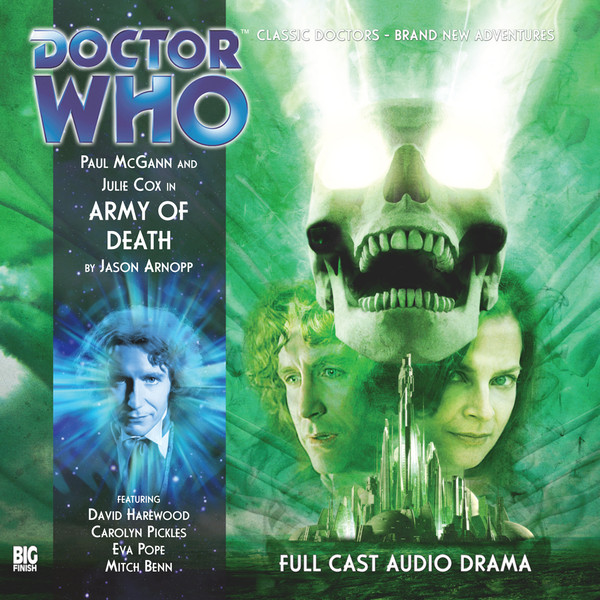
Army of Death sounds like the kind of title that should arrive kicking the door off its hinges with a flaming skeleton cavalry and a choir screaming in Latin while the sky explodes into bone fragments.
Instead it sort of wanders into the room, coughs politely, and spends four episodes explaining intergalactic local politics at me while an undead army mills around in the background like extras waiting for catering.
This SHOULD have been my jam. We’ve got Paul McGann and Mary Shelley landing on an alien world dealing with the aftermath of political assassination, scheming factions, staged murders, an undead uprising, and eventually a giant skeletal overlord because apparently someone looked at a heavy metal album cover and went “yes, narrative structure.”
That is objectively ridiculous. That is objectively WONDERFUL material. And yet somehow this story achieves the impossible feat of making an army of undead skeleton monsters feel like an administrative meeting.
The core plot revolves around the assassination of the planet’s leader and the political chaos that follows, with various power players manipulating events while the dead inconveniently refuse to stay dead. The undead themselves are tied into the planet’s social and political systems in ways that could have been fascinating, especially with all the implications about death, power, and control.
Could have been. Instead the whole thing just kind of… trudges.
It’s not even offensively bad. Honestly, I think that’s the problem. It’s this foggy middle ground of competence where scenes happen, information is exchanged, and my brain quietly drifts out of the nearest window searching for stimulation elsewhere.
At one point I genuinely realised I’d stopped processing the story despite it still actively playing in my ears. That’s not even boredom anymore. That’s astral projection. Which is tragic because there ARE good elements here.
Julie Cox is excellent as Mary Shelley. There’s intelligence and warmth in the performance, and she continues to bring a grounded emotionality that keeps the Eighth Doctor era feeling human even when the plots get particularly silly. Paul McGann, meanwhile, remains absurdly charismatic through sheer force of will. The man could read takeaway menus and somehow make them sound melancholically romantic.
But then the story decides to push the “Mary is romantically infatuated with the Doctor” angle and I just… Guys. Come on. Even in 2011 this was already a well-trodden road. We’ve BEEN here. We’ve bought souvenirs here. We’ve had entire seasons of television doing this exact dynamic already. And the frustrating part is that Mary and the Doctor already have enough chemistry without forcing it into “ooh tragic yearning” territory.
Sometimes a rich intellectual bond is enough! Sometimes two emotionally complicated weirdos travelling through time together can just EXIST without one of them gazing wistfully into the middle distance every twelve minutes!
Thematically, there’s stuff buried in here about political decay, societies built on death, and the manipulation of fear during periods of instability. There’s even some interesting tension between memory and legacy, especially with the undead imagery looming over everything.
But the story never sharpens those ideas into anything memorable. They just sort of drift around in the fog alongside the skeletons.
And the skeletons SHOULD be memorable. There is a GIANT BONE LORD in this. A giant. Bone. Lord. How are we boring?? That feels medically impressive.
Final Thoughts
A story packed with potentially fantastic ingredients that somehow blends them into the sci-fi equivalent of room-temperature soup. Strong performances help, especially from Mary Shelley, but not enough to stop the whole thing feeling weirdly lifeless despite the abundance of literal undead.
2.5 out of 5 politically motivated skeleton uprisings that desperately needed more actual uprising