

Before continuing, please be aware that all of this content is made possible by the goodwill and support of my backers on Patreon. If you enjoy the work on this site, please consider supporting the creation of more content like this by clicking the button.
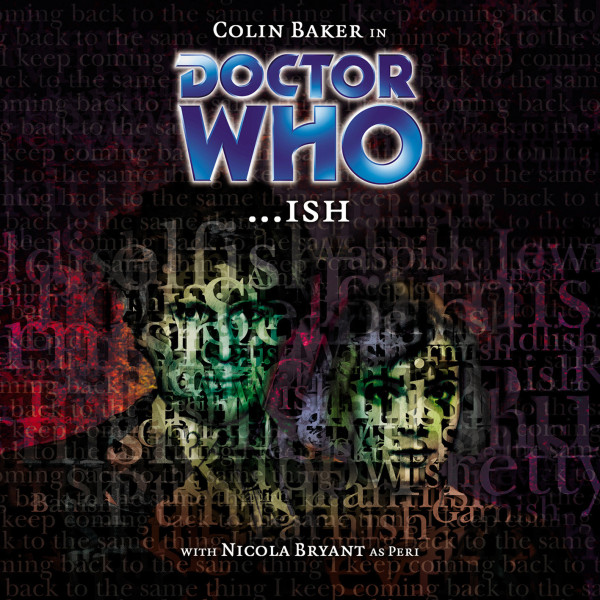
I get it—someone out there probably counts this as their favourite Big Finish story, what with all the clever wordplay and lexicon porn. But I’m not that person.
So here’s the gist: The Sixth Doctor and Peri tumble into a symposium where the universe’s biggest dictionary is being compiled—because when you’re out of actual plot, just invent space Oxford and go ham on lexicographical monologues. Things start to go very wrong when people begin saying “ish” and it turns out that’s basically a summoning chant for a malevolent lexical intelligence. Every utterance spreads it. Vanish… demolish… English. You get it. And when the Doctor realizes the danger, he cobbles together a handy censorship machine that literally bleeps the suffix “ish” whenever it’s said aloud—even embedded in longer words. It’s hilarious. For like, the first two minutes. Then it becomes the audio equivalent of getting elbowed in the ribs every time someone says “fish.”
Still, credit where due: the central conceit is beautifully sound-designed. You hear the words crawling through speech. The sound of “ish” warping and seeding new meaning into innocuous sentences. It’s eerie. Genuinely unsettling at times. The idea feels like a rarified cousin of Whispers of Terror, but with slightly better structure and an audio execution that understands you can’t feed dense dialogue to listeners without some gut-punch moments. And yet here I am, pitying Peri as she stares down a runaway lexeme while we’re told how marvellous the English language is. It’s boring, but with academic drift.
But the episode never asks the interesting question: why this language? Why English, specifically? Why does the Doctor, with all his supposed galactic nuance, spend a whole adventure essentially praising linguistic monoculture? There’s not a whiff of xenolinguistics here—just English supremacy painted as universal progress. Thematically, this story is paradigmatically blind to its own imperialistic undertones. The Doctor stands up on stage, chest puffed out, hailing the purifying, glorious power of the English language—never mind that the whole planetary linguist culture is a mash-up of colonial triumphalism and academic erasure. Yet the script never asks a serious question about that. Instead it’s “Look! Words are weapons!” without exploring why a language symposium is the perfect breeding ground for cultural dominance. The words literally kill, and no one’s asking which phrasing killed first.
And there’s the rub. Language, in this context, is treated like a quirky academic plaything, not the violent political force it really is. There’s a story lurking in here about linguistic imperialism, about the control of thought through curated vocabulary, about how language erases as much as it communicates. But it’s buried beneath thesauric wankery and a plot that would rather show off a talking footnote than interrogate why it was written in the first place.
Colin’s energy carries it. He wears the verbosity like a badge: furious, theatrical, slightly unhinged. And Peri, bless her, tries. She searches for warmth, for sincerity amid the word-war, and finds only dusty syllables and a history of linguistic complacency. You want her to pull Colin aside and say, “Look, big shot fathead—this sounds sinister,” but she never quite gets there.
Final thoughts?
Two points to Gryffindor for ambition and a genuinely creepy execution of the “ish” infection. But everything else is so enamoured with its own cleverness that it forgets to be about anything. It’s academic, self-indulgent, and tone-deaf to the actual power of language in shaping history and thought. The Doctor shouldn’t be worshipping the dictionary—he should be burning it.
1.5 out of 5 pedantic lexicographers.