

Before continuing, please be aware that all of this content is made possible by the goodwill and support of my backers on Patreon. If you enjoy the work on this site, please consider supporting the creation of more content like this by clicking the button.
Okay. Deep breath. This one’s gonna hurt a little.
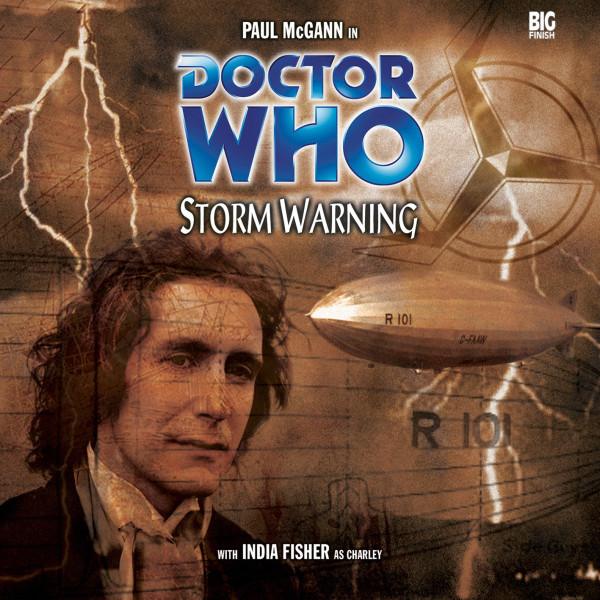
Storm Warning is one of those stories that’s somehow everything to me and also… not quite enough. Like a love letter written on a napkin—gorgeous sentiment, but smeared with soup. This was the Big Finish debut of Paul McGann’s Eighth Doctor, and it had an entire era resting on its floppy Edwardian shoulders. So let’s be real: the plot? Mid. But Paul? PAUL. Is. Divine.
He floats into this story with the detached melancholy of a man who’s spent too long in libraries at the end of time. He’s all romantic detachment and Wildean sighs, orbiting a lonely sadness, and from the first second he speaks, I was hooked. This is my Doctor. No arguments, no debates. Just me, clinging to his velvet coat and begging for one more monologue.
And then—Charlie. Charley Pollard. Charlotte “I-faked-my-passport-and-smuggled-myself-onto-a-doomed-airship” Pollard. She enters like she’s been here for seasons already, full of life and pluck and that perfect ‘just preposterous enough’ energy that makes a Doctor Who companion pop. India Fisher nails it. I love her immediately. She’s brilliant, brave, a little bit full of herself, and absolutely doomed—which, of course, makes her irresistible. The whole paradox thing? That she was supposed to die on the R101, but doesn’t? Already gives their relationship way more emotional weight than most New Who pairings get in entire seasons. She’s the impossible girl before Moffat trademarked it.
But yeah… the plot. Oh dear.
So we’ve got an airship, some mildly fascist British aristocrats, a couple of time-bats called Vortisaurs (not joking), and an alien race that feels like a mood board from a forgotten Star Trek pitch meeting. There’s some stuff about caste systems, creators vs uncreators, and a lot of “No, Doctor, you mustn’t interfere!” It wants to be a political thriller meets high-concept time mystery, but it ends up feeling like two radio plays awkwardly stapled together. And by Part Three, I could feel the script checking its watch.
The good news? The sound design slaps. Claustrophobic airship corridors, roaring engines, the metallic groan of time unraveling mid-storm. The atmosphere builds just enough pressure to keep you focused, even when the alien subplot is putting you to sleep with its exposition. There’s weight in the background noise, even when the plot forgets to carry it.
There’s still magic here, though. When the Doctor chooses to save Charley—knowing full well he’s creating a paradox—he does it anyway. No Time Lord arrogance, no lecture about laws of time. Just a man refusing to let someone die. It’s beautiful. It’s reckless. It’s why I love him.
So yeah. It’s a shaky opener. But like most beginnings, it’s not about where we start—it’s what this kicks off. And this? This is the start of something brilliant.
Final Verdict:
The characters crackle, the setting creaks, and the story… stumbles. But the emotional core lands.
3.5 out of 5 time‑tangled airships.