

Before continuing, please be aware that all of this content is made possible by the goodwill and support of my backers on Patreon. If you enjoy the work on this site, please consider supporting the creation of more content like this by clicking the button.
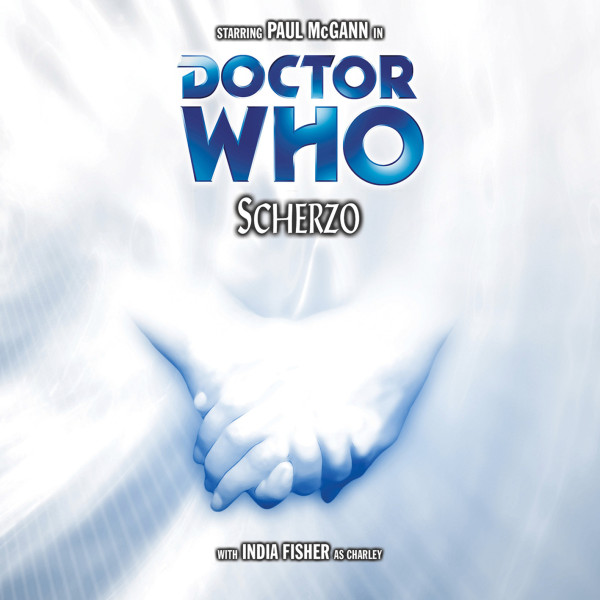
Okay. So. Scherzo. Imagine Doctor Who taking off its colourful scarf, shoving you in a pitch-black box, and whispering in your ear for an hour about love, death, and the slow erosion of your sense of self until you’re not sure where your edges are anymore. That’s this story. After the neon fever dream of Zagreus, the Doctor and Charley plunge into the Divergent Universe—where time doesn’t work, reality is an abstract painting that forgot to dry, and the TARDIS is gone. All you’ve got left are two voices, and they’re not even always on the same side.
The thing opens with the Doctor already in a mood. McGann’s Doctor can be charmingly Byronic one moment and a moody stormcloud the next, and here he’s somewhere between grief and condescension, lashing out at Charley because she wouldn’t let him throw himself onto the altar of Self-Sacrificial Martyrdom yet again. Charley’s response is essentially: “Cool story, drama queen, but I’m still here, so deal with it.” The script traps them in this sensory void where sight’s gone, touch is unreliable, and the only constant is sound—which is where Shearman’s genius kicks in. The threat isn’t a monster stomping down a corridor, it’s a presence made entirely of echoed voices. It copies them. It becomes them. It starts stealing their identity, their individuality, their everything, until you’re wondering which Charley is real, which Doctor is real, and whether either of them actually exist outside the sound at all.
And because it’s audio-only, it works terrifyingly well. You can hear the creature in the background, but you can’t see it. You start doubting yourself, just like they do. This isn’t just horror—it’s relationship horror. The kind where love is both your shield and your prison. McGann and Fisher carry the entire thing with performances that feel like eavesdropping on the last two humans alive trying not to disintegrate into the void. It’s intimate, almost indecently so, and also deeply uncomfortable—because this Doctor isn’t just sad, he’s petty and cruel sometimes, and Charley’s patience has limits.
Thematically, it’s about love as the last defence against oblivion. About identity as something we perform for others, and what happens when there’s no “other” to perform for. About how time—the constant in the Doctor’s universe—isn’t just a medium to travel through, it’s a safety net. Rip it away and you don’t just lose direction, you lose yourself. The sound-creature is terrifying not because it’s malicious, but because it’s evolutionary—it doesn’t hate, it just consumes, and what it consumes is the definition of you.
Final Verdict:
It’s experimental in the best way. Not smug-clever like Flip-Flop, but raw and stripped down, knowing exactly what audio can do that television can’t. You can feel the walls closing in, except there are no walls. You can feel the love between the Doctor and Charley, except it’s barbed-wire love—tender one second, slicing you the next. And when it ends, you don’t feel relief. You feel like part of you stayed behind in that void, humming in the dark.
4.5 out of 5 nothings. Which, in this case, is a compliment.