

Before continuing, please be aware that all of this content is made possible by the goodwill and support of my backers on Patreon. If you enjoy the work on this site, please consider supporting the creation of more content like this by clicking the button.
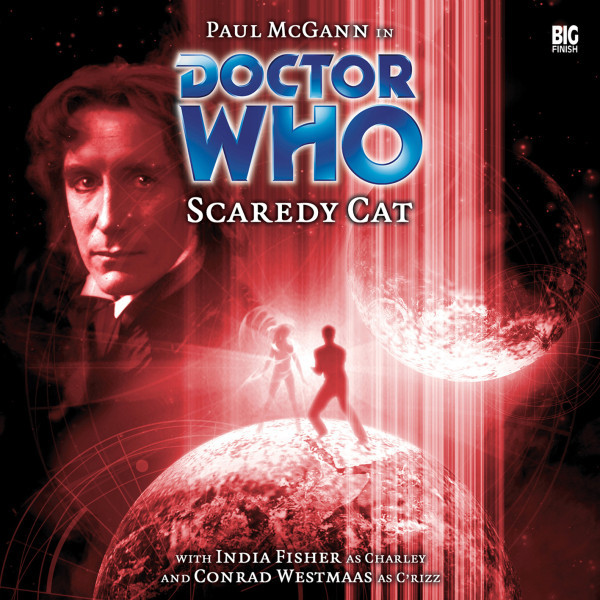
Scaredy Cat drags the Eighth Doctor, Charley, and C’rizz to the twin planets Caludaar and Endarra, flicks the “haunted planet” switch, sprinkles in creepy children, emergent psychic powers, and then lets most of its weird potential rot in the shallows. Millennia ago, the people of Caludaar pledged never to set foot on Endarra, and Endarra has been treated like Eden left alone—but “untouched” doesn’t stay that way when scientists and grief and vengeance decide that punishment = experiment.
From the get-go, the setup has promise: a planet forbidden, a treaty, mystery, and a hint of ecological horror. But the story almost immediately settles for tedious crap. Scientists are experimenting on emergent life, there’s a villainous psychic scientist who monologues about how evil they are, a kid singing a nursery rhyme (“Scaredy Cat”) in echoing corridors, cycles of “Doctor’s gonna explain now!” interspersed with C’rizz arguing to save the doomed. These are ingredients that could build something memorable. Instead, they pile up like layers of soggy cardboard, each more thin than the last.
Charley is present, sort of, but her choices often feel reactive or naive, falling into traps laid by flood of exposition rather than active investigation. C’rizz tries: he wants to defy the Doctor, to intercede, to act out of heart instead of obedience—but these moments are drowned in long stretches of the Doctor hopping through the planetary timeline, narrating consequences rather than showing them. It’s the difference between making you gasp, and making you check the clock (“Is this nearly over?”).
When the spooky child and the psychic experiments reveal themselves—that the child is an incarnation of the planet’s spirit, Eunis Flood is messing with memories and elders and the past—it’s too late. By then, any tension has leaked. The monsters feel generic, with the psychic scientist villain recalling The Twilight Kingdom’s melodramatic over-reach. The Eden vs experiment trope is recycled, but poorly pruned: many threads are planted, few are harvested.
Sound and atmosphere try. Music echoes. Strange noises. Lambda radiation, twin planet lore, treaty history, lost mothers, blame, regret. But with a short runtime (about 74 minutes), there’s no time for these textures to cohere into anything emotionally or thematically resonant. Instead they feel like background noise, pretty wallpaper for scenes that mostly exist to move the plot forward rather than to immerse you in anything deeper.
Themes are faint. The potential themes should have been strong: the danger of playing god with emergent life, the weight of memory and punishment, treaty obligations vs moral responsibility, whether some tragedies can’t be averted. Maybe even ecological horror, respect for untouched worlds, non-interference. But in Scaredy Cat, these themes are more suggestions than arguments. They whisper at the edges rather than screaming for attention. The nursery rhyme motif (“Scaredy Cat”) barely gets past creepy repetition to say something satisfying. The moral stakes feel lowered: sure, someone dies, someone experiments, someone regrets—but none of it builds to a moment you carry away.
Final Thoughts:
I wanted to like Scaredy Cat. I wanted sadness, dread, double takes, moral ambiguity. What I got was boredom with occasional creepy atmosphere. There are sparks—C’rizz’s guilt, Endarra’s mystery—but they’re smothered by exposition and lazy plotting. This story feels like a first draft idea that wasn’t sharpened. It’s not horrendous, just… profoundly forgettable. You finish it, maybe shrug, maybe feel a twinge of disappointment that more wasn’t done.
Rating: 1.5 out of 5 ghostly nursery rhymes