

Before continuing, please be aware that all of this content is made possible by the goodwill and support of my backers on Patreon. If you enjoy the work on this site, please consider supporting the creation of more content like this by clicking the button.
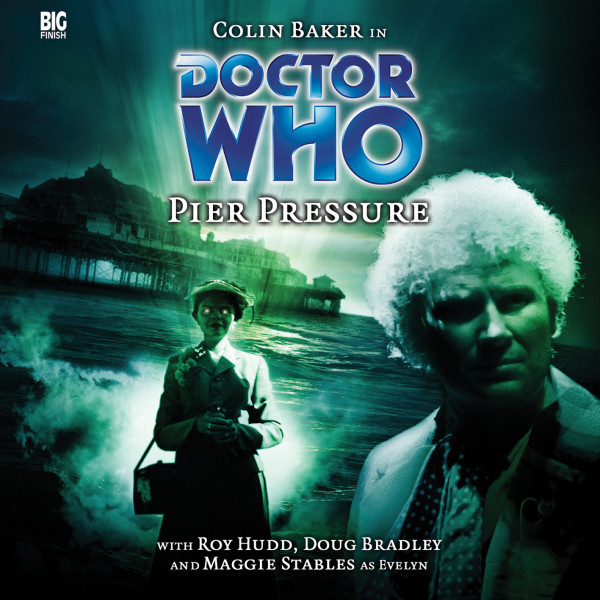
Pier Pressure is one of those Big Finish audios that leans into local colour and atmosphere so hard it sometimes forgets to do much with its ideas — but when it does land, it lands with flair. The Sixth Doctor and Evelyn set off for what’s meant to be a seaside break (because who doesn’t want to escape with Evelyn?) but the TARDIS throws a tantrum, refuses to go to Blackpool, and plonks them down in 1936 Brighton instead. Which is exactly where the fun begins.
Immediately we get the Brighton vibes: seagulls, piers, carnival lights, murmurs in alleys, the sense that behind the fun is something rotten. People are disappearing. There’s a fortune-teller stall at the far end of the Pier, run by Professor Talbot (Doug Bradley), and the whispers start: what if Talbot is possessed by alien negative energy, an entity that’s been feeding on fear and sorrow, incubating for years? The Doctor, Evelyn, local comedian Max Miller (voiced by Roy Hudd), and a parade of seaside characters all get pulled in. The villainous energy is real, the atmosphere is oppressive, and the pier itself becomes a character — a vessel for memory, for pain, for corruption.
Now. The good: the scripting leans into character and setting in strong ways. Evelyn remains the solid moral centre. Her exchanges with locals, her bewilderment, her compassion — Maggie Stables carries that beautifully. Talbot’s possession scenes have weight. The mystery has real bones. When the Doctor leads the “exorcism,” draining alien energy and dumping it into the metal structure of West Pier — tying that to the real-world ruin of Brighton’s piers decades later — there’s a cleverness there I admire. And the little Easter egg: the minor character Billy, an actor who has been in films that echo William Hartnell’s early roles, is a soft nod to fandom without clanging over the walls.
The pacing is uneven. Scenes linger just past their reach. Some characters feel like props rather than people — Max Miller’s presence, for all its historical fun, slides between charming and grating. He has chemistry with Evelyn, yes, but sometimes he overshadows where he should complement. The Doctor here is darker, more imperious — about 40 % more condescending than is often comfortable. Perhaps that’s by design, to reflect how possession and place warp our responses. But there are moments where I wished he softened. The final exorcism feels abrupt, a climax built on its own gravity rather than on cumulative emotional pressure.
Themes: haunting, memory, corruption, place as memory. The pier is a memory machine, storing grief and despair, feeding off the living. There’s something about how structures outlive us, how architecture can absorb psychic residue. Also, identity: how people perform roles, how Talbot is split between the “good man” and the negative energy within him. And guilt: Brighton, the pier, the notion that the burnt parts of history are rarely clean erasures but palimpsests of trauma.
Final Thoughts:
It never becomes profound, but it becomes vivid. It’s a story you don’t need to remember every line of, but one whose shadow stays with you: the echo of footsteps on a burned pier, voices in carnival wind, the resonant idea that our architecture remembers us when we forget it. It’s uneven, yes — middling in places — but more often than not it captures a ghost.
Rating: 3.5 out of 5 seaside phantom energies in a burnt pier.