

Before continuing, please be aware that all of this content is made possible by the goodwill and support of my backers on Patreon. If you enjoy the work on this site, please consider supporting the creation of more content like this by clicking the button.
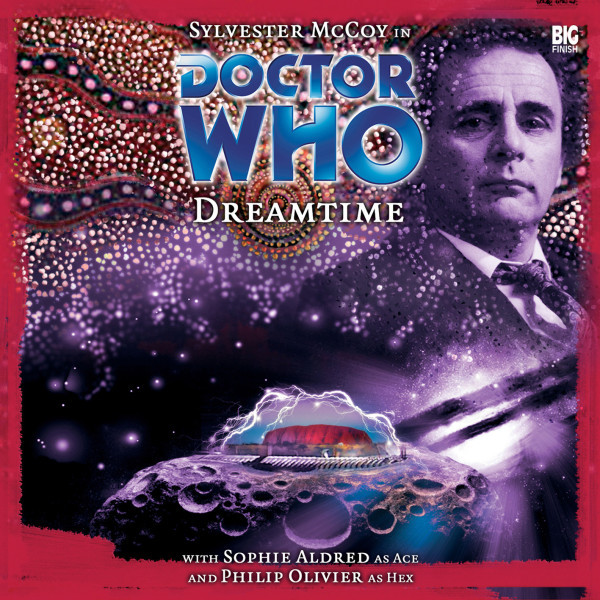
Dreamtime is one of those Big Finish audios that feels like you’ve walked into a fever dream where somebody put The Ark in Space, Walkabout, and the lingering ghost of a 90s Disney movie into a blender, pressed “purée,” and then politely handed you the results with the hopeful smile of “you’ll like it, I promise.” And the thing is: I kind of do like it. Sort of. Against my better judgment. It’s fascinating, it’s messy, and it’s a prime example of the Seventh Doctor’s adventures veering between “clever metaphor” and “did anyone think this through?”
The setup is peak audacity: the Doctor, Ace, and poor baby Hex land in a city drifting through space, discover that Uluru (yes, actual Uluru, casually uprooted and launched into orbit) is welded into its core, and then immediately get menaced by bunyips. Of course. The Doctor, ever the meddler, gets pulled into the Dreamtime itself, where he finds himself chatting with Baiame, an Aboriginal elder leading his people into space because prophecy said so. Honestly, it’s got shades of classic Who’s weird morality fables, except here the metaphor is all but screaming about colonisation, forced relocation, and the uneasy question of who gets saved when everything collapses. And then — oops — the script drops the baton and jogs away.
Back in “reality,” Ace and Hex stumble into the company of two Galyari traders. Which, let’s be real, is the best continuity flex of the story. We haven’t seen these scaly drama lizards since The Sandman, and bringing them back gives the whole tale a richer Big Finish texture. Sadly, they’re written like overzealous tabletop gamers — “Lawful Stupid Paladins,” bless them — who barrel into situations with good intentions and manage to make things worse with all the subtlety of a brick through a stained glass window.
The themes here could’ve been sharp as a scalpel. Forced relocation, cultural survival, the uneasy dance between settlers and Indigenous peoples — it’s all right there. But instead, the plot decides to shuffle sideways into “what if saving both cultures made the Dreamtime angry because… multiculturalism…?” which lands with the grace of a faceplant. The result is neither fully thoughtful nor fully pulpy, stuck somewhere in the uncanny valley between.
And look, context matters: this was written at the tail end of the “Indigenous wisdom as magical plot coupon” era in media. Ten years earlier, this would’ve been a nightmare of clichés. Ten years later, you might’ve gotten something genuinely interrogative. As it stands, Dreamtime is trying to be respectful, trying to tap into something profound, and doesn’t quite pull it off — but at least it never tips into outright caricature. Small mercies.
Final Thoughts:
So what do we end up with? An ark made from Uluru, bunyips as dream-ghost bouncers, Hex flailing, Ace bristling, the Doctor speechifying, and the faint aftertaste of a story that could have been a classic if it had just gone there thematically. Instead, it sits in the mid-tier drawer: interesting, flawed, and oddly charming in spite of itself.
3.5 out of 5 Dream-arks.