

Before continuing, please be aware that all of this content is made possible by the goodwill and support of my backers on Patreon. If you enjoy the work on this site, please consider supporting the creation of more content like this by clicking the button.
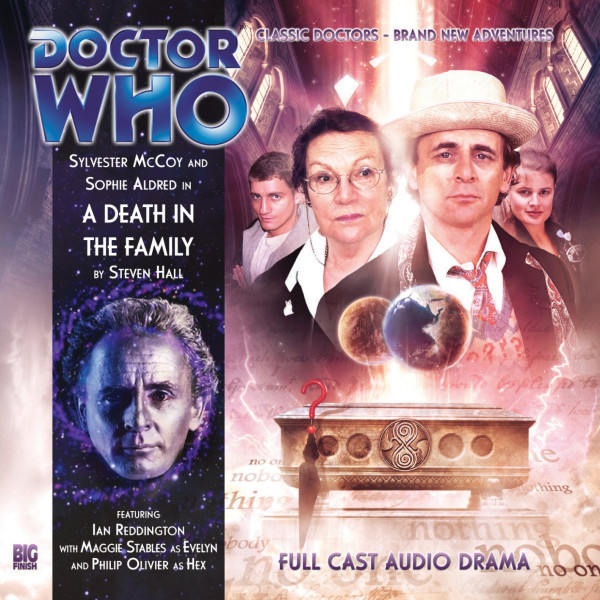
A Death in the Family wastes absolutely no time politely clearing its throat. It kicks the door open, unleashes a god-tier chaos gremlin onto modern-day Earth, and then murders the Seventh Doctor before you’ve even settled in with your tea.
Yes. That happens in episode one.
Enter Nobody No-One, the Word Lord. A being on the same cosmic shelf as the Celestial Toymaker, except instead of nursery-rhyme whimsy he wields linguistics like a switchblade. Words are his atoms. Syntax is his battlefield. He feels like someone spliced the manic petulance of The Master (John Simm flavour, unhinged grin included) with the theatrical cruelty of a pantomime god. He doesn’t just want to win. He wants to unwrite you.
When he forces a dying soldier to state that “nobody can make the Doctor die and not regenerate”… well. You see where this is going. Semantic loophole. Verbal trapdoor. The Doctor dies. No golden glow. No triumphant music. Just silence.
I actually sat there, headphones on, staring at the wall like: excuse me??? You can’t just do that. That’s illegal. There are RULES.
But this is a story about rules. And about how language shapes reality.
Episodes two and three are grief in surround sound. The companions live on. The universe does not pause. And it hurts.
Hex, freshly gutted by the revelations of Project: Destiny, is taken—by the Doctor’s final instructions—to see Evelyn Smythe. Evelyn. Oh, Evelyn. Older now. Frailer. Still morally titanium. Her scenes are luminous. Even in the twilight of her life, she is fierce, principled, cutting through nonsense like a historian with a scalpel. There is something unbearably tender about her lingering wish that it had been her Doctor. My heart actually did that awful squeezing thing. You know the one.
Meanwhile, Ace spirals in denial. Proper, messy denial. She drags the TARDIS back to Earth, tries to resume a normal life, and it is excruciating. Because she can’t. She’s too Doctor-shaped now. Too alienated from the mundane. Watching her try to fit into a world that no longer fits her is both hilarious and quietly devastating. She’s become him. Eccentric. Disconnected. Living in a box, emotionally and literally.
And through it all, Nobody No-One capers about, twisting idioms into weapons. The final resolution hinges—beautifully—on wordplay. On definitions. On the power of naming. It feels almost Russell T Davies in its audacity: language as salvation, as trap, as magic. Classic Who metaphysics colliding with modern emotional punch.
The themes are thick and deliberate: grief as transformation. Identity as narrative. The ethics of manipulation—because Seven has played his own share of linguistic games over the years. Nobody No-One is, in a way, his mirror. Weaponised cleverness without conscience.
And when the dust settles, what lingers isn’t just the shock of the Doctor’s death. It’s the ache of love. Of companions who were shaped—and scarred—by him. Of words spoken too late. Of stories that refuse to end quietly.
Final Thoughts
A daring, emotionally savage masterpiece that kills the Doctor, dissects grief, weaponises grammar and somehow makes it all sing. A perfect fusion of classic ambition and modern heart.
5 out of 5 weaponised dangling participles.