

Before continuing, please be aware that all of this content is made possible by the goodwill and support of my backers on Patreon. If you enjoy the work on this site, please consider supporting the creation of more content like this by clicking the button.
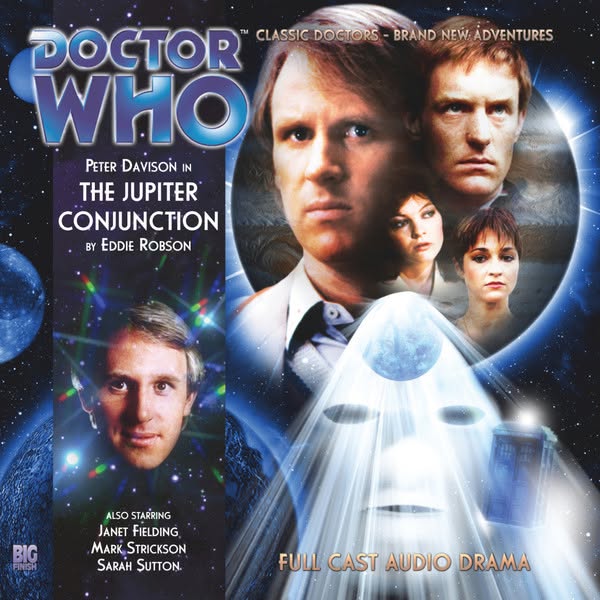
The Jupiter Conjunction is one of those stories that I finished listening to and immediately had to spend several minutes remembering what had actually happened in it. This is not an encouraging start.
The adventure drops the Fifth Doctor, Nyssa, Tegan and Turlough into a sprawling space-opera conflict involving political intrigue, ancient conspiracies, interplanetary tensions, mysterious artefacts and enough proper nouns to fill a small encyclopaedia. Somewhere in the middle of all that, there’s a conspiracy involving the titular conjunction, various factions attempting to manipulate events for their own benefit, and the Doctor trying to stop everything from collapsing into chaos.
At least, I think that’s what happened. The problem with The Jupiter Conjunction isn’t that it’s incomprehensible. It’s that it’s weirdly, aggressively forgettable. Everything feels like it’s been assembled from spare parts left over from better science-fiction stories. Political disputes? Check. Ancient secrets? Check. Courtroom scenes? Check. Betrayals? Check. Last-minute revelations? Check. It’s all there. None of it lands.
The biggest issue is momentum. Or rather, the complete absence of it. Characters spend huge portions of the runtime discussing events rather than experiencing them. Revelations arrive with all the excitement of somebody reading out council planning applications. Entire scenes seem to exist solely to explain things that weren’t particularly interesting in the first place.
By the halfway point I found my attention wandering repeatedly. That’s never a good sign. And it feels particularly frustrating because Big Finish has proven time and again that it can do grand political science fiction exceptionally well. We’ve had stories packed with tension, atmosphere and memorable worldbuilding. This isn’t one of those stories. Instead, it feels like everybody is trapped inside a very expensive spreadsheet.
The one recurring bright spot is Turlough. Now, admittedly, his contribution largely consists of pretending to betray the Doctor and his companions. Again. At this point Turlough fake-betraying people has become less of a character arc and more of a hobby. If somebody offered him a loyalty card, he’d probably qualify for a free coffee. Still, at least it injects a little energy into proceedings.
There’s also a sequence where the Doctor and company find themselves on trial, which is probably the strongest material in the entire story. Suddenly characters are forced into direct conflict. Accusations are thrown around. Stakes emerge. Things actually happen. It’s amazing how refreshing basic drama feels after hours of exposition.
The ending similarly threatens to generate genuine emotion when the Doctor believes one of his companions has died. For a brief moment I sat up. For a brief moment the story had my attention. Then the inevitable “surprise, they’re actually fine” reveal arrives and the tension evaporates faster than a puddle on Skaro. Which neatly sums up the entire experience. Every potentially interesting idea gets smoothed down into something safe and predictable.
The cast do what they can. Sarah Sutton remains reliably excellent as Nyssa. Janet Fielding continues to weaponise exasperation as Tegan. Mark Strickson gets the few moments of actual character conflict. Meanwhile Peter Davison soldiers on with admirable professionalism despite increasingly feeling trapped in a run of stories that simply don’t know what to do with him.
That’s perhaps the saddest part. The Fifth Doctor isn’t the problem. The material is. Because lately his corner of the Monthly Range feels stuck in a loop of uninspired, middle-of-the-road science fiction that never takes risks, never surprises, and rarely leaves an impression once the credits roll.
Final Thoughts
A sprawling political science-fiction adventure that mistakes complexity for depth and exposition for drama. There are a handful of decent moments scattered throughout, but not enough to rescue a story that ultimately feels bland, repetitive and strangely lifeless.
1.5 out of 5 Turlough betrayal attempts, because apparently twenty-two wasn’t quite enough