

Before continuing, please be aware that all of this content is made possible by the goodwill and support of my backers on Patreon. If you enjoy the work on this site, please consider supporting the creation of more content like this by clicking the button.
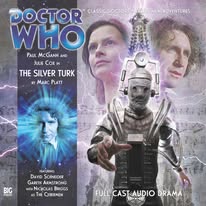
The Silver Turk clanks onto the stage in nineteenth-century Vienna wearing a velvet opera cape over cold metal horror and immediately goes “hello yes would you like existential dread with your gothic melodrama?” and honestly? That’s my kind of evening.
We’ve got Paul McGann’s Eighth Doctor at peak Byronic disaster genius levels, paired with Mary Shelley as a companion, which already feels unfairly overpowered. Like the universe looked at gothic science-fiction and said “what if we simply weaponised atmosphere?”
And atmosphere is EVERYWHERE in this thing. Foggy streets. Candlelight. Decaying grandeur. The constant sense that science has wandered somewhere it absolutely should not have gone and is now pretending everything’s fine while body parts twitch ominously in the corner.
Also: Cybermen. Or… sort of Cybermen. Because the genius move here is that the Cybermen aren’t actually the core threat. They’re almost the symptom. The real villain is the deliciously unhinged mad scientist energy at the centre of the story, all ambition and obsession and “I can transcend death if I simply ignore several ethical boundaries and most of human morality.” Classic. No notes.
The plot follows the Doctor and Mary arriving in Vienna and stumbling into a series of strange disappearances and experiments surrounding the titular Silver Turk, an automaton inspired by the historical chess-playing machine. Except this version has a little more corpse-adjacent nightmare fuel attached to it.
And what I love is how naturally the Cybermen fit into the themes. This isn’t just “oh look, Cybermen in corsets.” The story digs into the overlap between early scientific ambition and Cyber-conversion ideology. The fear of mortality. The desire to perfect humanity by stripping away weakness. The arrogance of believing suffering can simply be engineered out of existence.
Very Frankenstein. Which is PERFECT when one of your leads is literally Mary Shelley. And honestly? She’s fantastic here. Not just “historical celebrity companion” fantastic, but genuinely layered. Intelligent, compassionate, quietly haunted. The script gives her room to challenge the Doctor intellectually and morally, and Paul McGann plays off her beautifully. Their chemistry feels natural in that specifically Eighth Doctor way where half the scenes sound like flirtation between two people discussing cosmic horror over wine.
Meanwhile McGann himself is, unsurprisingly, excellent. Warm one second, ancient and quietly terrifying the next. He gives the story this emotional richness that smooths over the occasional structural wobble.
Because okay, critiques. The story is VERY good. Impressively so. But you can feel it brushing up against greatness without fully crossing the threshold. And that’s frustrating because all the ingredients are THERE.
The themes are rich enough to sustain something truly transcendent. Identity, mortality, the ethics of technological progress, humanity’s obsession with conquering death. This could have been one of those stories that stops being “great Doctor Who” and becomes “great science fiction, full stop.”
Think those rare moments in Star Trek where an episode escapes franchise gravity entirely and becomes timeless speculative fiction on its own merits. The Silver Turk gets SO close to that level I could scream.
But it doesn’t quite push far enough. It resolves a little too neatly. Some concepts that could’ve been explored more deeply instead stay comfortably within the bounds of “excellent franchise storytelling.”
Which still leaves us with an atmospheric, thoughtful, emotionally engaging Cyberman story that absolutely obliterates most of the competition. It just stops one step short of immortality.
Final Thoughts
A rich, gothic, beautifully produced Cyberman story elevated by strong performances, smart thematic work, and fantastic chemistry between the Doctor and Mary Shelley. Not quite the genre-defining masterpiece it could have been, but still exceptional Doctor Who.
4.5 out of 5 ethically catastrophic clockwork science projects fuelled entirely by grief and terrible ideas