

Before continuing, please be aware that all of this content is made possible by the goodwill and support of my backers on Patreon. If you enjoy the work on this site, please consider supporting the creation of more content like this by clicking the button.
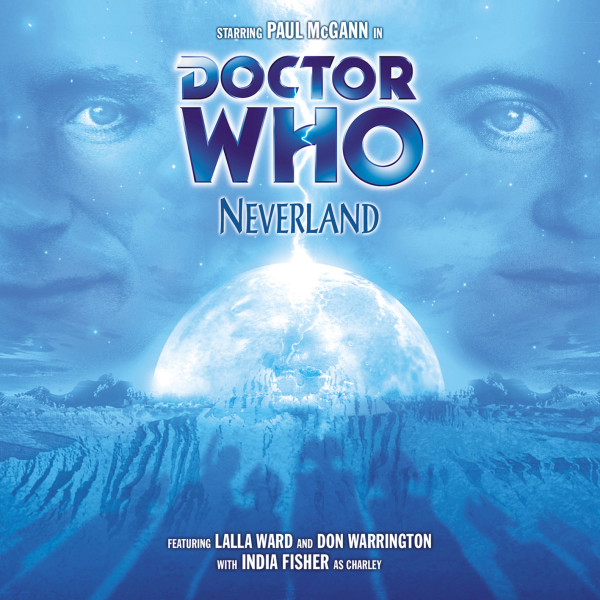
You know a story’s in trouble when it opens with a big flashing sign saying “THIS ONE’S REALLY IMPORTANT” and then spends two discs explaining why it’s important instead of just… being important. Neverland is Big Finish’s 33rd story, but you’d be forgiven for assuming it’s a 100th celebration special based on how much it’s straining under the weight of its own mythologising. It’s long, it’s loud, it’s got Romana, the CIA, anti-time ghosts, Gallifreyan class politics, and Paul McGann screaming with anguish while becoming Zagreus in a final “TA-DA!” that’s meant to rattle your soul. But let’s not lie to ourselves—it’s mostly just a lot of shouting.
The basic pitch isn’t terrible: Charley shouldn’t be alive (still), her paradox is now breaking reality (still), and the Time Lords have decided to Do Something About It (finally). Romana pulls the Doctor into a big anti-time field trip through a mirror to what is allegedly Rassilon’s cosmic graveyard (okay), where they meet the “Neverpeople”—basically the erased ghosts of Time Lord state violence. And just when you think we’re building to some delicious, nihilistic Zagreus confrontation in the style of a proper cosmic horror opera… turns out it’s a big trick. The Neverpeople faked the whole mythos of Zagreus and Rassilon’s grave to smuggle a weapon back to Gallifrey. It’s all a con job. And it’s kind of boring.
There’s something genuinely frustrating about how Neverland takes these massive, juicy concepts—state-sanctioned erasure, temporal fascism, Time Lords as political executioners, Zagreus as a Jungian anti-Doctor—and turns them into a game of Talky Chess™. It’s all characters explaining things to each other in a tone of increasing urgency, while your brain slowly melts out your ears. There’s not enough tension to sustain the runtime, and not enough character drama to excuse the info-dump avalanche. It’s lore, stacked on lore, stacked on a rapidly disintegrating cliffhanger.
And yet there are moments. Paul McGann going full sacrifice-mode, ready to murder Charley with his own hands to save reality, is heartbreaking in a way that harks back to classic Doctor Dilemmas. Charley comparing him to Peter Pan—eternally youthful, never growing, leaving people behind—is poignant as hell and deserved way more attention than it got. But like everything else good in Neverland, it flickers for a moment before the script barrels past it in favour of another lore bomb. The thematic meat—the real chewy stuff—gets thrown aside like it’s clutter.
The final twist, the Zagreus reveal, is cool on paper and lands okay in execution. But let’s be honest: it takes two whole discs to get to what feels like the actual beginning of the real story. And most of the journey there is people standing around saying “web of time” like it’s meant to be profound.
And yeah—can we talk about that name? Celestial Intervention Agency. CIA. It’s not even subtle. The Time Lords have literal spooks, dressed up in robes, executing “troublesome” members of their society and memory-holing them from history. And we’re supposed to just move on from that? It’s wild that the story goes “yep, they’re basically a shadow government of immortal assassins” and then decides to spend most of its runtime not unpacking that at all. Instead, we get debates about metaphysical constructs and reality equations, while the literal space-CIA skitters past any meaningful criticism. Honestly, if this story were really brave, it would’ve just been titled THE CIA HAS A HISTORY OF EXECUTING PEOPLE THEY CONSIDER POLITICAL THREATS AND CONTINUE TO DO THIS TODAY in flashing neon Gallifreyan.
Final Verdict:
Neverland wants to be a political tragedy, a mythic turning point, and a mindbending Doctor Who epic. But in the end, it’s just too much of not enough.
2 out of 5 dirty anti-time bombs and wasted potential.