

Before continuing, please be aware that all of this content is made possible by the goodwill and support of my backers on Patreon. If you enjoy the work on this site, please consider supporting the creation of more content like this by clicking the button.
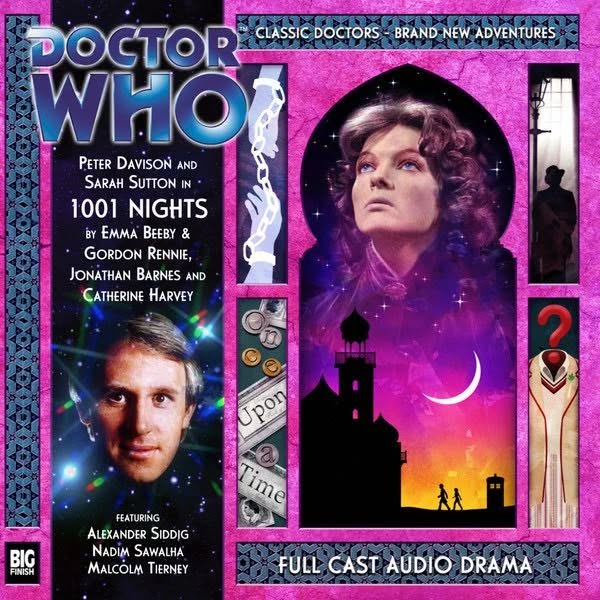
1001 Nights takes the Fifth Doctor and Nyssa, throws them into a perfumed palace ruled by a clever Sultan, and then decides that the best way to tell a Doctor Who story is to tell several Doctor Who stories while somebody tries not to get murdered. I approve.
The framing device is the star. Nyssa is imprisoned by the Sultan and forced to entertain him with tales of her travels with the Doctor, buying time while the Doctor investigates a mysterious prisoner and tries to work out why someone appears to be impersonating him. It gives the whole anthology the flavour of *The Arabian Nights*, with each adventure becoming another layer in the mystery. It is a clever structure, and Sarah Sutton gets to carry an enormous amount of the drama.
The first tale, My Brother’s Keeper, takes the Doctor and Nyssa to an isolated asteroid prison containing a solitary prisoner and his equally solitary warder. It’s a story about trust, isolation and the question of who is actually the prisoner when both sides are trapped by the same situation. The ideas are good, although the resolution is quick.
Then comes The Interplanetarian, which is basically Doctor Who does demonic possession. Nyssa becomes host to an alien entity and the Doctor has to play space-age exorcist. It’s fun enough, and Peter Davison throws himself into the silliness, but it’s the weakest of the three tales. The possession narrative is familiar, and Nyssa’s connection is barely exploited.
Then we get Smuggling Tales, and suddenly somebody has turned the good stuff back on. This is my favourite of the three, because its central idea is gloriously weird: a society where stories themselves function as currency. The tale folds storytelling into its own narrative structure, playing with the value of information and the idea that a good story can be worth more than treasure. It gets deliberately tangled at points, but that’s part of the charm.
And then the framing story comes roaring back for the finale.
The Doctor and Nyssa’s situation becomes increasingly sinister as the Sultan’s true intentions emerge. He’s not merely interested in Nyssa’s stories. He’s fascinated by the Doctor’s identity, and eventually attempts to steal it for himself, hoping to use the TARDIS to escape. It’s a lovely conclusion to an anthology obsessed with storytelling and identity. Who you are can become a story other people tell about you, and the Doctor’s identity is perhaps the most powerful story of all.
Alexander Siddig is excellent as the Sultan, balancing charm and menace, while Sutton gets strong material. Jamie Robertson’s sound design also gives the palace an appropriately dreamlike atmosphere.
Final Thoughts
A clever, varied anthology held together by an excellent framing story. Not every embedded adventure lands equally, but the Arabian Nights structure works beautifully, the performances are strong, and the final exploration of identity gives the whole thing a satisfying thematic spine.
4 out of 5 increasingly desperate Sultans demanding one more story before everyone can go to bed