Clash of the Princes

The Fighting Fantasy gamebooks by Steve Jackson and Ian Livingstone were blockbusters of the era. Today we are caught between two powerful combatants as they enter into a mighty Clash of the Princes!

In 1982, Steve Jackson and Ian Livingstone, founders of Games Workshop, released the book ‘The Warlock of Firetop Mountain’. Intended as an introduction to tabletop role-playing games of the era, the book’s choose-your-own-adventure format mixed with simple dice-based combat proved massively successful, giving rise to a full series of books – Fighting Fantasy. With over 65 books in the series by a legion of authors and illustrators, the series’ legacy continues to this day. Come along with us as Cybe and co play through each one – with no prior knowledge, no hints or walkthroughs and no cheating!  

Before continuing, please be aware that all of this content is made possible by the goodwill and support of my backers on Patreon. If you enjoy the work on this site, please consider supporting the creation of more content like this by clicking the button.

Clash of the Princes is perhaps the most unique of the Fighting Fantasy series. It’s slightly rarer than Steve Jackson’s Sorcery series, and is the only FF book (outside of Fighting Fantasy, The Riddling Reaver, and Dungeoneer/Blacksand/Allansia) that have multiplayer capabilities. It also predates these multiplayer books by several years, I believe. What is the big pull for this book? Well, it’s two-player. And it’s two books.

Two-player gamebooks weren’t unknown, but were better known under the ‘Duel Masters’ series, which really captured and perfected their form. With Clash of the Princes, each book could be played solo, unlike the ‘Duel Masters’ series. But the real heart of Clash of the Princes was the impression of freedom that it gave the players. The very first choice you make in the game, for instance, is if you want to work together or not.

But as I said, it’s also one of the rarer Fighting Fantasy adventures. This is mainly because it was sold as a box set of both books. Many bookstores simply didn’t know what to do with this big box – split them up? Display them separate? And then there was the price tag, which was a hefty £3.50. Can you imagine, two books costing that much? For 1986, that was crazy money. Let’s say that you’re 9 years old, your parents usually can be coaxed into indulging you with a Fighting Fantasy book for £2 every couple months or so. Now try begging them for one that’s almost twice that much!
Of course, books don’t cost anywhere near that little these days. Except for my book, that is – available on Kindle now, if you’re interested.

But anyway, the first book (The Warrior’s Way) sets you as Clovis, fighter-prince. The second book (The Warlock’s Way) sets you as Lothar, mage-prince. Both princes are sent out into a world full of crazy mad things that want to kill them, and told to find a magic gem in order to prove that they are worthy of ruling their nation. I am unsure if this is a good means to select a ruler. On one hand, I doubt that David Cameron could complete a quest any more dangerous than kicking a disabled person. On the other hand, I can’t really picture Clovis’s great-grantfather, Mad Douglas the Demented, would have much grasp on the economic nuances of ruling an entire empire when his only claim to rulership is that he headbutted a gryphon to death and nicked its ruby.

Clovis, the warrior, plays exactly the same as your typical Fighting Fantasy adventurer. Lothar, the warrior, has less skill points – but makes up for this with a number of magic points, which he can use either when the text allows him to cast a spell, or before combat to give him a variety of stat boosts or injure his opponent. I’d generally suggest that of the two players, the less experienced FF player take Clovis for the first few playthroughs.

Me and my partner decided to give this a shot. In order to keep both players synched up, we are required to record Status and Action scores. Both scores are essentially little more than flagpoints, but they work very smoothly. For instance, we might come to a section where Lothar has the chance to lay a trap for Clovis. If he does, he would change one of these two scores to a set number, and then continue on his way. When Clovis gets to that point, he is asked to look and see what number is set. If the score is set to the number associated with the trap being set, then Clovis would fall into the trap – otherwise, play continues as normal. This method of synching is very smooth and works surprisingly well.

As an example for this – the first choice we are asked to make is to decide if we want to travel together. I was playing Lothar, my partner was playing Clovis. Lothar wanted to travel together, so the text told me to change the Action score, and wait until the Status score changed. When Lothar changed the Status score, the text told me to turn to a paragraph (“If the Status score changes to X, turn to section Y. If it changes to anything else, turn to section Z.”) Section Z would mean that Clovis didn’t want to journey wth me and ran off on his own. You follow? No? Tough!

We decided mutually to travel off together. It wasn’t long before we come across a villager who tells us that his home has been over-run with orcs. Those pesky orcs, they’re worse than woodlice. We decide to split up, with Clovis charging in through the door whilst Lothar opens the window and chucks spells into the house, assuming that the villager doesn’t mind the inside of his home being consumed in a myriad of fireball spells. Unfortunately, Lothar’s plan fell apart when he got caught in a magical rope snare that was waiting at the window, leaving Clovis to chop his way through a bunch of unhappy orcs.

Clovis freed poor Lothar and claimed the majority of the loot for his trouble. Together the two hurried along to their next location, a large bridge across a vast river. The bridge, more a small fortress, had an upstairs area which was abandoned. Together the two princes hurried upstairs, only for Clovis to be caught by a giant moth. Lothar saved the day by turning the moth into a mouse (he had the option to cast a fire spell, but given that Clovis’ player was screaming for him not to use any fire because that would result in surely certain death, he went for the more sensible choice of spells). Lothar took some of the moth’s silk as a reward, and then promptly fell down a hole in the floor and got swept away by the river.

With both princes separated, they began their adventures apart. Clovis crosses the bridge and ventured north, going onwards until his path ventured into a small valley. The walls of the valley grew narrower and narrower, until they were wide enough for only one person to walk. Then Clovis seen someone in the distance. It was himself.

Realising that he was standing in front of a giant mirror that some mad bugger had installed in the middle of a ravine (and really, who does all this stuff? Fighting Fantasy books are replete with odd bits of geographical features that could only have been put there by mad buggers), Clovis stands around looking confused for a while. Then his reflection steps out from the mirror and tries to kill him. It’s a tough fight, because the mirror image had the same stats as Clovis, but Clovis is able to win through. No sooner has he killed his reflection, however, than Clovis begins to fade away. Without a mirror of his own to create a new reflection, he fades out of existence.

Lothar, meanwhile, fares no better. He drags himself out of the river and trecks across the landscape for a while until he encounters a lake. A group of boatmen tell him that it is the Lake Of Death (with capital letters, no less), and that it is filled with venomous , flesh-eating fish, which are also invisible!

Lothar, being no rube, tells then “You’re having a laugh, mate. Pull the other one!”. He isn’t stupid enough to fall for such a blatantly fake and utterly moronic story, especially not when it’s coming from a bunch of boatmen who are asking for almost every penny Lothar has in order to ride him across the lake, which is only a yard deep anyway. So the warlock-prince wades out into the lake to cross it. Whereupon he is promptly eaten by venomous flesh-eating invisible fish.

So ended the royal line.

I like to think that in the aftermath of this tragedy, the regent decrees an end to mad buggers installing geographical features at random and a cull on all implausible nonsensical monsters. But frankly, that wouldn’t be half as much fun. Early FF books really captured this sense of whimsical madness perfectly, and this is a wonderful example.

Clash of the Princes plays spectacularly. It has a whimsical atmosphere and a system that compliments it excellently. It is also fiendishly difficult in the traditional Fighting Fantasy manner. Playing it is a joy – the game advises that you play in silence and only talk with the other player when instructed to, but we had so much fun comparing the madness that occurred when we went our separate ways that we couldn’t resist speaking. I would recommend that if you love your Fighting Fantasy books, scrape your way through ebay to find a copy of this one. It tends to go for about £15 these days, but it’s worth it.

Cause of death: Eaten by venomous invisible fish.

The Port of Peril

The Fighting Fantasy gamebooks by Steve Jackson and Ian Livingstone were blockbusters of the era. Join us as we make a deadly venture back into the dreaded port Blacksand – The Port of Peril!

In 1982, Steve Jackson and Ian Livingstone, founders of Games Workshop, released the book ‘The Warlock of Firetop Mountain’. Intended as an introduction to tabletop role-playing games of the era, the book’s choose-your-own-adventure format mixed with simple dice-based combat proved massively successful, giving rise to a full series of books – Fighting Fantasy. With over 65 books in the series by a legion of authors and illustrators, the series’ legacy continues to this day. Come along with us as Cybe and co play through each one – with no prior knowledge, no hints or walkthroughs and no cheating!  

Before continuing, please be aware that all of this content is made possible by the goodwill and support of my backers on Patreon. If you enjoy the work on this site, please consider supporting the creation of more content like this by clicking the button.

2017 brought us many things. A sequel to my all-time favorite movie, Blade Runner (opinion on it is reserved). Real-life college professors living the Indiana Jones dream of punching nazis. A growing sense of unease in our international political landscape. But more than any of that, Scholastic released a reprint of classic Fighting Fantasy books. Including a brand new title, The Port of Peril. Let’s get stuck right into it.

We begin the adventure as a penniless down-and-out hero, struggling to survive on the streets of the port city of Chalice. The history of the city is described in lavish and loving detail, and draws you into the setting with whole swaths of atmospheric description. Despite starting the adventure with ten provisions, you are told that you are near-starving and in desperate need of gold to buy your way in life. Thankfully, you happen across a discarded old treasure map. Handy, that.

Now armed with a treasure map that is sure to lead us to riches, we begin our journey by turning to section one of the book, wherein we find a discarded tomato sandwich which saves us from starvation, allowing us to regain one point of stamina that we couldn’t have possibly lost yet because we’re only on the first section of the adventure. So, uh, off to a good start? I distract myself from this editing gaff by speaking to a street-sweeper, who kindly informs me that he will sell me some honey in exchange for some old nails that I happen to have in my backpack. I’m unsure if I’ll ever actually need the nails anyway (I’m not sure why I would, but you never know!) so I turn his offer down, on account that I am already so packed with provisions that I’m not sure why I need to eat discarded tomato sandwiches anyway.

I assume that the best place to go would be to leave the city and head off on the route discussed on the treasure map, so I decide to visit Armoury Lane in the hope of finding some useful items. In a store owned by a large cyclops, I have the option of buying a dagger in exchange for ten gold pieces, but as I cannot yet afford this I leave the store empty-handed. Heading to the end of the lane, I come to a timber yard, where I’m offered a job lugging lumber around for a few hours. After several hours hard toil, I ask to be paid, only for the manager to tell me that he won’t pay me. I guess he’s not fond of unions, either.

Naturally, a fight ensues. After an apt redistribution of wealth that would make Karl Marx happy, I leave the timber yard with a far happier coinpurse, an iron key, and only a few bruises to show for it. There’s two other alleys that catch my eye, Silver Street and Beggar Alley. I head to Beggar Alley, and share some of my newfound wealth with the locals. In return, one of them tells me a nice story of a friend of his, a mad ol’ bastard who took great pleasure in leaving booby-trapped chests of gold around the place. The moral of the story is not lost on me. Hoping to pry for a little more information, I ask for an opinion on the treasure map, only to be told that the map is written in ink and that the X must mark the spot. This valuable information costs me a copper piece. Glorious.

I trudge on to the far end of the alleyway, finding a small barrel nearby. Overcome with curiosity, I open the barrel, only for a pair of rats to jump out and attack me. After batting them away (they are only normal rats, not giant ones), I find that the barrel contains some rags and a dead dog. Hmm, is this book by Ian Livingstone? I decide to knock on a nearby door and ask a local exactly what is going on. “What?” screams the local, “No bloody door-to-door salesmen!” he replies before clubbing me over the head with a table leg. Yeah, this is definitely one of Ian’s books.

I reach a street which consists of houses, shops, and a large walled mansion. I’m given the option to peek into the windows of the houses, which I do, only for a lady from the upper floor to throw her chamber pot at me. I’m having flashbacks to my death in Khare, Cityport of Traps. Dodging the chamberpot, I go to the shop instead and buy a set of random brass keys. The only other option left to me is to try to break into the mansion. I don’t actually want to do this, but the adventure is written in such a way that my choice is either to go back to the house-peeping, the shops, or the mansion…

So with the help of two random bakers, I clamber over the wall, kill a pair of guard dogs, trudge up to the front door, ring the bell, and ask the butler if the owner of the house is interested in hiring me as a bodyguard. He’s so impressed with my determination and skill that I’m hired on the spot… actually, no, I’m dragged off to a cell under the mansion to rot. Wait, under the mansion? So, the wealthy in Chalice are basically allowed to imprison people without due process? Huh, good to know. Anyway, using the iron key that the orge from the lumber yard had on him earlier, I’m able to escape the cell. Why would he have the key to the cell under the mansion? No idea, perhaps he was a former guard there.

Anyway, I steal a decorative sword from the mansion’s gallery and flee the city. Finally out of Chalice, I hope to press on to the nearby Moonstone Hills. Leaving the beaten trail through the countryside and munching on a piece of corn that I’ve ‘borrowed’ from a field, I come across a ruined old farmhouse. Inside, we slay a few man-orcs and head down into the basement, which we are told reeks of death. In a flashback to Night of the Living Dead, I’m attacked by a zombie. Upon killing it, another man-orc wanders in, basically turning this section into a series of bloody gruesome combat sequences. After getting through it all, though, we are suitably rewarded with a bracelet of power, which raises my skill. And a jar of sheep’s eyeballs, if I want that. Oh, what the hell, I’ve carried worse things in these adventures.

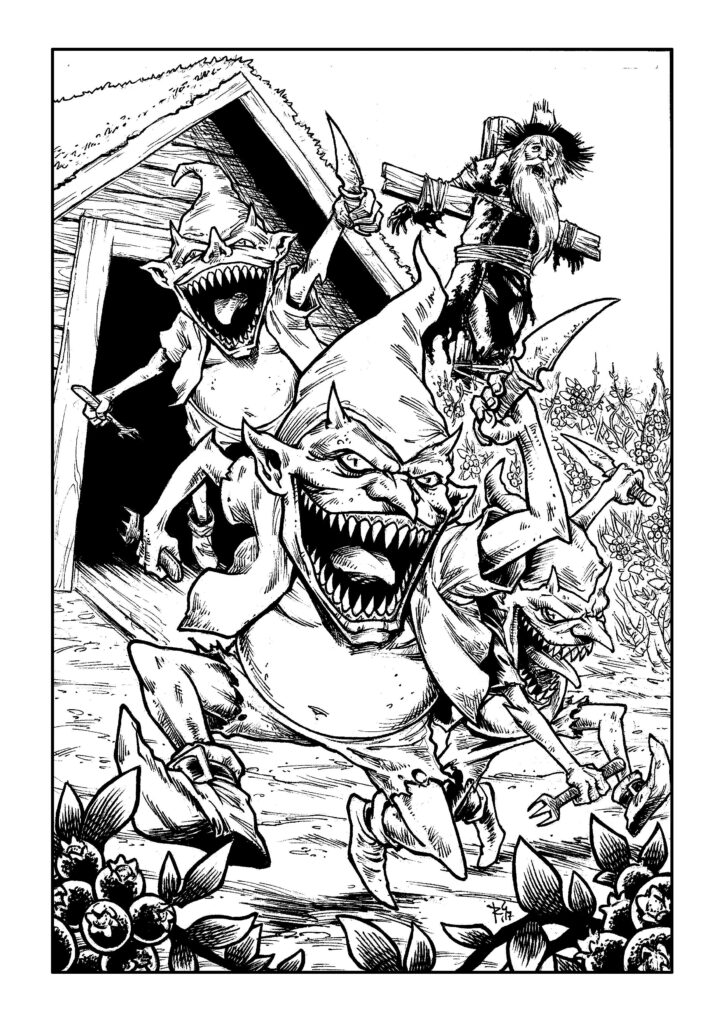
The next stop on our trail is a small shack with a scarecrow outside. On closer inspection, the scarecrow is actually a man who has been tied to a stake, and the inhabitants of the shack are imps. Slaying the imps, I rescue the man who rambles endlessly about blueberries until I wish I’d left him there. Thankfully I am able to claim a few jars of generic items like firewater juice as a reward for my efforts. Continuing along my trail towards the hills, we reach the point of stopping for the evening. I make camp.

The morning comes, and I decide that I’ve had enough faffing around and push on at full speed towards Skull Crag. I arrive there without too much difficulty, and as per the instructions on the map I climb up over the cave mouth to find a second entrance. Clambering inside, I find my way into a network of caves. Following the map’s instructions, I quickly find a dead adventurer. As I’m wont to do with dead bodies, I steal everything they have – a nice set of chainmail.

The cavern opens up into a chamber full of strange creatures called Gronks, who are quite poisonous. Thankfully, scarecrow man gave me some wax which, when applied to the wounds, ensures that I don’t die in great agony. Glad that I won’t have my nice new set of chainmail taken from my corpse by a greedy adventurer after I die of Gronk poisoning, I head further down the tunnels until I come to another opening, this one containing a large green dude who is in the process of cooking… something… in a large cauldron. As I enter, green dude is in the process of singing a happy song about how much he loves the taste of eyeballs. Well, guess that jar of eyes wasn’t useless after all. I hand them over, and he agrees to let me keep my own eyes. How kind…. Or not. Actually, he takes the jar and attacks me instead. How kind.

By this point, I’m running quite low on provisions but my stamina is fairly stable. Feeling quite confident, I push onwards through the caves. The final chamber, full of crystals, is home to a giant worm, which I kill without too much difficulty. I find the treasure chest, only to discover that it contains a small wooden box – the same kind of box that the beggar earlier described as having been made by his old friend, Mad McBoxexplodey. I pocket the box and retrace my steps back out of the cavern.

Leaving the cave, however, something interesting happens. We meet a friendly woman ninja, who kindly offers to join in our adventure. As with most Fighting Fantasy companion NPCs, I expect her to die immediately, but to my surprise she sticks around for a while, fighting some hill trolls and helping me to open McBoxexplodey’s box (which, as it turns out, contained poison gas rather than explosives, but I don’t feel like changing his name at this point in the adventure). We chat for a while and she tells me that she wants to help me out on this quest, mainly because she’s a bit bored. Well, better than nothing!

We head out on the trail of McBoxexplodey, hoping to find the ORIGINAL treasure from the chest! We trudge around the countryside for a while until, all of a sudden, PLOT HAPPENS!!

We catch sight of a giant war-hawk, a huge bird, carrying a vast basket. In mid-flight, the bird drops the basket, which crashes to the ground along with the sound of a person’s screams. We hurry to the crash site, slaying the bird, to find a fatally wounded stonemason who was riding in the basket. The man has been injured by the other item in the basket, a huge stone statue called a Keystone. The man explains that he was blackmailed into creating the Keystone by the servants of Zanbar Bone, the big bad of City of Thieves. He was on his way to place the Keystone at Yaztromo’s tower, which would channel the magic of the tower into the ritual of Bone’s resurrection. The stonemason explains that he will never see his wife again, who had been kidnapped by Bone’s minion, but pleads with me to save the world and THE PLOT FOR THIS STORY LITERALLY FELL FROM THE SKY.

We push on towards Yaztromo’s tower, burying the stonemason and… uhh, I don’t know what we do about the keystone, the text wasn’t too clear. We head on towards the forest, killing spore monsters and bandits, and eventually stumble by sheer luck into the home of McBoxexplodey. We wait around and eventually he returns, and in exchange for some gold agrees to tell us that he’s actually really, really sorry for having killed all of the people he did with deathtrap boxes (slap) and offers to help. He tells me that the only person who can stop Bone is Nicodemus, the wizard of Port Blacksand. In a curious twist of fate, the treasure chest in the crystal cave initially held Nicodemus’ magic ring, which is important to stopping Bone. McBox used to have it, but it was stolen by a chaos warrior in the service of the evil Lord Azzur, also of Port Blacksand. Looks like we know where we’re going next! But first, we have to warn Yaztromo that the evil minions are looking to steal his tower for their nefarious purposes.

After a few uninteresting encounters, including one with our old dwarven associate Bignose from the old classic gamebook, we arrive at Yaztromo’s tower. The wizard greets us, and is perplexed as to why his tower is transforming into a sinister black shade of colour. I tell him that it’s due to Zanbar Bone’s magical resurrection, and Yaztromo agrees to invite us in. That night, we have dinner and we get to learn a bit about Bone’s backstory and history, establishing him a little bit stronger than in the City of Thieves book. This bit of backstory is actually really nice and works very well with the narrative.

The following morning, Yaztromo grants me his horse and gives me a magical buff to my combat skill, and I ride off into the distance, leaving our ninja companion behind at the tower. Our destination, Port Blacksand. We eventually arrive at a small town on the outskirts of the port, where a suspicious lady offers to ‘take care’ of my horse in exchange for a boat, which I could use to sneak past the guards at the gate of Blacksand. Not wanting to risk having my lovely new horse stolen, I tell her no. We then proceed to ride up to the gate of Blacksand, pay the guards their requested entrance fee, only for them to immediately drag me off the horse and throw me in prison because they’re crooked evil bastards. My journey ends here.

So, uh, this was a rather nice book. It’s not great, though. It has some nice moments, and the idea of the main plot appearing during the adventure rather than being outlined right at the start is okay, but the story leaves it far too late. In terms of narrative flow, that’s the reveal that should be left for the end of the first act, not closing near the end of the second. In any case though, as with all of Ian’s books, there’s plenty of instant-death moments that make it especially brutal. The combat sequences are all fairly easy though, which does balance that out a little, but overall I think the book could have used some more testing before release.

Good points, though, is that it incorporates a lot from the classic series, which the last FF book (Blood of the Zombies) didn’t. That’s really nice, so people who want more of Allansia lore would enjoy that. Sadly, one of the biggest let-downs with this book was the illustrations. I know for a fact that the original internal illustrations were coloured art pieces, but the poorer mass print quality of the paper has left them as muddy and unpleasant-looking. For a book which is mass produced like this, art illustrations should either be depicted in full colour (which these aren’t) or limited to pencil and ink line sketches.

And worst of all, upon finishing reading this book, I noticed that part of the gold foil on the spine had rubbed off, leaving a white smudge across the title. Come on Scholastic, doesn’t this series deserve better?

Cause of death: Rotting in a cell in Port Blacksand.

Blood of the Zombies

The Fighting Fantasy gamebooks by Steve Jackson and Ian Livingstone were blockbusters of the era. It’s time to witness the rise of the undead as we return to Earth, in BLOOD OF THE ZOMBIES!

In 1982, Steve Jackson and Ian Livingstone, founders of Games Workshop, released the book ‘The Warlock of Firetop Mountain’. Intended as an introduction to tabletop role-playing games of the era, the book’s choose-your-own-adventure format mixed with simple dice-based combat proved massively successful, giving rise to a full series of books – Fighting Fantasy. With over 65 books in the series by a legion of authors and illustrators, the series’ legacy continues to this day. Come along with us as Cybe and co play through each one – with no prior knowledge, no hints or walkthroughs and no cheating!

Before continuing, please be aware that all of this content is made possible by the goodwill and support of my backers on Patreon. If you enjoy the work on this site, please consider supporting the creation of more content like this by clicking the button.

Hmm, wouldn’t it be interesting if Blood of the Zombies is set in the same universe as House of Hell? Gingrich Yurr could have been an old friend of the Earl of Drummer. Neat!

Blood of the Zombies is the second Fighting Fantasy game set in a modern world. It was released for the series’ 30th anniversary, and you no doubt already know this anyway. Otherwise, why would you be reading this? My copy must be second-hand, because it has someone’s name written inside it, Ian something-or-other. Honestly, some people!

Anyway, the biggest thing you’ll notice in this book is that the combat system has been completely reworked. Now, you have only one stat – stamina. Each zombie you encounter has only one stamina point, meaning that each hit you deal will kill one zombie. How many you can hit in each turn is determined by the type of weapon you have – a baseball bat deals 1 dice worth of damage, while a shotgun will deal 1 dice + 5 points of damage. You make your attack first in each turn, and then you receive one point of stamina damage for each zombie that is still surviving.

This means that, just like in the classic zombie Romero movies, it is fairly easy to dispatch one or two zombies on their own, but far harder to deal with them in swarms. And speaking of Romero zombies, let me just say here – fast zombies are stupid. They’re not scary, they’re just generic monsters that jump out at the characters. The reason Romero’s slow zombies are scary is because you underestimate them. On their own, a single one is no threat. So you don’t worry about it. If there’s two of them, well, still no real threat, they’re easy enough to get rid of. When it gets to five or six of them, well, it could be worse… but because you underestimated them when there were only a few, their numbers grew. You became complacent. Like the birds in ‘The Birds’, the next time you glance their way, there are hundreds of them. And suddenly they don’t seem so silly any more.

And you have nobody to blame for that, because you underestimated them. Your worst enemy wasn’t the zombies, it was yourself. Which hits right in with another key theme of Romero’s work – that the real threat doesn’t come from the zombies, but from human nature.

Do you think this will help me out at all during the game? Here’s a clue – NOOOOOOOOOOOOPE!!!!!!!!!!

I wake up in a cell in the basement of a dingy old castle. After having been kidnapped during my explorations in Romania, I am being kept alive for an unknown reason. My guard, a gruff and cruel man by the name of Otto, is the only light in my otherwise dreary daily cycle, and by ‘light’ I mean ‘person who comes into my cell and kicks me’.

One day, after drinking down a bowl of gruel with my feet (and being the envy of contortionists around the world while I do so), I decide that enough is enough and tell Otto that he smells like a bag of dead frogs. This sends him into a raging fury, during which time I kick him in the gut and grab his keys for my shackles. I lock him up in my place, and proceed to interrogate Otto.

He tells me that he is a poor man who is treated cruelly by his evil master, Gingrich Yurr, and is kept here as a virtual prisoner himself. Awww, poor Otto. I feel so sorry for him that I almost want to not kick him in the ribs a few times in revenge. I leave, and soon find my way into Otto’s bedchamber. I proceed to raid his entire belongings, steal a stylish backpack he happens to own, and snarf down what’s left of Otto’s dinner. Trust me, the guy deserves it.

Otto’s room also contained a small penknife, which I took as a weapon, because I currently had nothing at all to my name. I also helped myself to his whole wealth of $15, and a piece of string. Because string is the most useful thing in the world. No, really, you try escaping from a castle full of zombies without some string!

Toddling down the hallway, I found a small bag that contained some matches, a pen, and a key with a number ‘9’ engraved on it. One thing I’ve learned is that keys with numbers on them are always useful. Eventually I found my way into a store room, which to my surprise was inhabited. Two of Gingrich’s goons, who didn’t seem the most loyal of chaps, were quite willing to tell me his entire evil plan – for a small bribe, of course. Ah, good to know that money still buys henchmen loyalty. Here’s what they told me…

Gingrich Yurr is evil, and is amassing an army of zombies in order to take over the world.

Y’know, sometimes I think that these insane villains need to watch a movie sometime. Just so that they can get an idea about how this is all going to turn out. The henchmen then tells me that I will need to kill EVERY SINGLE ONE of the zombies. There’s even a space in my sheet to record how many zombies I kill. So I’m immediately left with a feeling that this is going to be very, very important. I’m then given the chance to buy some of his supplies, so I spent my remaining $5 on a hacksaw, a pair of rubber gloves, some batteries, glue, and sticky tape. I think these are sensible choices, I mean, it’s still cheaper than my local hardware store!

Thanking him for helping me in my work of saving the whole of humanity from the horrors of the undead (and charging me money while he does it!), I head on my way and soon find my way into the launderette. I’ll say one thing about Yurr, he’s fully planned out what he’s going to need in this castle. Seems that someone left a sports bag in here, which contains my first really useful weapon – a baseball bat. Sure, it’s not a cricket bat (which anyone who’s seen Shaun of the Dead will tell you, is the best thing for taking care of zombies), but it’ll do in a pinch.

Speaking of which, two zombies burst out of the cupboard in back of the launderette. My first encounter with them, and the dice are on my side, I manage to beat them both down with my newly-acquired bat without breaking a sweat. Nice work!. I finish putting on a change of clothes, grab some items out of the cupboard (a first aid kit and some bullets, which will be very useful if I ever find a gun) and make my way out of the room.

I make my way down the hallway, deciding not to open one small door I encounter, and eventually come across a stale old mattress that’s resting against the wall and obviously blocking a doorway. I push it out of the way and head through the hidden doorway, finding my way into an old and disused workshop. Before I even have a chance to look around, I am set upon by a swarm of eight zombies. I’m able to dispatch five of them in the first round, and the others in the second round of combat, leaving my health down by three points. As you see, taking on a large number of them at a time can be pretty deadly, and I’m hoping to find something better soon.

Taking a pair of blacksmithing tongs with me, I find a door hidden behind a curtain. It’s locked, but the key I found earlier unlocks it without any trouble, leading into a coal storage room. Buried in the coal, I find a grappling hook – making me wonder why anyone would bury a grappling hook in a pile of coal? I press on into the boiler room, where I’m able to bandage up my wrists (still sore from being chained up for so long) and dispatch three other zombies before I find a real treasure – a crowbar. If my hunch is right, this crowbar is going to be very useful in this adventure!

I follow the doorway back out of the boiler room and emerge into a main hallway of the castle. I’m instantly beset by four more zombies, and this time my dice are not too lucky. I’m forced to use my medkit from earlier to patch myself up. But my perseverance is rewarded, because on one of the zombies I’m fortunate enough to find my first real strong weapon of the game – a pistol. I will call her ‘Zombie-Killer the first’, and she will claim many deadites.

The crowbar is instantly useful because I find a wooden crate in the hallway, which contains two grenades. These are going to be awesome, dealing 2d6+1 damage each. Sadly, I have to part with one of them very soon. I pry open a manhole cover that leads down into the sewers, thinking that it’s unlikely that the zombies will have got so far down into the bowels of the castle. As I head down, I’m beset by a creature that isn’t quite zombie, but certainly isn’t human – a pack of fifteen giant mutated rats. Sadly there’s too many for me to be confident in shooting the lot, so I lob a grenade down into the tunnel to clear them out. This does a good job, and I’m able to clear up the remaining rats with my pistol.

My hope of the sewers being empty of zombies proves to be a pipe dream though, as I soon find two of them lurking in the tunnels. After shooting them down, I notice that one of them is carrying a locket that belongs to a woman called Amy Fletcher. I’m hoping this will be of some use to someone, but probably not for a while yet. I push on through the sewers, until the tunnel becomes too narrow, and my hopes of escaping from the castle by means of the sewer tunnels evaporates. I do, however, stumble across a scrap of paper that contains the combination lock for a safe, should I ever need it.

Emerging from the sewer, I swallow my sadness at having never met any mutant turtles and wonder how high my dry cleaning bill will be this month. Squealching through the hallway, it’s not long before I see a painting on the wall of a man. He has a cruel glare in his eyes, a flashy sports car in the background, and is holding a white rabbit. It’s a painting of Gingrich Yurr, which tells me that I’m pretty sure he had the rabbit for dinner later that same day. Even better, behind the painting I find a hidden cabinet, which contains… a shotgun! Groovy!

After refreshing myself in the cleaner’s cupboard, I start to head up the stairway when I run into an encounter that would no doubt kill me outright had I not found my trusted Zombie-Killer the second. A swarm of twelve zombies meet me on the stairway, each dragging weapons with them, each strong enough to deal two damage points rather than a simple one! This fight is rough, and although I’m tempted to use my grenade, I’m still able to emerge victorious without wasting it. But my health is down by almost a half at this point. I hope I’ll be able to find another health kit soon.

I get to the top of the stairs, and soon find my way into the games room. I like the games room, because it has a shelf full of Fighting Fantasy books which I could sit and read. Maybe it should be called the ‘breaking the fourth wall’ room. Sadly, the only thing I find in this room that’s of any immediate use (aside from a copy of Warlock of Firetop Mountain) is a safe box which is locked with a key that I do not possess. Sadly, I leave the room, wishing I could stay and play a few rounds of Arkham Horror.

As I enter the next room, my trusty crowbar betrays me. It slips on the locked door and hits myself on the knee, knocking my stamina down to eight. After I burst the lock open, I find that this new room holds a swarm of seventeen zombies… yikes! The book (wisely) advises that I chuck my last grenade into the room. I do so, and… what kind of sound do exploding zombies make, do you think? It’s easy to pick off the remaining ones, and for my effort I am rewarded with being able to retrieve a box from the room. It contains $15, an empty plastic bottle, and bullets that I already have. I feel like I wish I had skipped this room and kept my grenade.

I keep on walking down the hallway, when I come to a box that has a note pinned to it, which reads ‘do not open’. At first I’m about to open it, but then I think, who wrote the note? It’s not a zombie, so it must have been a person. And I assume that they’ll have put the note on there for a reason, so I guess that maybe the box contains a pack of flesh-eating zombie ferrets or something. I leave it alone, and enter the library.

Dispatching two more zombies, I manage to find a rather interesting book that documents the history of zombies from their days of carribean myth. I also find a hidden switch which, when I push it, fires a poison dart into the back of my head. Why would you have this sort of thing in your castle? Oy… My stamina’s now down three, so I guess that I’m going to either die or find a health pack real soon. I keep bumbling around with the switch until it makes a hidden doorway slide open.

I’m pretty excited when I enter this secret passageway, as I’m hoping it’ll lead me to a room full of health kits and grenades. Instead, it leads me to a room in which 19 zombies are locked. They break loose. The following death scene is reminiscent of Dawn of the Dead, so I’m sure to shout “Choke on them” to whichever zombie is eating my leg.

I can’t complain. I played a gamebook called ‘Blood of the Zombies’, and got eaten by zombies. There is nothing about this that is not perfectly in keeping with the theme of the game.

I loved this gamebook, it is fiendishly difficult just as I’d expected from Livingstone. I killed 50 zombies with this new combat system, and the way in which it works means that the player spends a lot more of their time and focus on exploration and item hunting. It’s not a combat system that would work in all FF books, or indeed most FF books, but because we’re dealing with zombies here (and remembering what I said earlier about them being a threat when in a swarm), it works. And I killed 50 zombies. Fifty! C’mon, that’s pretty impressive, isn’t it? Admit it, it’s better than you’d have expected, eh?

The atmosphere is lovely, the artwork is first-rate, the way it incorporates a modern setting while remaining true to the ‘dungeon crawl’ core is excellently executed, and this is definitely an instant classic of the Fighting Fantasy series. Seriously, play this.

Cause of death: Zombie Chow.

Night of the Necromancer

The Fighting Fantasy gamebooks by Steve Jackson and Ian Livingstone were blockbusters of the era. Turn off the lights and wrap up warm, it’s bedtime – during the NIGHT OF THE NECROMANCER!

In 1982, Steve Jackson and Ian Livingstone, founders of Games Workshop, released the book ‘The Warlock of Firetop Mountain’. Intended as an introduction to tabletop role-playing games of the era, the book’s choose-your-own-adventure format mixed with simple dice-based combat proved massively successful, giving rise to a full series of books – Fighting Fantasy. With over 65 books in the series by a legion of authors and illustrators, the series’ legacy continues to this day. Come along with us as Cybe and co play through each one – with no prior knowledge, no hints or walkthroughs and no cheating!

Before continuing, please be aware that all of this content is made possible by the goodwill and support of my backers on Patreon. If you enjoy the work on this site, please consider supporting the creation of more content like this by clicking the button.

This is the last of the newer FF books that I’ve picked up. Written only a few years ago by Jonathan Green, this was the most recent FF book until Blood of the Zombies came out. I still struggle to consider the Wizard Publishing books as ‘true’ Fighting Fantasy ones, even though there’s several that are just simply fantastic books, and I’m sure that this one will be no exception.

As I return home from a long crusade against the forces of evil and darkness, I am waylaid by assassins. Among their number is a cultist of Death, who fires a spell upon me. The spell kills me instantly.

So, what did I think of this book? Well, it was short. Overall I’d give it a seven out of ten, and… Oh wait, I’m not quite dead.

My undead soul has been ripped from my body, becoming a wraith-like spirit of vengeance. I fight the cultist, showing him the fury of the un-living. He tries to banish me, but I resist too strongly and he escapes before I have the chance to beat information from him. I don’t know who it was that ordered my death, but it’s my goal to find out.

The site of my murder is a set of standing stones, called the Nine Sisters. In the ethereal light of the moon, the spirits of the stones elect me as their champion, fusing me with ancient power. This raises my stats somewhat, which is rather nice as I’m unsure quite how dying would affect my stamina score. No, seriously. This is something of a mystery to me at this stage. As I receive the power from the standing stones, I find a portal which seems to lead off into the realms of the dead.

I step through the portal, and find myself in what I assume to be some kind of nexus of the spirit world. Up ahead is what I can only describe as a doorway to hell (or more accurately, the hereafter). I feel vaguely drawn towards it, but I’m strong enough to resist it. I emerge from the portal with a new codeword, as my Will score is sufficiently high enough that I do not get drawn into the hereafter. Returning back to the earthly realm, I decide that it’s high time I stop faffing around with ethereal ghostly energies and go talk to someone who can help me with my current problem.

Remembering the stories of an old woman who lives in the Wraith Woods not too far from here, I decide to make my way over there and speak to her. As I stumble through the woods though, I am beset by the terrible Baron Blood, the spectral huntsman, and his hunting party. I try to hide in the undergrowth, but his hounds manage to drag me out of the shrubbery, kicking and screaming.

Blood gives me an ultimatum – he wants to have some sport, so asks me to run to a nearby tree before his dogs can catch me. If I get to it, he’ll leave me alone. So, I start running. So do the dogs. They run faster. They catch me and use me as a play-toy. Then Mister Blood takes my soul off with him, and I awake back in the realm of the dead. It’s pretty clear that I’m going to wind up here each time that I ‘die’ in this adventure. This time, that big doorway I mentioned earlier that’s trying to draw me into the hereafter? Well, there’s things in it. Bad things. Things I have to kill. It’s called a Sin Eater. And it looks like bad nightmares.

I manage to kill the thing, rather more easily than I had anticipated, and claw my way back out of the realm of the dead and into the woods once again. It isn’t long until I’m able to find the hut of the Wise Woman. Now, there’s three things you need to know about the Wise Woman. The first is that she’s a Woman. The second is that I think I’ve made this joke before. The third is that, when she offers to summon a powerful netherworld imp that will answer the questions about who ordered my murder, the imp states that he cannot say as he is bound by another power before he rips the old woman’s throat out and tries to kill me.

Wiping some demonic imp blood off my ghost-sword, I head off to the village of Sleath instead. The route to the town passes through a graveyard, and the spirits of the dead ask me to aid them. It seems that they are being bothered by a Grave Golem (like a Clay Golem or a Flesh Golem, but it’s made out of Graves). One thing I’ll say about Jonathan Green’s books, they’re full of imaginative monsters.

I’m making pretty good progress when I get to Sleath. Upon entering the town, I’m attacked by the external personification of the town’s nightmares – a vivid cloud of billowing insanity called a Phantasmagoria. Actually reminds me something of one of the monsters that I fought in Black Vein Prophecy. Which in turn reminds me of the Angels from Evangelion, which in turn reminds me of the Colour Out Of Space, which in turn reminds me of fractals, which in turn… anyway, I kill it.

While I puzzle over how I can kill something that doesn’t quite have a body of its own, I notice that the town has a spiritual medium called Zelda who owns a little store in town. I hurry on over, hoping to possess her and re-enact the pottery wheel scene from ‘Ghost’. Zelda agrees to read my fortune in her crystal ball, and (much to her own surprise) gives me some rather useful information, such as not to trust someone who believes only in good.

I decide to head into the local tavern, hoping to terrify some foolish mortals. To my surprise, I find that I have developed a few ghostly powers – I can pass through solid walls and I can conceal myself in shadow. Very nice. Anyway, inside the tavern is a ghost hunter who seems only to believe in the power of good, so I decide to avoid him and check out the local chapel instead. Surely that’s a bit more safe, eh?

Pushing through a ward of protection (which bloody well hurts and knocks my stamina really low), I encounter a ghost of an old paladin. He tells me that he can sense great evil in the land, and offers to help me if I can answer a puzzle for him. It’s a reworking of the old ‘a man was going to St Ives’ puzzle, and I get it right, for which the paladin teaches me how to use poultergeist skills to move objects with the power of my ghostly mind.

Without much else to do in town, I head to the Burgomaster’s house. The house, it seems is already haunted, and when I accidentally step on the cat, it wakes up the three ghosts who are already in residence. I manage to fend them both off and escape with only one stamina point remaining. By this point, the town has nothing to amuse me further, so I let myself be drawn back towards my family home in the castle overlooking the village.

Now, when I was alive, I was a noble and the guards would certainly have let me pass. But being that I’m currently not in possession of a body, I don’t think the guards would be too keen to see me strolling town the road to greet them. So instead I decide to crawl through the castle’s sewer to get into my old home. Sadly, the sewer is also home to a pack of giant skeletal rats. “Bite bite bite”, go the rats. And before you know it, I’m back in the land of the dead, staring at that portal to the hereafter once again.

This time, I am greeted by the grim reaper himself, in full black robes and scythe regalia. We discuss the philosophical meaning of justice and I debate the merits of having a second chance, and much to my amusement he does not ask to play chess. Or Cluedo, or Twister even. He decides to let me run around for a little while longer, because it will be a laugh for him. Yeah, nice to see that Death has a real sense of humour.

Anyway, I’m chucked back into the mortal world once again, and I’m in the main courtyard of the keep. I investigate the stables, only to find my own horse in one of the stalls. Curious. Could the death cultist who murdered me have brought the horse here? I manage to tame a spectral steed in the stables and go to the blacksmiths to investigate further. The keep’s blacksmith, a childhood friend, recognises me instantly. She tells me that there is indeed evil rooted here in my own family home.

I decide to make the most of my time by trying to see who else I can coax onto my side. I try the kennels first, and find my trusting hunting dog Korzen, who will follow me into battle. Trying the guard’s barracks, I encounter the captain of the guard, who (once I convince him that I’m who I say I am) tells me that a group of knights have been invited to stay in the keep by the chamberlain. They have forbidden my family’s guard to enter the keep proper, and my sister is imprisoned in the tall tower.

The barking of the dogs in the kennel alerts a pair of Spirit Hunters, trailing ghostly brains with tentacles (yeah, I’m not sure either) and I manage to kill them without too much hassle. I opt to sneak through the hidden tunnelways into the keep proper, and as I do, I find the dessicated husk of a truly giant spider. The narrowness of the tunnel means I have to step over it, and – oh crap it’s alive! Actually this spider is kinda unfair, because it’s brought back to life because I’m relatively healthy – if I’d been close to death, it’d have remained dead too. Anyway, it has a really, really nasty poison that serves to heal it whenever it bites me, and that’s enough to send me spinning back to that big ol’ gateway to the realm of the dead once again.

Sometimes, I wonder if stepping through this door would take me to 1920s Berlin.. sorry, that’s such an obscure reference, I doubt anyone’s going to get it. Anyway, this time the gateway gives a booming voice screaming that it will devour me and hurl my soul into the abyss, but the cries of a million souls who have deemed me the champion. I’m given one last codeword – Endgame. One more ‘death’ and that’s it, game over.

I don’t want to risk wasting any more time – I charge straight through this part of the castle and into the main drawbridge, eager to get to the final encounter as soon as possible. I hurry over the drawbridge, when something genuinely massive lumbers into view. It’s a giant iron golem that breathes fire. And… why is this a thing? What kind of insane megalomaniac castle-stealer me-murdering git builds a giant fire-breathing golem to guard his stolen castle? I mean…

My ability to hide inside shadows is almost no use here. I try my best to avoid its fire, and soon I’m able to dodge my way through, hurry over the drawbridge, and get to the large main entrance to the keep, only to find that it is painted over with large runes and scripts. It has been completely sealed against spirit beings like myself, and I don’t have the requisite powers to get through it. I’m sure that they were in the second part of the keep, which I ran right past in over-eagerness to get to the ending.

And there is no way to get in. So, I fail. I have nothing else I can do but to re-enact the sad ending to Warlock of Firetop Mountain – sit there and cry.

This is a very impressive book. The use of the recurring gate into the lands of death is a nice dramatic touch, and gives you a countdown of remaining ‘lives’. The book completely forgoes the idea of an inventory system in favour of code-words for everything, which gives it a more ‘puzzle’ feel to it. The atmosphere is very nice, with a lot of horror tropes and themes recurring throughout the adventure. There’s also a few rather nice touches, in that normal weapons don’t seem to hurt you, only magical or monsterous ones do – and it seems that pretty much everyone has one of those. Might want to borrow them for the next time I run into a Fighting Fantasy monster that can’t be injured by non-magical weapons, I think!

Cause of death: Sat at the door and cried.