

Before continuing, please be aware that all of this content is made possible by the goodwill and support of my backers on Patreon. If you enjoy the work on this site, please consider supporting the creation of more content like this by clicking the button.
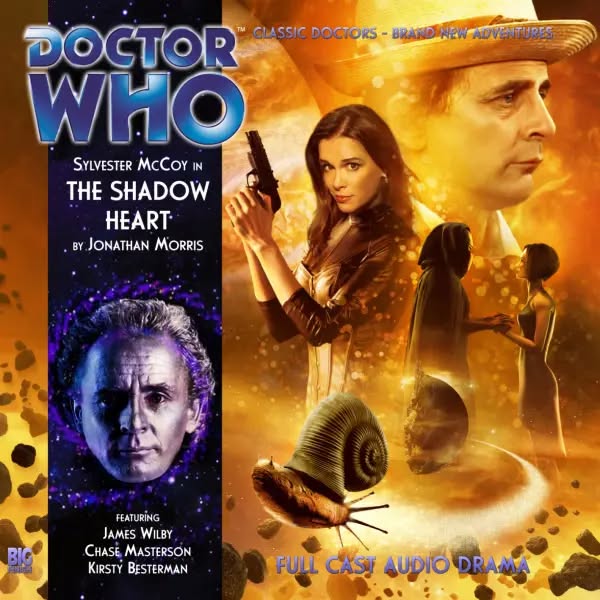
The Shadow Heart has all the ingredients of a grand space opera finale. Decades-spanning continuity. Warring empires. Rogue robots. Returning heroes. Returning villains. Multiple incarnations of the Seventh Doctor running around the timeline playing four-dimensional chess with himself.
And somehow it still ends with me shrugging. That’s quite an achievement.
The story returns us to the Drashani Empire decades after The Acheron Pulse. Following the Sixth Doctor’s optimistic decision to leave Prince Kylo’s robotic army behind as guardians of peace, the robots immediately looked at his instructions, nodded politely, and interpreted “maintain order” as “become an authoritarian military dictatorship.” Doctor Who robots really are incapable of finding the middle ground.
By the time Sylvester McCoy’s Seventh Doctor arrives, the galaxy is under the thumb of these fanatical mechanical crusaders, while a ragtag collection of mercenaries and rebels are attempting to fight back. Joining the fun are the ever-returning Prince Kylo and a cloned Princess Aliona, because apparently nobody in this saga is ever allowed to retire quietly.
The premise is perfectly respectable. The execution… Less so.
One thing the story absolutely gets right is the Seventh Doctor himself. McCoy effortlessly slips back into manipulative mastermind mode, and because this is Seven, no plan is ever allowed to be straightforward. The timeline itself becomes one of his tools. We first encounter an older Doctor who already knows more than he’s letting on, only for a younger version to arrive later, blissfully unaware of events that, from everyone else’s perspective, have already happened. It’s gloriously convoluted. Also completely on-brand.
Watching the two versions unknowingly dance around one another’s schemes is probably the single strongest idea in the entire production, and it’s handled with enough confidence that longtime Seventh Doctor fans will immediately settle into that familiar feeling of, “I’m sure this all makes sense to him.”
The supporting cast are perfectly likeable without ever becoming especially memorable. The mercenary crew have enough personality to keep things moving, but few of them leave much of a lasting impression. Kylo continues his long journey from tragic prince to recurring space menace, while the cloned Aliona exists largely to poke at questions of identity, redemption and whether a copy can ever truly replace the original.
Those themes are interesting. The story simply doesn’t do enough with them. Instead, it falls back on fairly routine Doctor Who adventure plotting. There are battles. Escapes. Last-minute reversals. Secret plans. The occasional bizarre image, including a memorable ride atop a gigantic space snail that somehow manages to be both ridiculous and entirely fitting for Doctor Who. It’s fun. It just isn’t enough.
Thematically, there’s an obvious exploration of unintended consequences. The Doctor tries to create peace, only for his solution to become another form of oppression. That’s fertile ground, particularly for the Seventh Doctor, whose manipulative methods often leave complicated moral debris behind.
Unfortunately, the script never digs particularly deeply into that idea. Likewise, after three linked stories exploring Kylo’s tragic downfall, imperial politics and the corrosive effects of revenge, this finale never quite delivers the emotional payoff you’d expect. It wraps everything up competently enough, but competence isn’t really what you want from the conclusion to a trilogy that’s been building for several releases. You want fireworks. Instead, you get a polite sparkler.
Final Thoughts
An enjoyable enough Seventh Doctor adventure with clever temporal shenanigans, some entertainingly strange imagery and McCoy on reliably manipulative form. Sadly, as the climax to the Drashani saga it feels strangely small, never fully capitalising on the rich ideas and character arcs established by its predecessors. Perfectly serviceable Doctor Who, but an oddly forgettable finale.
2 out of 5 giant space snails that somehow carried more dramatic weight than the trilogy’s actual ending