

Before continuing, please be aware that all of this content is made possible by the goodwill and support of my backers on Patreon. If you enjoy the work on this site, please consider supporting the creation of more content like this by clicking the button.
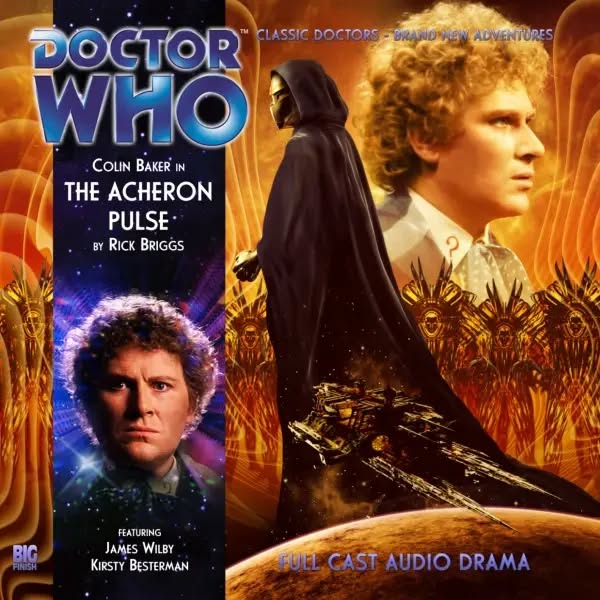
The Acheron Pulse commits one of my favourite storytelling sins: it spends two hours pretending a mystery exists when literally everyone in the audience solved it before the opening credits had finished.
Who is the mysterious masked warlord Tenebris? Who could possibly possess an inexplicable command over fire? Who has a deeply personal grudge against the Drashani Empire after being betrayed and left for dead in the previous story? Well, unless this was secretly Davros wearing a barbecue, I think we can all work it out.
Picking up roughly thirty years after The Burning Prince, the story finds the once prosperous Drashani Empire in ruins. The peaceful reign of Empress Cheni has given way to a devastating conflict against the Wrath, a mysterious invading force wielding the terrifying superweapon known as the Acheron Pulse. Entire worlds have fallen, civilisation is collapsing, and the Sixth Doctor arrives just as everything begins spiralling towards its inevitable conclusion.
Curiously, this sequel stars Colin Baker rather than Peter Davison. And honestly? That turns out to be one of its strongest decisions. Colin Baker once again demonstrates why he could probably read the instructions on a washing machine and make them sound like Shakespeare. His Sixth Doctor attacks every line with the enthusiasm of a man who genuinely believes every conversation deserves to become the defining speech of the century. Even when the script isn’t firing on all cylinders, Colin is.
He almost drags the story across the finish line through sheer force of personality. Almost. And this story is definitely a step up from the previous one. Which… kinda cements my theory that someone at Big Finish must rather dislike Peter Davison, given that he seems to get the weakest of these scripts.
The central mystery simply doesn’t work. The script clearly expects the audience to spend half its runtime wondering who Tenebris really is. Could it possibly be Prince Kylo, who was betrayed and left for dead in the last story? Well, you’ll be SHOCKED to discover that it is! The reveal lands with all the dramatic force of someone solemnly announcing that Darth Vader might be Luke Skywalker’s father. Yes. We noticed. Several decades ago.
That’s a shame, because beneath the predictable plotting are some genuinely fascinating ideas. The story explores the long-term consequences of empire and asks what happens when today’s glorious civilisation becomes tomorrow’s occupying force. The native inhabitants of Cawdor, still developing along roughly medieval lines, view the Drashani less as enlightened neighbours and more as incomprehensible colonial invaders. That’s compelling science fiction. It’s exactly the sort of moral ambiguity Doctor Who often does well.
Then there’s Athrid. Oh, Athrid. Played with magnificent scenery-chewing enthusiasm by Chook Sibtain, he’s essentially Brian Blessed if somebody handed him an axe and declared him King of the Vikings. Every scene he appears in suddenly becomes alive. He bellows. He boasts. He charges heroically into danger with complete confidence that everything will somehow work itself out.
Naturally, this means the script rewards him by having a monster abruptly eat him. Rude.
His absence leaves a noticeable hole in the second half because very few of the remaining supporting characters possess anywhere near the same charisma.
Thematically, The Acheron Pulse wrestles with revenge, imperialism and the corrosive nature of hatred. Kylo’s transformation into Tenebris is hardly subtle, but it does underline how betrayal can twist idealism into fanaticism. Unfortunately, the story never digs quite deeply enough into those ideas, preferring straightforward military science fiction over genuine character exploration.
Which ultimately sums up the whole production. It’s better constructed than The Burning Prince. It’s certainly more entertaining. But despite Colin Baker’s magnificent performance and a handful of genuinely inspired supporting characters, it never quite escapes the feeling that you’ve seen most of its twists coming from several star systems away.
Also, with this story referencing Cawdor (the name of the planet, and mentioned in Macbeth), and the previous story centring around two rival houses and young lovers (a la Romeo & Juliet), I’m wondering why the Doctor hasn’t called out that these all seem to be stylistically influenced by Shakespeare. Would stating it be too much of a fourth wall break?
Final Thoughts
A respectable sequel elevated enormously by Colin Baker’s wonderfully theatrical Doctor and Chook Sibtain’s gloriously larger-than-life Athrid. There are thoughtful ideas about empire, revenge and colonialism buried beneath the surface, but an entirely predictable central mystery and a shortage of memorable moments stop it from becoming anything truly special.
3 out of 5 masked warlords whose secret identities were about as surprising as the Master turning out to be evil again