

Before continuing, please be aware that all of this content is made possible by the goodwill and support of my backers on Patreon. If you enjoy the work on this site, please consider supporting the creation of more content like this by clicking the button.
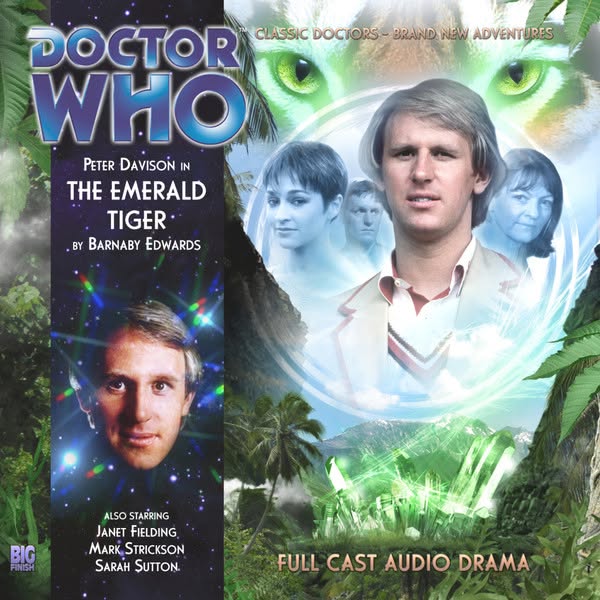
The Emerald Tiger begins with the Fifth Doctor dragging Nyssa, Tegan and Turlough halfway across time and space because he wants to watch a cricket match in 1920s Calcutta, which is perhaps the most Fifth Doctor sentence ever written. Unfortunately, the cricket match is the most interesting thing that happens for quite a while.
The story revolves around the mystery of the titular Emerald Tiger, a legendary figure tied to disappearances, hidden identities, colonial intrigue and jungle adventure. There are secretive aristocrats, mysterious attacks, local folklore, suspicious characters and enough references to old imperial adventure fiction that you can practically smell the dust on the library shelves.
And look, I can see exactly what the story is aiming for. This is trying to be one of those old-fashioned pulp adventures. Part mystery, part jungle serial, part colonial-era boys’ own yarn. The problem is that it never really becomes exciting enough to justify the exercise.
The mystery itself is strangely inert. Clues are uncovered, revelations happen, characters move around from one location to another, but very little of it feels urgent. The plot progresses because it has to, not because you’re desperately invested in finding out what happens next. More than once I realised I’d stopped paying attention and was thinking about literally anything else. That’s not a great sign.
What’s particularly frustrating is that this is an audio drama, a medium that lives and dies on atmosphere. Big Finish has produced stories that feel enormous. Stories where entire alien worlds seem to materialise inside your headphones. Stories packed with energy, texture and imagination. The Emerald Tiger feels weirdly cheap by comparison. Not necessarily in budget, but in ambition.
Fight scenes consist of the usual shouting, generic scuffling noises and somebody helpfully informing us that a fight scene is occurring. Action sequences arrive and leave without making much impression. The sound design rarely creates a sense of place beyond the bare minimum required. Even the jungle never feels particularly alive. It’s all functional. Painfully functional. Like everybody involved turned up, did their jobs professionally, then immediately went home.
And look, I understand what the story is trying to do. It’s deliberately emulating a particular style of adventure narrative. In many respects it succeeds. The atmosphere is convincing, the pacing is brisk enough, and the mystery itself is reasonably well constructed. There are some genuinely entertaining moments buried throughout.
The issue is that the style being emulated comes with a lot of baggage. A LOT of baggage. The story often feels less interested in interrogating those colonial adventure tropes than simply recreating them. Which means you spend much of the runtime bumping into familiar stereotypes and assumptions that were already questionable decades ago.
It’s a similar problem I have with Doctor Who stories like The Talons of Weng-Chiang. You can absolutely appreciate the craftsmanship involved while simultaneously recognising that some of the foundations are deeply uncomfortable.
The frustrating thing is that there are glimpses of a much stronger story hidden underneath. But rather than building toward something rich or thoughtful, the story remains trapped inside the shadow of the colonial adventure fiction it’s emulating. Less Loups-Garoux, more The Talons of Weng-Chiang. Not because it’s actively offensive, but because it’s dragging around all the baggage of its inspirations without bringing enough fresh ideas to the table.
The regular cast don’t help much either. Nyssa remains consistently reliable. Tegan sounds annoyed, which is admittedly her natural state. Turlough continues his lifelong campaign to be tolerated by the people around him. Meanwhile Peter Davison’s Doctor increasingly feels like somebody’s slightly grumpy grandfather who accidentally wandered into an adventure while looking for the cricket pavilion.
And honestly? That’s the problem. Nobody feels energised. Nobody feels excited. The whole production feels like it’s running on autopilot.
Final Thoughts
A competently made but deeply uninvolving adventure that mistakes movement for momentum and homage for atmosphere. There are traces of a stronger story hidden beneath the surface, but they’re buried beneath a dull mystery, uninspired production choices and a style of storytelling that never justifies revisiting.
1.5 out of 5 cricket matches that somehow managed to be less boring than the actual plot