

Before continuing, please be aware that all of this content is made possible by the goodwill and support of my backers on Patreon. If you enjoy the work on this site, please consider supporting the creation of more content like this by clicking the button.
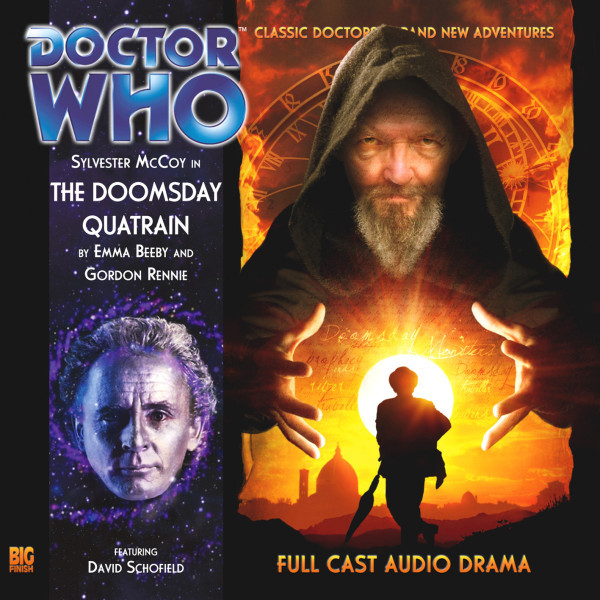
The Doomsday Quatrain is the 151st of these audio plays I’ve listened to, and it strolls into Renaissance Italy with a lute in one hand and an apocalypse in the other, winks at you, and goes “don’t worry, it’s only the end of the world… probably,” which is exactly the kind of chaotic energy Sylvester McCoy thrives on.
So, picture this. The Doctor rocks up, meets Nostradamus, and is immediately told “ah yes, I have foreseen the end of everything.” Standard Tuesday. Except this time, the universe goes “actually, yes, we’re doing that now,” and suddenly we’ve got crocodile-esque aliens invading like they’ve taken a wrong turn at a historical reenactment.
At first glance, it’s playing things very straight. Prophecy. Doom. Renaissance setting. Big scaly invaders ruining everyone’s day. You’re settling in like, okay, I know this rhythm, I know this beat.
And then the story just casually leans over and whispers, “by the way, none of this is real.”
Because the twist, and it’s not even hiding it for long, is that this isn’t Earth. It’s a simulation. A fully fabricated Renaissance playground populated by synthetic people, including Nostradamus himself, rented out by a third-party alien race so some other aliens can practice invasion tactics like it’s the galaxy’s most ethically questionable training simulator. Which is WILD.
And also where the story lives or dies. Because instead of holding that reveal back like a big mic-drop moment, it just… tells you. Early. Very early. We’re barely settled before the curtain is pulled back and the narrative goes “here’s how the trick works.”
Now, on one hand, bold choice. It shifts the focus away from “what’s happening?” to “how do the characters respond to what’s happening?” On the other hand… yeah, you do feel that lost potential. There is a version of this where the reveal hits later and absolutely floors you.
Still, what it lacks in surprise, it makes up for in character. Sylvester McCoy is in full manipulative chessmaster mode, but with that slightly whimsical edge that keeps him from tipping into full cosmic menace. He knows more than he’s saying, as always, and watching him navigate a world that isn’t real but still matters is where the story finds its teeth.
And then there’s Nostradamus. Genuinely the MVP here. Because he knows. Not in a vague, mystical “I sense doom” way, but in a creeping, existential “I am predicting the end of a world that only exists because someone rented it” way. His prophecies stop being dramatic flair and start being… awareness. Self-awareness. And that’s where things get properly interesting.
Because what does it mean to foresee your own non-existence when your entire reality is already artificial? Fun! Light! Totally not going to spiral about that later!
The supporting cast do solid work selling the stakes, even when those stakes are technically happening inside what is essentially a very elaborate alien sandbox. The performances carry the emotional weight needed to make you care, even when the plot is going “none of this is technically real,” which is always a tricky balancing act.
Critically though, it does feel a bit front-loaded. The early reveal robs some tension, and the pacing occasionally dips into “explaining the concept again just in case you missed it” territory. You get it. Simulation. Layers. Ethics. Move on.
But when it leans into the emotional core, especially through Nostradamus, it really works.
Final Thoughts
A clever, concept-driven story that sacrifices a killer twist for early transparency, but still lands thanks to strong character work and a quietly unsettling central idea about reality and awareness.
3.5 out of 5 deeply concerned Renaissance prophets slowly realising they’re in a cosmic training simulator