

Before continuing, please be aware that all of this content is made possible by the goodwill and support of my backers on Patreon. If you enjoy the work on this site, please consider supporting the creation of more content like this by clicking the button.
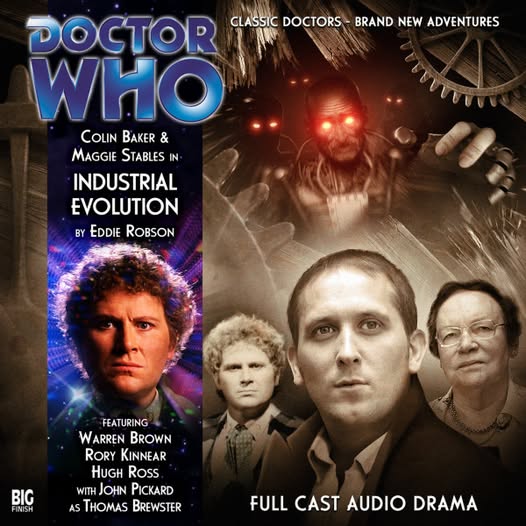
Industrial Evolution stomps in wearing steel-toed boots, covered in soot, coughing up factory smoke and whispering “hey… what if capitalism was the real monster? no wait, also there’s a literal monster stitched out of people, don’t worry, we multitask here.”
And I’m just standing there like, cool cool cool I did NOT sign an emotional consent form for this but go off I guess.
We’ve got Colin Baker’s Sixth Doctor, still radiating chaotic theatre kid energy with a moral core of molten steel, alongside Evelyn Smythe (queen, icon, walking dissertation on compassion), and Thomas Brewster, our favourite morally dented Victorian raccoon of a man, returning to, oh look, his own era.
Which is already spicy. Because Brewster back in the 19th century isn’t just “guy in wrong time” anymore, it’s “guy confronting the SYSTEM that made him Like That.”
And that system? Oh boy.
Factories. Smoke. Exploitation. Workers treated like replaceable cogs in a machine that does not care if you live, die, or get ground into paste as long as production quotas are met. You can practically hear the clanking gears chewing on human dignity.
Subtle? No. Effective? Oh absolutely.
The plot kicks off with the TARDIS crew infiltrating this industrial hellscape where labour unrest is brewing, union-busting is in full swing, and management has all the warmth and empathy of a brick soaked in oil. Threading through all this is the sci-fi horror hook, a creature cobbled together from human body parts, animated and weaponised.
Yes. We’re doing Frankenstein by way of OSHA violations.
And honestly? It works disturbingly well.
Because the monster isn’t just a monster, it’s a metaphor with teeth. Workers reduced to components. Bodies commodified. Identity stripped away in service of profit. It’s grim. It’s messy. It’s the kind of story that looks you dead in the eye and goes “this isn’t fiction, I just added tentacles.”
And the Doctor? Oh, he is furious. Not the bluster-for-show kind, but that cold, righteous anger where every word lands like a hammer. Colin Baker absolutely FEASTS on this material, big speeches, sharp edges, zero patience for injustice. You love to see it.
Evelyn, meanwhile, is the emotional anchor as always. She doesn’t just see the system, she sees the people crushed under it. Her interactions with the workers bring this quiet, devastating humanity that stops the story from becoming just a lecture wrapped in gears.
And Brewster… oh, Brewster.
This is HIS episode in a lot of ways. Watching him navigate this world, his world, is like watching someone realise the cage they grew up in wasn’t normal, just… familiar. He gets it. Too well. And that makes his choices here feel raw, conflicted, and painfully real.
But okay, deep breath, critiques.
Because as strong as the themes are, the story can get a bit heavy-handed. Like yes, I SEE the metaphor, you don’t need to hit me with it again using a shovel labelled “INDUSTRIAL CAPITALISM BAD.” Some side characters also blur into “angry worker #2” or “evil boss variant C,” which weakens the impact slightly.
And pacing? Slightly uneven. It lurches a bit, ironically, like badly maintained machinery.
But when it clicks? Oh, it sings. Or, more accurately, it SCREAMS over the sound of grinding gears and systemic injustice.
Final Thoughts
A grimy, angry, deeply human story that blends sci-fi horror with historical critique. Not subtle, but effective as hell, with standout character work, especially for Brewster, and a monster that lingers in all the worst ways.
4 out of 5 ethically-questionable factory abominations held together with bolts and bad decisions