

Before continuing, please be aware that all of this content is made possible by the goodwill and support of my backers on Patreon. If you enjoy the work on this site, please consider supporting the creation of more content like this by clicking the button.
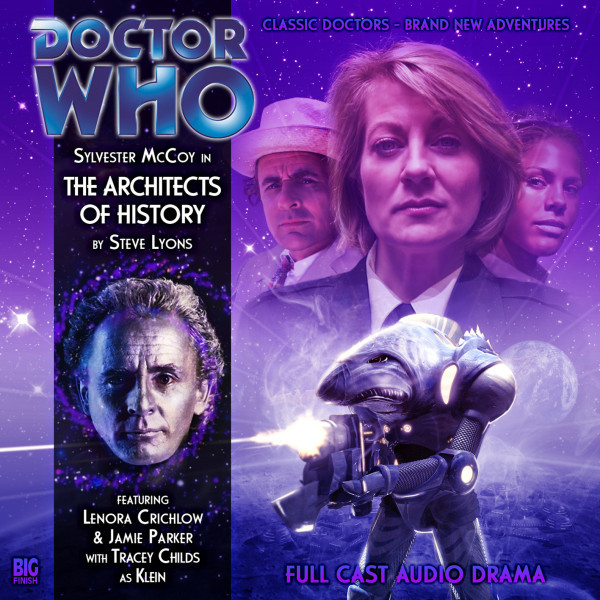
The Architects of History opens with that horrible, delicious Doctor Who feeling where you know something is deeply wrong before anyone says it out loud. It is 2044. A hundred years into the Galactic Reich. Klein steps out of the TARDIS onto a moon base she helped create, and the air itself feels contaminated by ideology. This is not just an alternate timeline. This is a worked timeline. Chiselled. Sanded down. Rewritten again and again until it fits her vision. And the cost of that is starting to show.
Klein is fraying. Her memories no longer line up cleanly. People she loved flicker in and out of existence like a badly spliced reel of film. The Doctor is no better. Sylvester McCoy’s Seventh Doctor is a prisoner here, dropped into a reality that even he does not fully understand. He knows another version of himself was here before, running a long game to fix things, but that knowledge is half instinct and half guesswork. It is like watching someone try to defuse a bomb using muscle memory alone. That uncertainty is genuinely unsettling, and McCoy leans into it beautifully.
Then the Selachians arrive, and the story pivots hard. They are a predatory alien race who see humanity as inferior and ripe for subjugation. They do not care about the Reich. Fascism is irrelevant to them. Power is power. There is a moment where civilians kill one of them, and the Selachians respond by executing humans at random until the culprit is handed over. It is grim in a very specific historical way. And the kicker is that the Doctor’s other self brought them here deliberately, intending to use them as part of his plan. Naturally, they refuse to stay on script. Fascism always believes it can control bigger monsters. It never can.
This is where the story slightly stumbles. The Selachians are effective as a threat, but not as a thematic mirror to Klein. The narrative collapses into a fairly standard base under siege structure, and while it is competently done, it lacks the surgical ideological bite of the previous two stories. You keep wishing it would dig deeper rather than lean on familiar genre scaffolding.
What saves it is the secondary cast. Lenora Crichlow’s Rachel Cooper is excellent, a working class woman recruited by the Doctor’s earlier self to play companion to a plan she barely understands. Ian Hayles’ Sam Kirke is painfully human, a man complicit through exhaustion rather than conviction, dreaming of a life where he is not a cog. Lloyd McGuire’s Generalleutenant Tendexter is a standout, a fascist commander experiencing genuine terror as his authority evaporates. These characters feel lived in, and they give the story emotional weight even when the plot machinery creaks.
And then there is Klein. This is her reckoning. She finally experiences the brutality she normalized, the horror she authored. The Doctor cannot erase her. He refuses to become an executioner. Instead, she is sealed inside the TARDIS’ temporal bubble, condemned to live out her life alone, a prisoner of time. It is chilling, and it feels earned.
The epilogue restores the timeline and shows us another Klein. One who never became a Nazi officer. One who lived a different life. The story leaves you wondering whether the Doctor nudged history to make that happen. Quietly. Carefully. Architects of history, indeed.
Final Thoughts
This is a powerful, thoughtful climax that does not quite reach the razor sharp heights of its predecessors, but still lands hard. Ethically thorny, emotionally heavy, and unwilling to offer easy absolution. I admire it deeply. But even so, its punch could have landed even heavier if it tried.
Rating: 4.5 out of 5 repeatedly rewritten timelines that still bleed through the cracks