

Before continuing, please be aware that all of this content is made possible by the goodwill and support of my backers on Patreon. If you enjoy the work on this site, please consider supporting the creation of more content like this by clicking the button.
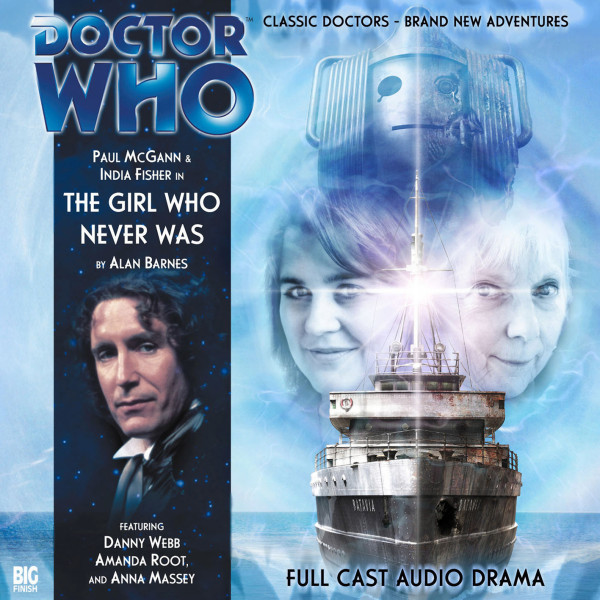
The Girl Who Never Was feels like a love letter written in the middle of a storm—half-smeared ink, half aching clarity, all feeling. It’s the 103rd Big Finish release, the last stop for the Eighth Doctor and Charlotte Pollard in the main range, and it knows it’s the end. You can hear the melancholy in every echo of the TARDIS hum. This story wants to be the big emotional goodbye, the moment where all the loose threads come together. And for the most part, it actually works. Mostly.
Charley Pollard, the first Big Finish original companion, has always been a paradox in heels. A runaway Edwardian debutante who got drunk on adventure and nearly drowned in it. She’s spent years falling through time, and now she’s back on Earth—Shanghai, 2008—completely out of her depth. Except “home” isn’t home anymore. Time’s fractured, realities are bleeding into one another, and somewhere in the chaos, a ship from 1942 has been abducted by Cybermen trying to convert its crew. It’s ambitious, layered, occasionally confusing, but that confusion is part of its texture.
The first listen feels like falling through fog. The second time, it starts to make sense—the story skips across three eras, and the transitions aren’t always clear, but when they click, it’s satisfying. The time-stranded Cybermen are classic horror fodder, their metallic decay matching Charley’s emotional corrosion. There’s a real melancholy here about memory and identity—about what happens when your life stops belonging to a single timeline.
The standout moments are pure heartbreak. Charley resisting cyber-conversion, screaming defiance while the machinery grinds around her. The Doctor, trying and failing to ‘Donna Noble’ erase her memory, realizing too late that love doesn’t fit into a paradox equation. And that final goodbye—God, that hurts. India Fisher gives one of her best performances, all trembling warmth and quiet devastation, while McGann’s Doctor sounds like a man trying to smile through loss. The chemistry between them—always slightly doomed, always slightly electric—flickers one last time.
But yes, it’s messy. The plot tries to do too much at once, and the storytelling sometimes tangles itself in its own ambition. You can tell Alan Barnes wanted to end things on a high note, but the structure just barely holds together. Still, the emotion cuts through. This isn’t a story about Cybermen or time paradoxes—it’s about memory, loss, and the cruel kindness of moving on.
In closing: while this is a goodbye for both Charley and the Eighth Doctor, it isn’t a farewell. Paul McGann goes on to headline his own Eighth Doctor Adventures before moving into the later box set format, even picking up Mary Shelley as a companion. I won’t be following him into those since I’m sticking to the monthly range, but it’s comforting to know his story keeps unfolding. Charley, meanwhile, is left stranded in the far future, sending out SOS signals into the void, hoping the Doctor will find her again. And he does—but not the Doctor she’s expecting. The ending track even hints at that twist, slyly using the Sixth Doctor’s theme. Deliciously ominous.
Final thoughts:
The Girl Who Never Was doesn’t always make sense, but it always makes you feel. It’s haunting, tragic, occasionally confusing, and utterly sincere. A flawed masterpiece with a heart that won’t stop beating.
Rating: 4.5 out of 5 paradoxical love letters floating in the time vortex, still waiting to be opened