

Before continuing, please be aware that all of this content is made possible by the goodwill and support of my backers on Patreon. If you enjoy the work on this site, please consider supporting the creation of more content like this by clicking the button.
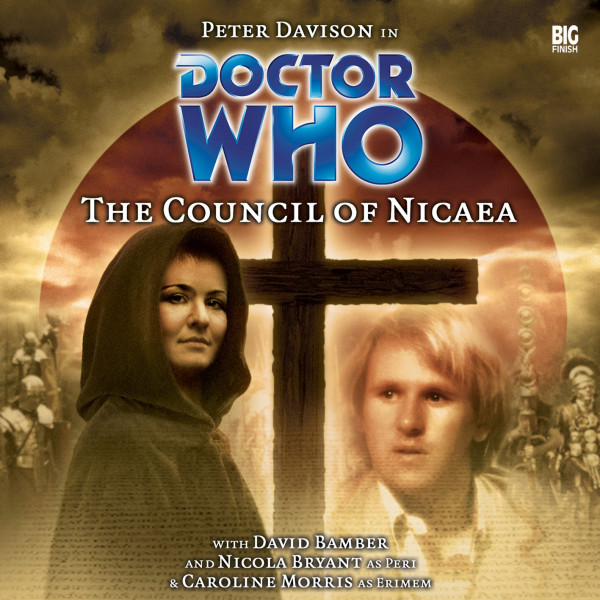
The Council of Nicaea is a breath of old-world air: no monsters, no spaceships, no alien creeps—just politics, theology, ambition, and people pushed to stand (or fall) for ideas. The Fifth Doctor, Peri, and Erimem show up in Nicaea 325 AD, ostensibly just to observe the First Church Council called by Emperor Constantine. But of course, “just observing” is never how these things go, especially when dissenting voices like Arius are being silenced, mobs are stirring, and history itself seems like it might snap if somebody screams too loud.
What I most enjoyed is how this story leans into its historical bones. Emperor Constantine (David Bamber) is no cartoon tyrant; he’s desperate, overreaching, teetering between survivor and autocrat, trying to hold together a fracturing empire. There’s urgency in his choices, and you believe him trying to preserve unity, even while his methods grow shady. Arius (Steve Kynman) is the theological underdog, speaking what many deem heretical, struggling for his voice. But the real standout is Erimem. At last, she’s not just tagging along—she takes a stand. She allies with Arius—not because she loves the doctrine, but because she believes someone being silenced is wrong. That moment where she demands a voice on his behalf is powerful. Peri is caught in the tension between loyalty to the Doctor and compassion for Erimem. The interplay between those three gives this story its tension.
Now, I’m a sucker for historical dramas that aren’t about alien invasions, and this scratches that itch. The city streets rumble with unrest, mobs form, religious convulsions shake the people, even ordinary traders and Fausta, Constantine’s wife, have weight. Speaking of Fausta: she’s subtle but strong, the kind of character who has influence but fractured by patriarchal constraints. You feel her frustration, her inability to act directly. It’s in the way bishops sneer at Erimem speaking, or the way women and lesser voices are forced into shadows. Those are threads that elevate the story beyond mere “look, history!” to “look, history hurts, silence hurts.”
But—and you knew there’d be a but—this story isn’t perfect. The theme of patriarchy hovers, occasionally bites, but is never fully given room to breathe. There’s a lot of speaking out, a lot of moral weight, but no deep excavation of how faith, power, suppression, and gender intersect in that moment. Erimem’s moral stand is thrilling, but it feels a little sudden in its intensity at times—her shift is powerful but not always fully set up. The theological debates (about Christ’s divinity, etc.) are interesting, but they’re mostly foregrounded as political tools, not deeply felt spiritual crises. That’s fine—politics is religion here—but I wanted more friction inside Erimem, more personal cost, more inner struggle, not just “I believe so I act.”
Also, the resolution leans safe. History is history; Arius loses; Erimem sees she can’t fundamentally change the arc; Constantine holds together enough to avoid collapse. It’s satisfying in a conventional way, but part of me wanted something messier: consequences, ruins, ambiguous victories. Because that would’ve made it linger. As it stands, once the credits roll, you remember themes, good performances, moral conflict—but not a gut punch.
Final Thoughts:
If you like your Who without lasers, if you love political intrigue, theological hot spots, and characters pushing back against silence, The Council of Nicaea! hits a lot of high notes. It’s my favorite from Davison’s run so far, especially because of Erimem’s arc and the sharp tension between action and ideology. But because it skirts some thematic depths and resolves more neatly than some of its best peers, it isn’t quite legendary.
Rating: 4.5 out of 5 thoughtful doctrines.