

Before continuing, please be aware that all of this content is made possible by the goodwill and support of my backers on Patreon. If you enjoy the work on this site, please consider supporting the creation of more content like this by clicking the button.
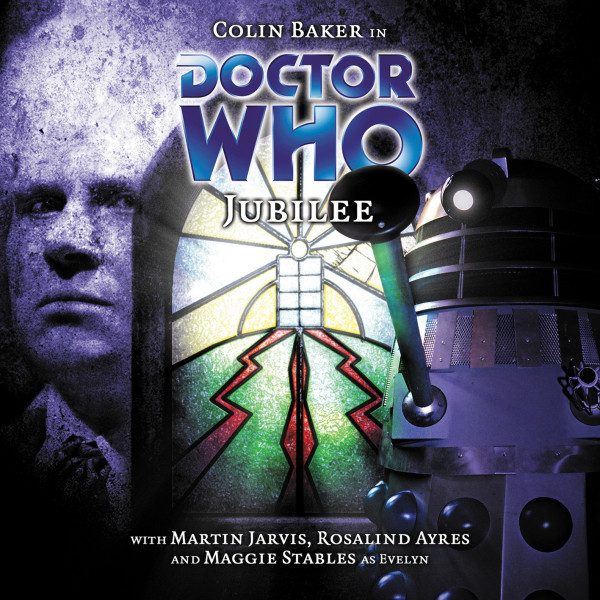
Right. So. this might take a while. But I have a lot to say about this one. Let me just go ahead and say it: Jubilee is the best Doctor Who story Big Finish has ever produced. Yes. Better than The Chimes of Midnight. Better than Spare Parts. Better than that dream you had where the Doctor kissed you and gave you anti-fascism laser eyes and you rode off together on a flaming gay horse into a Time War. This is the one.
Imagine 1984 meets The Prisoner meets The Man in the High Castle directed by Terry Gilliam in the middle of a nervous breakdown and you’re almost in the vicinity of how Jubilee feels. It’s a story where everyone’s laughing, screaming, lying, hallucinating, and doing photo ops with a torture victim. And it is utterly, unbearably brilliant.
The Sixth Doctor and Evelyn Smythe land in a nightmare version of 2003, where England—not Britain, don’t get fresh—rules the globe after defeating the Daleks in a war that never quite happened. In this version of history, the English Empire is a bloated fascist relic of its own trauma, like an aging colonel polishing medals that were never earned. There’s only one Dalek left, locked in a dungeon, screaming into the void, tortured into inertia. A symbol of victory, a propaganda puppet, a mirror. And the Doctor? He’s a national icon. A poster boy. A war god. Played in action flicks by meat-headed hunks in tight leather. The country loves him like it loves its boot pressed firmly against the neck of the world. But underneath the smog of parades and jubilee tarts and memorabilia stalls selling Dalekade™, the rot is impossible to miss.
Things spiral. The Doctor and Evelyn are detained by the regime—President Rochester and his wife Miriam, whose marriage is a state-sanctioned performance of imperial order. Miriam is simultaneously ornamental and monstrous, brutalised by power but utterly complicit in its preservation. They all orbit the imprisoned Dalek, whose condition is grotesque: screaming, begging, barely coherent. It’s a victim and a warning, a justification for England’s fascism.
But the real gut-punch comes when they discover the truth: the Doctor who originally arrived in 1903—the one who “won”—has been locked away in the Tower all this time. Forgotten. Muzzled. Because he refused to be the mascot of empire. They canonised him, turned his legacy into a weapon, and buried the man. The Doctor walking around now is the future version, dropped into a reality sculpted by his own silencing.
Everything unravels. Rochester loses control. Miriam fractures. The Dalek, even in its pitiful state, begins manipulating the chaos. The regime collapses under the weight of its own performance. The timeline begins to reset—but not before the Doctor and Evelyn confront the horror of what’s been done in his name. En masse the Daleks return; not because of timey-wimey nonsense, but because the masses, drunk on their own urge to celebrate their own glory, became it. Gosh, it’s almost like we’re looking into a mirror.
Let’s dig right into the carcass of empire because Jubilee is dripping with critique. This isn’t just about what empires do; it’s about what they are—and how men, and I do mean MEN, dress up brutality in ceremony, rebranding genocide as national identity.
Let’s talk themes. Jubilee is imperialism dissected. It’s a takedown of patriotic pageantry, of men who rewrite history to serve their egos, of women bent into feminine archetypes that help uphold the machine. It’s how myth becomes law, and law becomes atrocity. It’s not “what if England won a Dalek war?” It’s what if we learned nothing from surviving one?
Enter Nigel and Miriam Rochester: the power couple of the English Empire, wrapped in velvet, ego, and bloodstains. Nigel, the President, is a blustering tyrant in ceremonial brass and psychological denial, chewing the scenery and his own conscience in equal measure. He insists he’s only pretending to be monstrous—that the executions and fascist grandeur are all roles he plays out of necessity. But that’s a lie he clings to like a comfort blanket soaked in blood. He enjoys the power, the reverence, the violence. His delusion is a defence mechanism—if he admits culpability, the whole house of cards collapses. He doesn’t just enable atrocity, he scripts it. Miriam, his First Lady, wields pearls, passive-aggressive smiles, and gallows flirtation like state-sanctioned weaponry. She’s been conditioned into a trophy—beaten into place as an ornament to her husband’s monstrous success. But there’s something feral behind her eyes, a hint of self-awareness curdling into madness. She’s the perfect face of performative femininity in a patriarchal imperialist hellscape: propped up by her husband, given illusions of power, and absolutely complicit in the cruelty beneath. But don’t pity her—she has teeth. Together, they are empire distilled: deluded, dangerous, and desperately trying to convince themselves they’re victims of the very system they revel in. And both are performed to horrifying perfection—Martin Jarvis oily with denial, Rosalind Ayres terrifying in her restraint.
The sound design in Jubilee deserves its own damn parade. The score slithers under your skin like it knows your browser history. There’s this wet, grimy reverberation to the Dalek’s screams—like they’re echoing from inside your skull. The sound of its casing creaking, its voice glitching between sobbing and scheming, it’s ghastly. Real. Uncomfortable. You can hear the trauma. And the background ambiance? That haunted silence in the Tower where the Dalek is imprisoned? It’s like the audio equivalent of mildew: sticky, damp, and suffocating. Every character’s footsteps feel heavy with history they’re afraid to remember. The atmosphere? Paranoid. Oppressive. Fermented with guilt.
Let me tell you something: Colin Baker is on fire in this. His Doctor is wounded, furious, dangerous—but not cruel. He sees the horror his myth has become and it breaks him. Six is disgusted by what he sees. By what he’s become in this world. And Baker sells it—voice cracking with suppressed horror, bristling with unspoken shame. He’s a relic of a story he never agreed to. A man being rebranded into genocide. The Doctor saved the world? Cool. Let’s print his face on propaganda and put the real him in a dungeon so nobody questions the version of him we need.
So here’s the core thematic blood-sacrifice of the whole play: the real Doctor is the one they buried. Literally. In the Tower of London. The prisoner in the tower is not just a previous version of the Doctor—he is what’s left when you strip away his agency, his truth, his challenge to power. Because in this version of history, the Doctor won. And that victory was used—twisted, rewritten, memefied into “the glorious Jubilee.” They sanitized him. They canonized him. And then they got rid of the real one. Because he knew too much. Because he kept asking questions. This it METAFICTION at its finest!
Yes, yes, let’s talk about that other story—RTD’s “Dalek.” Y’all, we all love it. But let’s be real: Jubilee did it first, and it did it better. This isn’t just “what if we tortured a Dalek and made you feel bad.” This is what if we built an empire on the bones of one tortured Dalek and told ourselves we were the good guys. And unlike the TV version, this story isn’t afraid to say the quiet part loud: torture doesn’t cleanse you—it rots you. You don’t defeat monsters by out-monstering them and slapping a flag on the corpse. You become them.
Final Verdict:
Jubilee is about memory. Trauma. Power. And the horrifying rituals we perform to avoid accountability. It’s about how men rewrite war into legend, about how women are weaponized as symbols and silenced as people, about how violence becomes theatre when the crowd is obedient enough to applaud. It is the most savage satire Doctor Who has ever attempted. And it’s still staggeringly relevant. Because Jubilee isn’t just about some alt-fascist England—it’s about us. It’s about how we build statues of men who kill, sell toys of wars we didn’t win, and call it history.
5/5 mugs of Dalek juice made from WHAT??