

Before continuing, please be aware that all of this content is made possible by the goodwill and support of my backers on Patreon. If you enjoy the work on this site, please consider supporting the creation of more content like this by clicking the button.
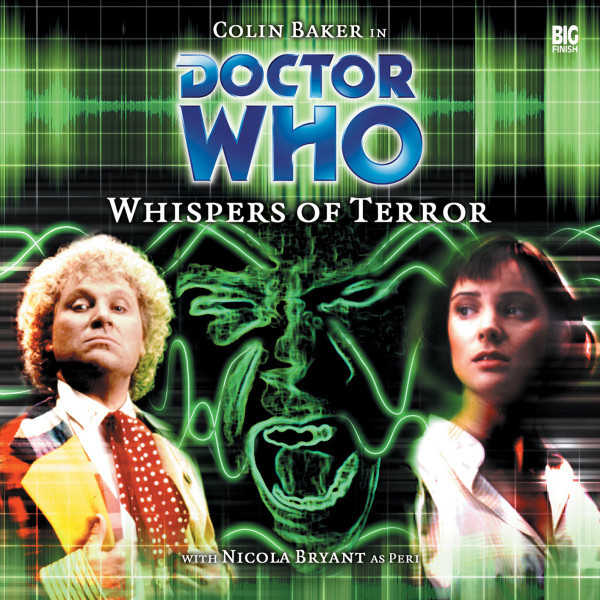
Ah yes, Whispers of Terror, Big Finish’s third ever stab at a Doctor Who audio play. A story so deeply rooted in the concept of sound, it almost—almost—justifies being an audio drama. Unfortunately, the execution is less “brilliant innovation” and more “cursed podcast from 2002.”
We’ve got Colin Baker’s Sixth Doctor here, all velvet bombast and Shakespearean chest-puffing, paired with Peri in full “I’m stuck on this TARDIS with a man who treats me like an undergrad he’s tutoring badly” mode. Their endless verbal sparring kicks in around the two-minute mark and never lets up, like an audio version of being stuck behind an arguing couple in the queue at Sainsbury’s.
So the Doctor and Peri arrive at the Museum of Aural Antiquities, where sounds are archived like dusty books—because nothing screams “gripping sci-fi” like libraries and record-keeping. There’s a murder right off the bat (death by electrified door, no less—a bold Health & Safety violation), but the story seems significantly more concerned with an altered audio recording than with, say, the fresh corpse cooling on the floor. Priorities.
That altered recording belongs to the late Visteen Krane, a supposedly beloved political orator whose speeches are, we’re told, magnificent. What we actually hear is a man chewing the nonexistent scenery with the gusto of a ham left in the sun too long. There’s no transcript, no backup, no digital redundancy—just the One Recording That Matters. It’s as if nobody on Gallifrey’s entire timeline has heard of Ctrl+C.
Naturally, the story escalates with the introduction of a sentient sound monster (no, really), and we spiral into a plot of political assassination, Orwellian media tampering, and revenge beyond the grave. Thematically, it’s aiming for something about fascist opportunism and the manipulation of truth. What we actually get is ghost-blob of a disgraced politician hunting down his rivals like a haunted cassette tape.
And while the Doctor races to solve the mystery, everyone else forgets about that poor dead guy from Act One. I guess he’s still rotting in the corridor, completely unimportant next to… sound wave editing?
Production-wise, the sound design tries to lean into the concept—lots of distorted effects and aggressive musical stabs. It’s ambitious, sure, but mostly ends up being annoying. The music is lifted straight out of the 1980s with all the awkward cheese you’d expect, and not the fun synthy kind either—the wailing “suspense” kind that made Colin Baker’s TV era such a sensory assault.
There’s a story here about how fascists rewrite history, but it gets drowned out—ironically—by the noise. The idea of a sound-based villain in an audio format should work. It doesn’t. Instead, Whispers of Terror ends up feeling like a sluggish ghost story trapped in a bad episode of Yes, Minister.
Final Verdict:
An improvement over The Sirens of Time, but that’s not exactly a high bar to clear. Whispers of Terror has a decent concept buried under all the yelling, weak sound design, and a plot that mistakes convolution for complexity. Not the worst Big Finish has to offer, but we’re still a ways off from “good.”
1.5 out of 5 haunted Dictaphones.